Law schools should not adopt Chicago's bonkers new laptop ban
Berkeley has banned students from using AI for much of their schoolwork; Chicago has responded by banning 1Ls from using the machines on which legal work is now done.
Required 1L Core Courses
We will be piloting a coordinated approach to classroom and examination policies for the core 1L curriculum during the 2026–2027 academic year. Across all 1L sections, we will prohibit the use of electronic devices such as laptops, tablets, and phones in the classroom.
There will be some limited exceptions to this policy. For instance, professors can designate classroom “scribes” who can use electronic devices to take notes for the class, professors can authorize electronic device use for specific tech-enabled activities (such as interactive in-class polling), and we will ensure that disabilities are accommodated in conformity with applicable law, as appropriate for the program of study.
The full text of the new University of Chicago Law School policy can be found here: https://www.law.uchicago.edu/news/ai-strategy-statement.
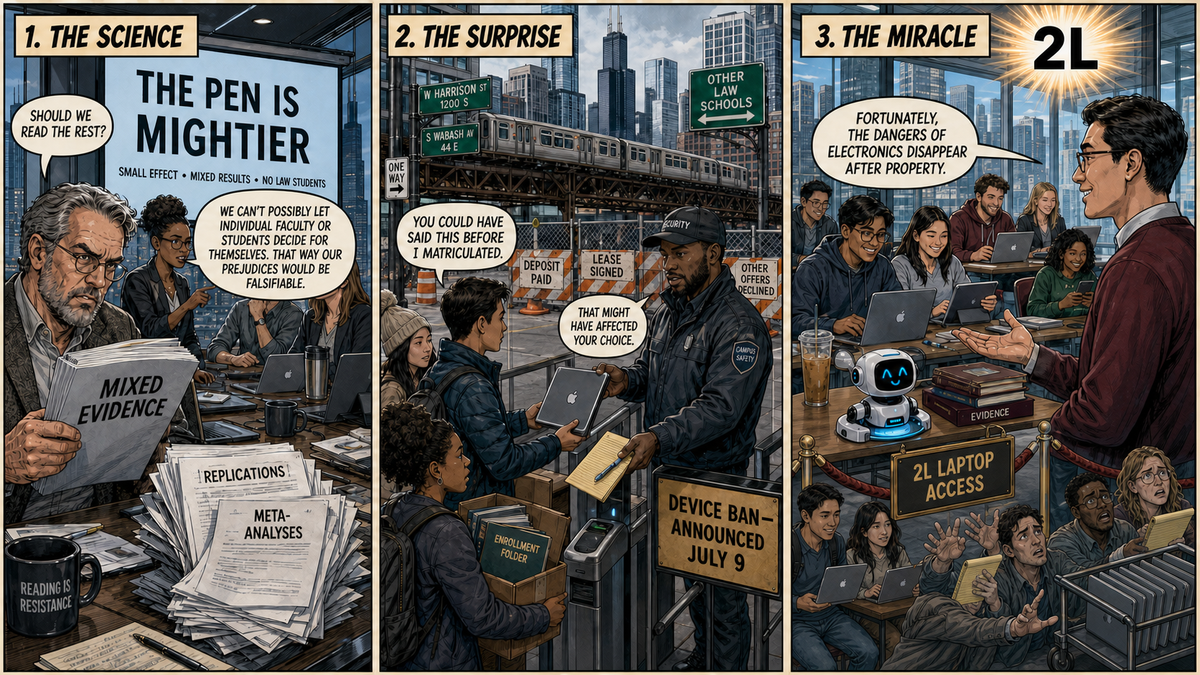
A student picks Chicago in April. She turns down Columbia, NYU, Michigan, maybe Berkeley. She pays a deposit, signs a lease, and buys a laptop meant to last three years. Then, on July 9, Chicago announces that it will "pilot the general prohibition of electronic devices from all core 1L classes, with some limited exceptions." Her laptop can come to campus. It just can't come out during the classes that fill most of her first year.
Let me concede the strongest thing Chicago has, because the concession is where the real argument starts. Laptops can distract. The evidence for that is respectable, and I will come to it. None of it is fashionable or new, and none of it depends on ChatGPT. It means a professor may sensibly clear the screens from a discussion-heavy class. It means a school may act when milder steps have been tried and have failed.
That, however, is not what Chicago did.
Chicago, to my knowledge, did not seriously ask professors to enforce the rule it already has: Personal devices may be used only for the work of the class; games, email, and streaming can cost a student points or credit. That rule is aimed squarely at the actual misconduct, and it sits on the school's website today. Rather than make professors use it, Chicago went straight to DefCon 1: a blanket keyboard jettison for every 1L doctrinal course. There is a wide gap, however, between distraction can justify a restriction and distraction justifies this restriction, and Chicago has sprinted across it without pausing to explain why the smaller step would not do. The remedy for a distracting off-task screen is to bar distracting off-task screens, not all screens. The remedy for students whose brain goes into court reporter mode rather than lawyer mode during class is to provide quality class summaries so that they can focus on the law and actually think during class. Don't take a laptop away from a student who hasn't handwritten anything in years and who learned throughout college not to be distracted by their Etsy-loving neighbor.
And then there is the label. Chicago unveiled this as an "AI strategy statement," and the device ban arrives inside it as an "example." But the distraction problem it actually solves is older than generative AI by more than a decade — old enough that Chicago wrote a policy against it years ago. AI supplied the occasion, and maybe the cover. It did not supply the reason.
I should be a little fair about the limits of my own side of this. I have no study showing that Chicago's 1Ls will learn less writing notes by hand, because no one has run that study on law students at all. But the missing evidence cuts against the school, not toward it. Chicago is the party imposing a new mandate on a captive first-year class, and the party that compels bears the burden of showing that less would not have worked. Silence in the literature is not a warrant to go first and go furthest. Berkeley tells students that they cannot use a new tool to help perform certain academic tasks. Chicago now tells captive 1Ls that they cannot use the basic machine on which nearly all modern legal work is performed—even for a concededly legitimate purpose such as taking notes. It seems to be a race of irrational AI-hate to the bottom.
I also wonder how Chicago faculty feel about this. Did all 1L faculty think this was a good idea?
If I'd been assigned a 1L course and had wanted my students actively using computers in class — for note-taking, for AI, or for other research — I would feel that the policy interfered with my academic freedom.
The quotation marks around “AI” are doing work
Chicago’s announcement says the school wants students to learn to think “with, without, and about AI.” Fine. I like the slogan. This AI enthusiast even likes the idea. There are moments when students should work without AI. A professor who wants to know whether a student can spot an Erie problem should not have to guess whether Claude spotted it first. An exam should test the student under the rules announced for that exam. A legal-writing assignment may need some AI-free stages if the point is to build a skill rather than polish a product.
But then comes the switch:
Removing AI from critical points in the learning process, such as when students are taking exams or learning foundational concepts in the classroom, is one major part of the new strategy. For example, the Law School will pilot the general prohibition of electronic devices from all core 1L classes, with some limited exceptions.
That “for example” hides the whole problem. Banning ChatGPT is one thing. Banning a student from typing “Pennoyer is mostly dead, but territorial presence still matters” into a blank document is another. The first keeps a model from supplying thought. The second keeps a student from recording her own. Chicago calls this an AI policy, but it is really a blanket device ban: it treats using AI, being distracted, typing notes, and possessing a screen as if they were the same thing.
This is the bait-and-switch move: identify a narrow harm and impose a broad rule that would be hard to defend in the harm’s own name. AI can give students answers, so no laptops. AI can summarize cases, so no tablets. AI can take a shortcut, so write everything by hand. If taking notes is so distracting, why not bar handwritten notes too and leave everything to the central "scribe"? If slower note taking is better, why let students use those fancy ballpoints and instead insist on fountain pens or, better yet, quills?
The device ban is connected to AI in the way an electricity ban would be connected to AI. It would work. It would also stop quite a few other things.
Chicago knows this. Its announcement soon shifts from AI to claims that faculty and students have seen “positive effects on the quality of discussions and learning when the environment is distraction-free, not just from AI but from technology in general.” Now we have a different policy with a different rationale. The problem is no longer artificial intelligence. It is Etsy, SportsCenter, email, text messages, and the glowing screen in the next row. But Chicago’s existing policy already prohibits all of that. Call me crazy but how about seriously enforcing the policy aimed at the actual misconduct before banning the way many 1Ls have taken notes for years? Chicago instead goes from “some students misuse laptops” to “no student may type notes,” then wraps the loss in a you will thank us later story about learning the hard way. Perhaps they will. The research gives Chicago no basis for being so sure. That argument is better. It still does not justify this ban.
No, the research does not show that handwriting is better
When I have raised variants of these points on fora such as LinkedIn over the past few days, I have gotten responses that I am sure are offered in good faith and that purport to be based on science. The popular story goes like this. Typists act as stenographers. They capture lots of words but do not think. Handwriters cannot keep up, so they select, compress, and restate. The slower method makes the brain work. The student learns more.
You can see why professors cherish this story. It turns an irritation for some—sixty laptop lids between professor and class—into cognitive science. It casts a preference for their own classrooms of yesteryear as an intervention backed by research. And it gives tough love the glow of neuroscience. If only it were true.
The story comes chiefly from Mueller and Oppenheimer’s 2014 article, “The Pen Is Mightier Than the Keyboard.” In three experiments, laptop users took more nearly verbatim notes and did worse on some conceptual questions. The explanation was plausible. It became gospel.
Then other researchers tried to reproduce it.
Morehead, Dunlosky, and Rawson conducted a direct replication and extension. They added groups that took notes on eWriters or took no notes at all. Across two experiments, performance did not consistently differ among the groups. In the second experiment, allowing students to study their notes reduced the differences further. A meta-analysis of the direct replications found small, statistically nonsignificant effects favoring longhand. Their title asked the right question: “How Much Mightier Is the Pen?” The answer was: perhaps a little, perhaps not at all.
Two broader syntheses found, at most, a small average advantage for longhand, although they did not reach the same statistical conclusion. Voyer, Ronis, and Byers gathered 77 effect sizes from 39 samples in 36 articles, focusing on comparisons intended to isolate note-taking medium from off-task digital distraction. Their estimated average effect was essentially zero: (g=-0.008), with a confidence interval spanning advantages for either method. Lau’s 2022 doctoral dissertation examined 88 effect sizes from 42 independent samples. It found a statistically significant but small advantage for handwriting— (g=0.144)—and some evidence that allowing students to review their notes may substantially reduce that advantage.
That is not nothing. If I were advising a student who took equally good notes either way, never reviewed them, and wanted every small edge on a quiz given twenty minutes after a recorded lecture, maybe I would suggest pen and paper if they had recent experience with using it.
Except ... that is not modern law school.
The studies mostly use undergraduates, short lectures, and short tests. They do not study law students sorting holdings from dicta over ten weeks. They do not study students searching their notes for the professor’s Erie hypothetical. They do not study the work of turning class notes into a course outline. They do not study whether a student can read her handwriting in December. Critically, they do not study whether there is any cognitive loss when other means such as having a class scribe or (gasp) AI-generated transcript reduce the stress coming from the belief that every comment from the professor must be placed on one's notes.
The leap from this literature to “all Chicago 1Ls should be made to handwrite” is enormous. Where are the critical thinking skills the cultivation of which has been a hallmark of education at the University of Chicago?
Students differ
Put two students in the same classroom. The first kept handwritten journals through college, took seminar notes on paper, and can write quickly without looking at the page. The second studied engineering, typed every assignment since ninth grade, and has not handwritten more than a thank-you note in a decade. Chicago’s rule treats the two as if “handwriting” were the same cognitive act.
It is not.
The first student may compress a rule while keeping her eyes on the professor. The second may spend half the class trying to make the letter r look different from the letter v. One has spare working memory for personal jurisdiction. The other burns it on penmanship. The first leaves with usable notes. The second leaves with six pages of archaeological evidence.
This is a recruited-intuition hypothetical. We do not need a randomized trial to know that fluency differs. Typing speed differs. Handwriting speed differs. Students differ in motor skill, prior practice, language background, attention, and the way they organize information. Some type everything the professor says. Some use headings, arrows, questions, boldface, links, and short analytic propositions. Some handwrite thoughtfully. Some handwrite garbage.
Chicago’s ban takes an uncertain average effect and applies it to every student. That is bad use of social science. An average does not tell us that every person benefits from the treatment. It certainly does not tell us that a student trained for years on one medium will benefit when an institution abruptly forces another.
Nor is formal disability accommodations the answer. That process will not handle ordinary human variation. There is no DSM or ICD-10 code for having slow or sloppy handwriting. The fast typist with slow handwriting probably has no ADA claim. Chicago officials will likely and rightly scoff at self-generated proof of handwriting difficulties. The result will be that the typical engineer or English major or the non-traditional student going to law school after years in industry taking notes on their laptops will just be out of luck.
The distraction argument is real—and still not enough
I want to give Chicago its best point. Laptops distract. Not just the person using one. I have sat in the back of enough classes while doing various reviews over the years to know that any existing policies against non-class use of laptops can bear a closer relationship to prohibitions on jaywalking.
Sana, Weston, and Cepeda found that students assigned to multitask on laptops learned less from a lecture. Students sitting where they could see a multitasker’s screen also learned less. Ravizza, Uitvlugt, and Fenn tracked actual web use in a college course and found that nonacademic browsing was common and linked to worse performance. Most impressively, Carter, Greenberg, and Walker randomly assigned West Point economics sections to different device rules. Students in sections that permitted computers scored about 0.18 standard deviations lower on the final exam—even when tablets had to remain flat on the desk.
This evidence is stronger than the handwriting evidence. It supports rules against off-task use. It supports asking laptop users to sit in designated rows. It supports screen filters, notification-free settings, participation norms, and professors calling out the student shopping for shoes on Zappos. It may even support a professor deciding that a particular discussion-heavy class works better without devices.
But a school-wide ban in every core 1L course is a different creature. It says that no professor may judge the needs of Contracts differently from the needs of Civil Procedure. It says that no student may weigh searchable notes against possible distraction. It says that because some students will misuse a browser, every student must lose the keyboard. A school may police students who shop or stream in class without forbidding every student from using the basic machine on which modern legal work is done.”
Chicago already had a policy for the actual harm — the one quoted above. That policy remains on the school’s website.
Perhaps Chicago found the rule hard to enforce. Say so. Perhaps professors dislike policing screens. Say that. Perhaps the school thinks one student’s distraction of another creates a collective-action problem that student choice cannot solve. Say that too.
But do not make AI the villain. The irony is that the "distraction" often runs the other way. A student who opens ChatGPT to test a point the class is debating — to see whether the professor's rule really holds, or to run down a case that sounds wrong — is not drifting away from the discussion. She is diving into it. That is engagement wearing the costume of distraction, and a device ban cannot tell the two apart.
Is this the moment to confess that I constantly do much of what the Chicago policy would ban? When I sit in a scholarly talk not only do I keep my laptop open -- gasp -- I often use AI to chase down the points I find interesting. And, yes, sometimes I might thus neglect a minute or two of bon mots from the speaker, but I find the engagement tradeoff worthwhile.
Why only 1Ls?
The 1L scope of the Chicago policy gives away the game. If handwriting makes students learn law better, why stop after Property? Does the effect vanish in Evidence or the small Antitrust seminar? Does a keyboard begin promoting deep thought when the student enrolls in Federal Courts? Does the human brain change during the summer after 1L? Does a summer of working at a firm stop students from reviewing Sports Center replays during unengaging moments of a federal tax class?
Of course not.
Chicago could say that novices need more scaffolding. That would make some sense. First-year students lack the knowledge that helps experts decide what matters, and they may be especially tempted to transcribe everything. A one-year rule might force them to build habits of selection before regaining access to faster tools.
But that is a hypothesis about novice legal education. Chicago cites no study testing it. I found no credible experiment comparing handwritten and typed notes among law students at all. The research does not show that 1Ls gain a special handwriting benefit or that the benefit disappears once they become 2Ls.
The other defense is that this is a pilot. I guess that's better than being announced as a permanent policy (though anyone want to bet how long this policy survives?). A pilot has outcomes announced in advance, a comparison group, measures beyond student satisfaction, attention to who is harmed, and a real chance of termination. Which classes will serve as controls? Will Chicago compare exam performance with prior cohorts? Will it measure attendance, discussion, note quality, accommodation requests, and student stress? Will it separate the effect of reduced distraction from the effect of forced handwriting?
Or does “pilot” mean the school will collect a few comments from professors who already dislike laptops and declare success?
I am not sure. Chicago has not said.
The matriculants deserved to know
The timing makes this worse. Chicago announced the policy on July 9 for the coming autumn. By then, the student in my opening — and hundreds like her — had made a choice that was costly to undo. Some surely chose Chicago over peer schools with different approaches to technology and student autonomy. Chicago announced a material change after incoming students had paid deposits, signed leases, and turned down peer schools. Those students deserved to know the rules before their choices became costly to undo
A categorical device ban in core 1L classes is material to that choice. I would want to know. The engineer who has typed everything since ninth grade would want to know. The student with marginal—not formally disabling—handwriting difficulty would want to know. The student who has built a linked note system through four years of college would want to know.
Schools demand disclosure from applicants. Applicants might reasonably expect the same when a school makes a late change to the basic conditions of instruction.
Maybe few students will care. My suspicion is the opposite. Chicago matriculants tend to have options. They will soon learn – thanks, no doubt, to a distraction-free contracts class – about reliance arguments. Some will think they chose an intellectually serious law school and discovered, after the choice became costly to undo, that the school does not trust them with a laptop. One wonders how those students, beset during their undergraduate years with fellow students looking at YouTube, ever managed to acquire the knowledge that made them suitable for Chicago in the first place.
That will land badly. It should.
What this means for legal education
Berkeley bans a technology it does not know how to govern. Chicago bans the machine that carries it. Both schools call the result rigor. I am fearful these decisions, amplified by irrational AI hatred, will spread.
It is not rigor. Rigor lies in designing work for which students must account for their reasoning, defend their choices, check their sources, revise bad analysis, and show what they understand. Rigor asks a student why a case cuts against her and waits for the answer. Rigor can use oral follow-ups, in-class problems, version histories, closed-AI stages, and assignments built around judgment rather than information retrieval.
Taking away a laptop is easy. Teaching students when to close it is harder.
Chicago has one piece right: there are points in learning at which students must think without AI. The school loses the thread when it treats “without AI,” “without distraction,” “without typing,” and “without a device” as the same condition. They are not. The research does not make them so.
Call the policy what it is: a paternalistic 1L classroom-device experiment, imposed late, supported by decent evidence about distraction, weak evidence about handwriting, and almost no evidence about law students. Then let students and faculty argue about whether its costs are worth it.
The quotation marks belong around “AI.” The ban goes much further.
Notes
- I would preserve disability accommodations without grudging documentation games. “Limited exceptions” needs to mean more than relief for students prepared to litigate their handwriting problems against their own law school.
- Yes, students routinely overestimate their ability to multitask. Professors routinely overestimate their ability to identify what caused a good class discussion. That is why Chicago should actually measure the results pilot instead of collecting impressions.
- I used a laptop to research and draft this post. At several points I also closed it and thought. Somehow both remained possible. And – shocker – I also used ChatGPT and Claude for Word to draft much of its prose. No thunderbolt has yet come down from the sky nor, to my knowledge, has my brain suffered any marginal rot.
- Berkeley’s policy and Chicago’s rule are not identical. Berkeley regulates students’ use of generative AI in academic work, while Chicago’s announcement combines restrictions on AI with a device-free 1L classroom. That distinction is the point.
- It's curious that both Berkeley and Chicago have used an "AI" policy to implement things that have little to do with the generally stated harms of AI. As set forth here, Berkeley used it as a basis for banning uploading of professor materials into AI, which is more about intellectual property protection than anything else. And Chicago used it to ban laptops even though the anti-distraction rationale has existed for two decades and, if anything, the availability of AI means that "distracted" students may actually be more engaged.