
Law schools should not adopt Berkeley's awful new anti-AI policy
Executive Summary
Berkeley Law's Artificial Intelligence Policy, effective Summer 2026, makes prohibition the default for student AI use. It forbids AI in conceptualizing, outlining, drafting, revising, translating, or editing any work submitted for credit; bans AI use in any exam situation; prohibits students from uploading course materials into generative AI systems; and permits AI in research only to identify sources. Faculty are not regulated. Instructors may deviate from the default in writing. The policy is being received nationally as a serious institutional response to a hard problem, and there is sure to be pressure given prevailing hatred of AI for other schools to follow.
They should not. The policy collapses under five kinds of pressure visible on a single chart of ordinary student conduct: it regulates the medium of inquiry rather than the cognitive operation; it exempts faculty from rules it applies to students; its prohibition on uploading course materials is an intellectual-property rule wearing AI clothing; its core terms generate ambiguities the policy itself cannot resolve; and its sweep into anything connected to graded participation produces results no reasonable administrator could endorse. The defense that the prohibition is "only a default" is rhetorical packaging — the prohibition is what students will fear, what gets enforced, and what employers will read.
Beyond enforceability, the policy fails on substance. It substitutes prohibition for the supervised practice through which professionals form judgment about powerful tools, and it sends graduates into a profession that has already chosen AI fluency as a baseline competence. A workable alternative is not difficult to describe, and is sketched at the end of this piece. Berkeley's policy is not that alternative. Other law schools should resist the temptation to copy it.
What did Berkeley actually do?
Berkeley Law has adopted an Artificial Intelligence Policy that forbids students from using AI to conceptualize, outline, draft, revise, translate, or edit work submitted for credit, bans AI use entirely in examinations, prohibits uploading course materials into generative AI systems, and permits AI only to identify research sources. Instructors may deviate from this default in writing. The policy will be presented at conferences and posted all over the Internet as a serious institutional response to a difficult problem. It is not. It is a bad model for American legal education. Other law schools should resist the temptation to copy it. Here's a copy of the policy.
Before discussing the demerits of the policy, the policy itself deserves a clean restatement. Much of the early praise and criticism has failed to grapple with its actual structure.
Berkeley Law's Artificial Intelligence Policy, effective Summer 2026, regulates three categories of student conduct. First, AI use is prohibited for any purpose in any exam situation. Second, in any work submitted for credit, AI may not be used for conceptualizing, outlining, drafting, revising, translating, or editing; AI may be used only to identify research sources such as cases, statutes, and secondary materials, and citations to nonexistent sources raise a presumption of prohibited use. Third, students may not upload course materials — including assignments, readings, slides, class recordings, or other class content — into generative AI systems. Note that the first two prohibitions reach "AI" generally; the third reaches only "generative AI." Instructors may deviate from these defaults in writing, with notice, and must require disclosure of authorized AI use. The burden of resolving any ambiguity falls on the student, who must obtain written clarification from the instructor before engaging in any use whose status is uncertain.
The clearest way to see what this policy actually does is to walk through ten ordinary activities a law student might undertake during a semester and ask, of each one, how the policy classifies it. Many are activities I invite my own 1L and other students to undertake. The table below does that. The pattern that emerges is the subject of everything that follows: five distinct kinds of failure, all visible on the face of the chart, taken up in turn after the table.
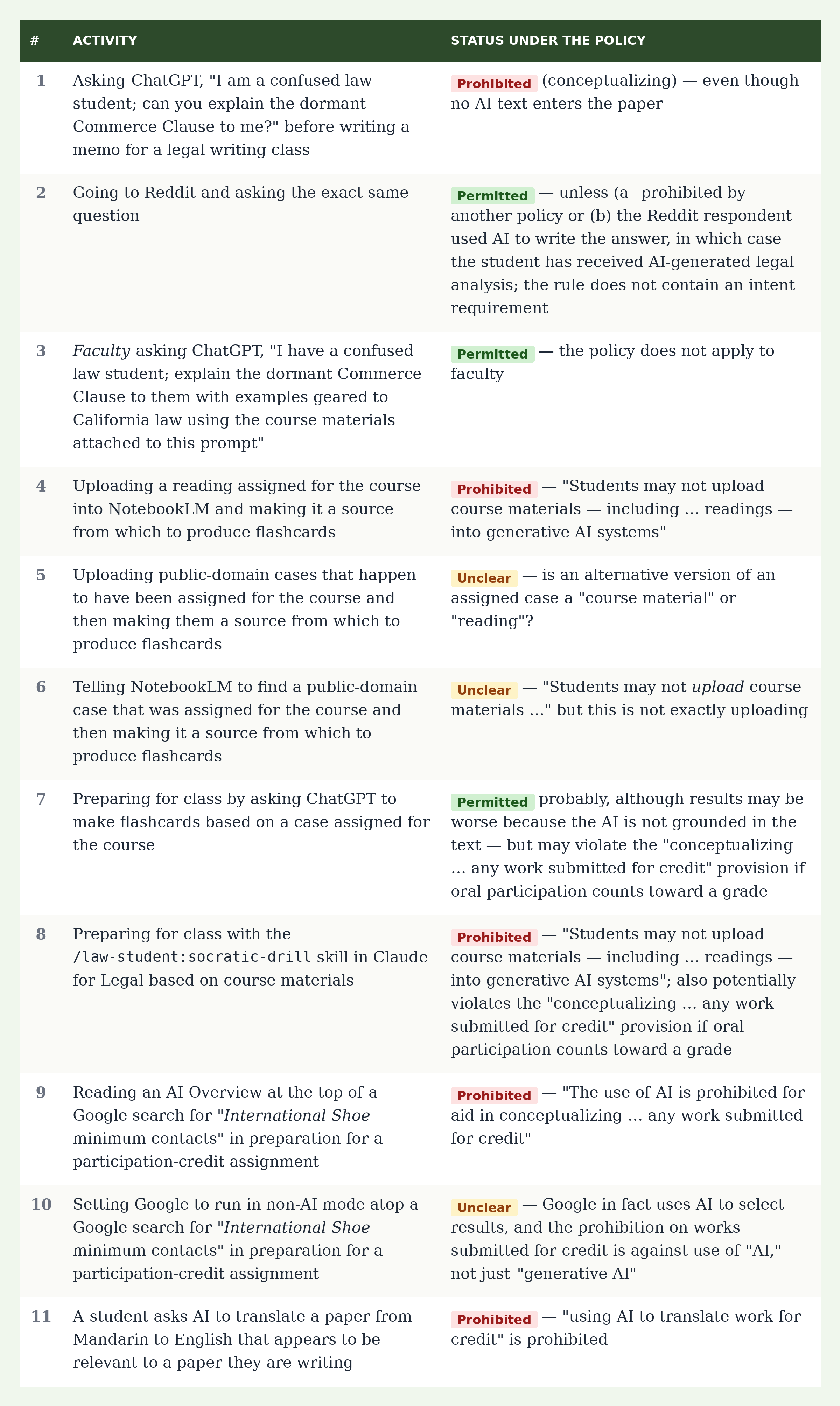
The table is devastating, and the devastation lies not in any single line but in the cumulative pattern. Five distinct kinds of failure are visible on the face of the chart, each developed in one of the sections that follow: the policy regulates the medium of inquiry rather than the cognitive operation; it exempts faculty from rules it applies to students; its prohibition on uploading course materials is an intellectual-property rule wearing AI clothing; its central terms generate ambiguities the policy itself cannot resolve; and its sweep into anything that touches graded participation produces results no reasonable administrator could endorse.
The medium-not-the-mind problem
The first three rows expose the policy's central conceptual failure: it regulates the medium of inquiry rather than the cognitive operation being performed. A student who asks ChatGPT to explain the dormant Commerce Clause before writing a memo is doing the same thing — pedagogically, cognitively, in terms of what enters her brain and what enters her paper — as a student who asks the same question on Reddit. In both cases she is seeking background orientation that will shape her thinking but will not appear in her submitted work. This policy permits one and forbids the other. Now it may be that Berkeley has other policies that prohibit the student from consulting the Internet on certain assignments and that all this policy is doing is honoring AI by treating it like live humans. If that's all it's doing, however, I wish Berkeley would say so; the policy would not then deserve all the hoopla it is currently receiving from AI bashers.
If Berkeley does not have policies prohibiting Internet consultation, the new AI policy is problematic because the offloading is identical. It cannot be defended on grounds of source reliability, because Reddit answers are notoriously worse than current frontier models. It cannot be defended on grounds of professional formation, because future lawyers will use AI for orientation routinely and need practice in evaluating its output. The only thing the distinction tracks is which interface the student used. A policy that treats interface as the regulatory variable is not thinking about thinking; it is thinking about which apps are open on the student's screen.
The Reddit row also exposes a defect the policy itself does not contemplate: it contains no intent requirement. A student who asks a question on Reddit and receives an answer composed with AI assistance has, under the policy's literal text, received AI-generated legal analysis used in conceptualizing her work. She has no way to know this and no obligation to investigate. The rule is therefore either over-inclusive in ways that punish the diligent, or it must be read with an implicit knowledge requirement the policy does not articulate.
The faculty asymmetry, in concrete form
The third row is the cleanest demonstration of the faculty asymmetry the policy embeds. The same prompt — "explain the dormant Commerce Clause to a confused law student, with California examples, using these course materials" — is forbidden when the student sends it and permitted when the professor sends it. I would feel a lot better about the Berkeley policy if the faculty would subject themselves to it. One notes that Berkeley has not proposed a parallel restriction on AI use in the writing its junior faculty submit as part of promotion and tenure. The professor, after all, is doing the same cognitive operation: producing an AI-generated explanation of the doctrine to be presented to a student. The only difference is which side of the lectern the prompt comes from. There is no pedagogical theory that justifies this. There is no academic-integrity theory that justifies it. The asymmetry rests entirely on the unspoken premise that AI is a tool the trusted may wield and the trained may seldom touch, which is the structure of a guild rule, not a learning rule.
The course-materials prohibition is an IP rule wearing AI clothing
The sharpest single point in the table involves the prohibition on uploading course materials. That prohibition cannot be understood as a learning rule. It must be read as an intellectual-property rule the school has been unwilling to defend on its own merits.
Consider what the rule actually forbids. A student may not upload an assigned reading, a slide, an assignment, a class recording, or "other class content" into a generative AI system. Look at what this list has in common: every item is something the school or the faculty produced or selected. The rule does not forbid uploading a public domain casebook such as those Harvard makes available via its H2O project. It does not forbid uploading a case the student found on her own initiative. It forbids (I think) uploading the same version of a case once it appears on a syllabus. The transformation from permitted to prohibited happens not when the cognitive risk changes but when the school's claim to the curated assemblage attaches.
This is an IP rule. The school is protecting its curricular work product from being ingested by purveyors of academic materials and by third-party AI vendors who might thereby reverse-engineer the school's pedagogical choices, train on its faculty's slide decks, or aggregate its readings into a competing study product. These are real institutional concerns. They are not, however, AI-pedagogy concerns. The policy disguises an institutional-data-protection rule as a student-learning rule and thereby achieves two things: it gets the rule adopted under the moral framing of brain protection, and it avoids the conversation the school would have to have if it admitted what the rule actually does. That conversation would expose the policy as protecting the school rather than the student.
The fourth and fifth rows show how poorly the disguise holds. The student uploading an assigned reading to NotebookLM to produce flashcards is then preparing for cognitive activity that decades of learning-science research has established as the gold standard for durable comprehension. The rule forbids it. Meanwhile, the same student uploading the same public-domain case found through her own search produces, somehow, a different result, even though the AI is doing the same thing and the student is learning the same way. The cognitive operation is identical. The IP overlay is the only thing that changes.
The unclear rows reveal the rule's incoherence
Rows five and six are diagnostically valuable because the policy cannot answer them. Is a public-domain case that happens to be assigned a "course material"? Does telling NotebookLM to fetch a case count as "uploading"? The policy does not say, and no responsible interpretation can be supplied.
A student facing this ambiguity has three options, all bad. She can ask her professor for written clarification, as the policy requires, which embarrasses her, takes her professor's time, and produces an answer that may differ from her classmates'. She can guess conservatively and forgo the activity, which costs her the learning. She can guess aggressively and proceed, accepting the risk that her interpretation will later be deemed wrong and her conduct sanctioned. The policy has constructed a regime in which careful students bear ongoing transaction costs that careless students do not bear, and in which the careful student who guesses wrong is punished worse than the careless student who never thought about it.
This is the opposite of how academic-integrity rules should function. A well-designed rule sharpens the line between honest and dishonest conduct and makes the honest choice easy to identify. The Berkeley policy does the reverse: it multiplies edge cases the policy never anticipated and assigns the cost of resolving them to the student.
The conceptualizing-for-class-participation trap
Rows seven through ten reveal the policy's deepest absurdity. The prohibition on "conceptualizing … any work submitted for credit" sweeps in oral class participation if participation counts toward the grade — which it does in most law school courses. A student preparing for class by asking AI to make flashcards from a case is, on the literal text of the rule, conceptualizing material that will inform work submitted for credit.
This reading produces results no reasonable policy could endorse. A student who reads an AI Overview at the top of a Google search while preparing for a class that awards participation credit has used AI to aid in conceptualizing work submitted for credit. A student who explicitly disables AI mode in Google has done what, exactly — used a search engine that still uses AI to rank its results, while believing she has not? The policy does not say. The student has no way to comply with confidence. She is left to develop folk theories about which features of which products count as "AI" for purposes of the rule.
Row ten is particularly telling. The student who tries hardest to comply — who actively configures her search engine to suppress AI features — still cannot know whether she has complied, because Google in fact uses AI throughout its result-ranking infrastructure. The rule forbids "AI," not "generative AI," in the conceptualizing provision. A student attempting good-faith compliance is forced into the absurd posture of trying to identify whether each piece of software she touches contains AI components, which is a category that now describes virtually every information tool a law student uses.
The translation prohibition
Row 11 notes that the policy "forbids using AI to translate work for credit, thus providing students with the opportunity to develop and exercise their own fluency with legal English." Let them learn English! So if an enterprising student who does not read Mandarin asks for a translation of a work on commercial law and then uses that to inform a paper on international trade, they have violated Berkeley's policy. One wonders if the policy's proponents would prefer that the student ignore the paper, hire someone to translate the paper at $40 per page (without the hated AI of course), or learn Mandarin.
Moreover, this aspect of the policy — foreign-language-to-English translation — does not develop fluency in legal English at all. It merely lets a student understand a source that would otherwise be inaccessible. So one has to suppose that the policy also prohibits a non-native English-speaking student from translating English-language materials into the student’s first language in order to understand them more fully. But Berkeley is not admitting people who cannot function in English. The question is whether a student who thinks partly in another language may use a contemporary tool to move legal ideas across a linguistic boundary without being treated as a cheat. Apparently not. And yet, because of the policy's anti-AI animus, the rule seems to disappear if the student is wealthy enough to pay a human translator. One wonders how all of this will be received in Berkeley’s extensive foreign LL.M. program.
The "they'll fix it in administration" defense
A defender will reply that this is all nitpicking. The bugs will be patched. Berkeley will issue clarifications, beleaguered faculty will refine their syllabus statements, and prosecutorial discretion will keep the rule from being applied to the absurd cases the table identifies. The text of the rule is rough, the defender concedes, but the operation of the rule will be sensible. Other deans need not worry, because the rule as administered will look nothing like the rule as written.
This response misunderstands what academic-integrity rules are for, and it misunderstands the position of the student who has to live under one. As one prominent Berkeley scholar has written, "[I]t’s essential to have clear guidelines surrounding anything that can trigger an academic dishonesty allegation." A rule whose operation depends on continual administrative repair is a rule whose written terms cannot govern student conduct, which means students cannot rely on the text to know what is permitted and what is not. They must instead rely on a folk understanding, constructed from rumor, faculty asides, occasional clarifications, and their own guesses about what the school is likely to enforce. That is a worse position than no rule at all, because it punishes the literal-minded and rewards the well-connected. The student with access to the informal network — the student whose study group includes a 3L with strong faculty relationships, the student whose mentor sits on the academic-standards committee — learns which provisions are dead letters and which are live. The student without that access takes the rule at its word and either over-complies or violates without knowing she has done so. Prosecutorial discretion is not a feature of a fair regime; it is a feature of a regime that has given up on writing rules it is willing to enforce as written.
The "Berkeley will fix it" version of this objection is worse still, because it concedes the case against adoption by other schools. A faculty elsewhere who adopts the text inherits the text, not the institutional knowledge that makes the text livable. She gets the absurd results without the local culture that has learned to suppress them. A policy whose only defense is that its institution will not enforce it as written is not a policy other institutions should follow.
What the table proves
Taken together, these rows establish that the Berkeley policy is not a coherent rule that has hard edge cases. It is an incoherent rule that has only edge cases. The policy's central terms — "conceptualizing," "course materials," "upload," "AI" — do not pick out stable categories in the technical environment of 2026, and the policy supplies no apparatus for resolving the ambiguities it generates. The result is a rule that the school cannot administer fairly, that students cannot follow confidently, and that protects the institution's intellectual property while pretending to protect the student's cognitive formation.
Why the policy fails on the merits
Everything in the table is enforcement-and-coherence trouble. The deeper trouble is substantive, and it has a single underlying source: the policy is an institutional attempt to recover the world of 2018. In that world, AI was a research curiosity, not a tool clients pay for and firms have built into their workflows. In that world, a law school could plausibly define its mission without reference to generative AI because the profession had not yet defined itself with reference to it. That world is gone. The Berkeley policy is a romanticized quest to bring it back, and like most romanticized quests, it will produce damage in the present while failing to recover the past.
Several substantive failures follow from that misdiagnosis. First, the policy misjudges what professional education is for: a profession learns to use powerful tools by practicing with them under supervision. Berkeley has chosen to substitute prohibition for that practice. Second, the policy sends graduates into a profession that increasingly expects AI fluency without giving them the practice that produces it. Third, the policy cannot be enforced and will corrode the institutions that try.
The policy substitutes prohibition for the supervised practice that forms professional judgment
Professional education is, at its core, supervised practice with the tools of the profession. Surgeons handle scalpels in residency, not after graduation. Pilots fly with instructors before they fly alone. The premise is that judgment about a powerful tool is built by using the tool under conditions where mistakes are recoverable and a more experienced practitioner can intervene. Berkeley's policy abandons that premise for the most consequential general-purpose tool legal practice has ever acquired and offers no account of why this tool should be the exception. A defender will reach for an analogy at this stage: schools and parents routinely restrict children from technologies they cannot yet handle responsibly. Many toddlers are kept off iPads. Preteens are not handed unfettered internet access. Middle schoolers are made to wait for their first cell phone. The argument runs that Berkeley is doing the same thing — withholding a powerful technology from users not yet ready to manage it, in service of their longer-term development. The analogy is meant to make the policy sound prudent rather than restrictive.
The analogy collapses on inspection, and it collapses in a way that exposes the incoherence at the policy's core. The premise of withholding technology from children is that children are not the people whose professional judgment we are trying to form; they are pre-professionals, pre-adults, whose cognitive and ethical development must reach certain stages before they can responsibly handle the tool. Law students are not children; some are older than the professors in front of them. They are adults who have already passed through whatever developmental gates the iPad-and-cell-phone analogies invoke. Most have college degrees, professional experience, and years of independent AI use already in their personal and academic histories. To treat them as not-yet-ready for a tool their younger siblings use unsupervised is not protective; it is a category error about what kind of human being is sitting in a Berkeley classroom.
The cost of substituting prohibition for practice is concrete, and it shows up at graduation. Sophisticated AI use is itself a cognitive skill, and like other cognitive skills it requires practice. The empirical record on AI in legal work supports this directly. Choi, Monahan, and Schwarcz's randomized controlled trial — the first of its kind on AI-assisted legal analysis — found that giving law students access to GPT-4 (now a relic) produced large and consistent gains in speed but only slight and inconsistent gains in quality, and that quality gains were uneven across skill levels: where AI helped at all, lower-skilled participants benefited most. Choi and Schwarcz's companion study of AI-assisted law school exam-taking found, similarly, that GPT-4's own performance depended dramatically on prompting methodology — mediocre with basic prompts, capable of outperforming the average student with optimal ones. Both findings point in the same direction: the value a lawyer extracts from these tools is a function of skill the lawyer has had occasion to build. A curriculum that forecloses the activity in which that skill develops cannot be neutral about it.
Consider what AI fluency actually means in concrete terms — not the marketing version, but the version a hiring partner would recognize. It means being able to design prompts that produce useful legal-research output rather than confident hallucinations. It means cross-checking AI-generated case summaries against primary sources, recognizing characteristic failure modes, and knowing which kinds of legal questions current models handle reliably and which they do not. It means evaluating an AI-generated draft for unsupported claims, missing counterarguments, and citation accuracy before relying on it. It means reasoning about what client information can safely be entered into which tool, and what the firm's confidentiality policy and the bar's ethics rules require. It means knowing when an AI workflow saves real time and when it produces apparent efficiency that costs more in verification than it saved in drafting.
A student who has spent three years under a policy whose default forbids AI on work submitted for credit — with narrow carve-outs for source identification and whatever individual faculty affirmatively permit — could graduate without meaningful practice in any of this. She may not have developed habits of cross-checking output against primary sources. She may not have learned which prompts produce reliable results and which produce hallucinations. She may not have practiced the iterative work of generating a draft, critiquing it, generating an alternative, and deciding which is stronger. These skills are not learned best by reading about them. They are learned by doing them under conditions where mistakes are recoverable — which is what law school is supposed to provide in this area as in others.
The policy disserves the profession
The profession is moving toward AI fluency at a pace that no law school can credibly ignore. This is the part of the analysis where Berkeley's denial of the present is most consequential.
Consider what has actually happened in the legal market over the past three years. Clients have begun to insist that their attorneys use AI tools to reduce hours billed on document review, legal research, and contract analysis. Corporate clients audit law firm invoices and ask, pointedly, why a task that an AI tool could complete in minutes was billed at associate rates for hours. Law firms have responded — not reluctantly, not at the margin, but with money. The largest firms have built internal AI platforms, retained consultants to redesign workflows around AI tools, and begun training partners as well as associates in the new methods. The largest firms now deploy dozens of distinct AI tools across research, drafting, due diligence, and contract review — not as experiments but as billable infrastructure. Mid-sized firms have followed, often more quickly than the large firms, because their margins do not permit them to bill the old way against clients who refuse to pay for it. The profession adopted AI on its own. Lawyers using it discovered that for many legal tasks it is genuinely excellent — faster than unaided work and, frequently, better.
The Berkeley policy is written as though none of this happened. It addresses an environment in which AI is an academic-integrity threat to be policed rather than a professional tool to be taught. It treats the prohibition as a pedagogical position when it is in fact a sociological one — a position about what kind of professional world law schools should pretend exists. The pretense is that nothing has changed, that clients still pay for the unaided work of a single lawyer's mind, that firms still operate as they did in 2018, and that the law school's job is to produce graduates trained for that vanished world. None of these things is true. The policy does not respond to the legal profession of 2026; it responds to the legal profession the policy's authors wish still existed.
This is not a quibble about timing. The trajectory is the point. If AI capabilities had peaked in 2024, a school might plausibly bet that students could learn what they needed after graduation. But AI capabilities are still rising sharply, and the next inflection is already visible: agentic systems that do not present themselves to the student as a chatbot to consult but as an autonomous workflow embedded in the tools she already uses — research databases that draft as they search, document editors that complete arguments as she types, operating-system-level assistants that act across applications without being summoned. A policy that turns on whether 'the student used AI' presupposes that AI use is a discrete event the student initiates. Agentic AI dissolves that presupposition. The tools available to lawyers in 2028 will not just be substantially more capable than those available now; they will be substantially harder to draw the policy's central line around. The gap between Berkeley-trained graduates and graduates who practiced AI use in school will widen every year the policy remains in force, and the gap between what the policy says and what the policy can mean will widen alongside it. A school that adopts this policy is not making a one-time decision; it is making a decision that gets worse each year, against a target that keeps moving away from it.
There is also a professional-responsibility dimension that the policy actively undermines. The duties lawyers owe regarding AI use — competence, confidentiality, supervision, candor about output, reasonable fees — cannot be discharged by lawyers who first encounter the tool in practice. Those duties presuppose practiced judgment about what AI can and cannot do. A school that wants to graduate ethically competent AI users must give its students supervised practice in being AI users. A school that forbids the practice forbids the formation of the judgment the ethical rules require. Lawyers sanctioned for AI misuse have almost all been lawyers who never developed the judgment that supervised academic AI use would have given them. Berkeley's policy makes that disciplinary record longer, not shorter.
The policy is unenforceable and will corrode the institution that tries
The policy presupposes a world that no longer exists. It imagines a student sitting at a desk choosing between her own mind and a chatbot in a separate browser tab, and it imagines a faculty member who can tell the difference between work produced in the first scenario and work produced in the second. Both pictures are obsolete.
First, AI is no longer a discrete tool that students visit; it is ubiquitous. Microsoft Word now offers Copilot suggestions while a student types. As of this week, Google search now incorporates AI intensively. Google Docs offers Gemini completions in real time. Grammarly, which law students have used for years without controversy, now incorporates generative AI for sentence rewrites. Westlaw and Lexis embed AI research assistants in their core products. The student who opens a laptop to write a paper in 2026 has to make a heroic effort not to use AI. The line between AI-assisted writing and unassisted writing has been engineered out of the software stack, and the trajectory is toward more integration, not less. Every year the policy remains in force, the gap between the rule and the technical environment will widen. A policy that is barely enforceable today will be unenforceable in three years and absurd in five.
The damage extends beyond enforcement statistics. Consider the environment the policy will create for Berkeley students. A student who has used AI legitimately in college now arrives at Berkeley to find that her ordinary writing workflow is forbidden. She does not know exactly where the line falls — neither does her professor, neither does the dean — and she fears that work she produced honestly will be misread as AI output. She begins to defend herself preemptively. She saves drafts compulsively. She avoids sophisticated vocabulary that might trigger suspicion. She runs her own prose through AI-detection tools, which are unreliable, and worries when they flag her sentences. She spends time and emotional energy not on learning law but on managing the appearance of not using AI.
Meanwhile, students who do use AI develop a different and worse skill: rewriting AI output to evade detection. They learn to break up parallel structures, introduce small grammatical irregularities, vary sentence length artificially, replace polished phrasings with rougher ones. They even read my blog entries and find the belcher-proof skill that rids prose of AI tropes. Enormous student energy will go into making AI output look more human — not because making AI output look more human is intrinsically valuable, but because the policy makes it necessary. This is the precise opposite of the cognitive formation the policy claims to protect. Students are being trained to launder machine output, which requires sophisticated judgment about what unaided human writing sounds like, and to do so secretly, without faculty guidance, in service of a rule they have decided to violate. The school will graduate students more practiced in covert AI use than they would have been under any disclosure regime.
This is also where selective enforcement becomes most pernicious. The students best positioned to launder AI output successfully are those with the strongest pre-existing writing skills, the strongest native command of legal English, and the most leisure to iterate. The students caught by enforcement will disproportionately be those who lack these advantages.
The "default" defense is rhetorical packaging for a substantive prohibition
On the Internet, I see that a frequent defense of the policy is that the prohibition is "only a default." The prohibition is merely a default; any instructor may deviate in writing; courses designed to teach AI fluency may permit broad AI use; pluralism is preserved.
Funny, though, how the real world is not perceiving it that way. AI critics have championed Berkeley’s move as a stand — a law school finally drawing a line. Many have circulated it on that basis. The policy's structure invites their enthusiasm. If the rule were genuinely a default, indifferent between use and non-use, the school would have no reason to write it. Defaults exist to express institutional preferences. The policy and admiration for it lie significantly in the symbolic space. The Berkeley policy is not silent until a professor chooses; it pre-selects prohibition, requires the burden of departure to be carried by faculty members willing to publish a written deviation, and embeds the prohibition in the school's policy documents, its honor-code architecture, and its enforcement presumptions. The "default" framing is rhetorical packaging for a substantive institutional position: AI use is presumptively academic misconduct unless a faculty member has affirmatively legitimated it.
This recognition matters because the prohibition, not the deviation clause, is what does the institutional work. It is the prohibition that students will fear violating. It is the prohibition that gets enforced when enforcement happens. It is the prohibition that employers and bar examiners will read in the policy document. It is the prohibition that adjuncts and junior faculty will hesitate to override, because the cost of publishing a deviation falls on them while the cost of the default falls on no one. A school whose stated philosophy of legal education can be set aside by any faculty member with a syllabus footnote does not have a pluralist philosophy. It has a prohibition with an escape hatch that few will use. The defense that "professors may deviate" is true and irrelevant. The rule is the rule. The three failures below all depend on it.
At a minimum, demand this much
Here are three threshold demands for any school tempted to adopt Berkeley’s posture. They are not concessions to the policy. They are the minimum conditions for making even a prohibitionist regime administrable, candid, and durable.
First, demand clarity. The published document is a draft that reads as if it had not been workshopped against the cases it will actually have to govern. (By the way, AI might help Berkeley develop difficult cases, but the school will need to consider whether doing so would atrophy its collective intellectual heft.) The policy's core terms — "work submitted for credit," "any AI assistance," what counts as "course materials," what counts as research "for identifying sources" — carry ambiguities the policy does not resolve and that a student trying to comply in good faith cannot resolve from the text.
Second, demand honesty about goals. If the underlying objective is intellectual-property protection — keeping course materials out of training corpora, preserving the institution's pedagogical capital — then say so, and apply the rule consistently. A school that prohibits students from uploading slides into a generative-AI tool while leaving untouched every other channel through which a student can expose the same materials — emailing them to a study group, posting them to a class Discord or a public outline-sharing site, pasting excerpts into a Reddit thread asking for help, handing them to a tutor — is not protecting intellectual property. It is protecting the appearance of protecting it. The materials reach the same training corpora by the same hops; the policy has simply picked AI as the choke point even though the leaks are everywhere else. The policy should either name the IP rationale and follow it through to all the places course materials are exposed, or drop it and offer a different justification for the upload ban.
Third, attend to the real world. A policy designed for the generative AI of 2025 will not survive contact with the agentic systems already arriving in 2026, in which a model is not a chatbot the student consults but an autonomous workflow embedded in the tools the student already uses — research databases, drafting software, the operating system. "Did the student use AI?" will shortly become a question with no operational answer. A policy that does not anticipate this is a policy that will be obsolete on the timescale of its own rollout, and a school that promulgates one without acknowledging the trajectory is choosing not to look at the horizon.
What law schools should do instead
If you want a default instead of the current pluralism that tends to prevail, let it be to permit AI use across the curriculum. Let individual faculty depart from that default on particular graded assignments where they have a pedagogical reason for doing so — a faculty member who wants to assess what a student has internalized, or who wants to test a skill that the AI would simply perform on the student's behalf, may reasonably restrict the tool on a particular exercise. The closed-book examination is the familiar instrument for the first of these, and there are others. Live AI assistance during class itself — a real-time feed from AI glasses, an AI earpiece, or a phone under the desk that supplies answers as a question is being asked — is the harder case, and it is going to get harder as this technology evolves. What is traditionally being assessed in class participation is the student's own thinking in real time, and a continuous AI feed displaces that. But the same technology will, before long, probably be how lawyers think in meetings, in depositions, and in court — the question of whether it belongs in a law-school classroom is the same question Berkeley is refusing to ask, only sharper.
Preparing for class, by contrast, is not a close case: students should be as free to use AI in their preparation as they are to use any other study aid. Students should use AI to help them read cases, work through hypotheticals, or test their own understanding before walking into the room. Require disclosure, if you must, that AI was used, but resist the temptation to demand granular workflow disclosure: modern AI workflows are already too entangled with ordinary research and drafting tools to be reported in detail without burying both the student and the instructor in process documentation that no one will read.
Berkeley's policy does none of this. It tries to ban the tool, declares the problem solved, and exports the resulting graduates to a profession that will have to teach them what their school refused to. It is the policy of an institution that has decided to legislate the present out of existence rather than respond to it. Other faculties should not follow.
Notes
- Like most of my work over the past year, this blog post was the result of an extended conversation among me and several AIs, with much of the editing being done through an iterative process in the "ridiculously useful" Claude for Word. If I were a student at Berkeley and trying to get credit for this, I would likely be expelled.
- You could argue that the Berkeley policy is a Great Books move for legal education. The Great Books tradition — St. John's College, the old Chicago and Columbia cores, the line that runs from Hutchins and Adler through Bloom — holds that students should wrestle directly with primary texts rather than have contemporary commentaries do the cognitive work for them. The wrestling is the point. The struggle to articulate what Plato or Aquinas is actually doing produces a kind of mind that summaries cannot produce. A Berkeley defender could plausibly say the policy applies the same principle to legal reasoning: students should conceptualize, outline, and draft unaided because the unaided cognitive labor is what produces the lawyer's mind.
The resemblance is real. It is also, on inspection, the most damaging comparison available to the policy, because Berkeley is doing the Great Books move improperly in three specific ways.
A Great Books program is honest about what it is. St. John's tells applicants exactly what they are signing up for and defends the choice openly. The Berkeley policy frames itself as a default rule with a deviation clause, declining to avow the philosophical commitment that would justify it. It wants the moral authority of the tradition without the institutional cost of professing it.
A Great Books program also preserves texts that are not professionally vestigial. Plato in 2026 is the same Plato as Plato in 1937. No client is demanding summaries instead. The Berkeley policy preserves by default a working method — unaided legal drafting — that the profession is actively abandoning in real time. The texts stay; the methods do not. And a Great Books program does not exempt its faculty. The St. John's tutor reads the same texts the students read. The Berkeley faculty member may use AI freely in preparing the materials students must encounter unaided. The policy invokes a serious tradition while declining the discipline that tradition requires.
- If Berkeley and the rest of the legal academy is worried about AI now, wait until real-time instruction becomes technically feasible. We are probably just about there with AI on the laptop being able to provide real-time commentary on the professor's lecture and may shortly be there with wearables such as eyeglasses providing the same real-time information. ("Hint, student, the professor wants you to tell her that subject matter jurisdiction isn't waivable because it protects federalism and other non-personal interests"). There's an excellent article on this topic to which I want to give a shout out. (I found it – gasp – using AI to help me research). Read Rebecca Eaton, et. al., AI smart glasses and the future of academic integrity in a postplagiarism era. Eaton and her coauthors treat AI glasses not as a marginal cheating gadget but as a sign that the old academic-integrity model is collapsing. Their answer is not technological prohibition. It is assessment redesign, explicit AI literacy, accommodation protocols, course-specific rules, and the integration of wearable AI into the learning environment where appropriate. The point is not that students no longer need foundational knowledge. The point is that an assessment system built around keeping information away from students becomes increasingly brittle when information is worn on the face, embedded in accessibility devices, and mediated through ordinary tools of cognition. The better question is not how to police every device. It is how to design education (including legal education) so that using AI to cheat becomes beside the point.
- (This note was added shortly after the piece was originally published). Since writing this piece, I was pointed to Stefan Ecks’s contribution, “The Law School That Failed Its Own Midterm Exam,” at Living Value Theory. Ecks reaches a conclusion broadly similar to mine, but by a different and valuable route. Where my critique focuses on the policy’s practical operation — what ordinary students, faculty, and administrators are actually supposed to do with it — Ecks emphasizes the policy’s defective inference structure. His central analogy is to Lombroso’s criminal physiognomy: the discredited effort to infer hidden moral or legal status from surface features. The point is not that Berkeley Law is engaged in anything like Lombroso’s project in motive or historical meaning. It is that AI enforcement can reproduce the same form of error: surface features of prose, to suspected AI use, to moralized institutional sanction.
Ecks is especially strong on the dangers of detection, false positives, burdens on non-native writers, and the way vague rules produce strategic self-protection rather than ethical judgment. Our pieces overlap on vagueness, overbreadth, translation, course materials, and the need to teach responsible AI use rather than drive it underground. They differ mainly in emphasis: mine is institutional and professional; his is epistemological and anthropological.
- Since this blog entry was published a few hours ago, I have gotten several alerts to other resources. One of them is the 2026 Law Student Pulse Survey from The Thomson Reuters Institute, which draws on responses from 1,874 law students collected in April 2026. Several of its findings supply empirical backing for arguments this post makes from first principles. Seventy-two percent of students agree that AI literacy is an essential professional skill; seventy-four percent simultaneously recognize the risk of over-reliance. Holding both views at once is the kind of professional judgment law schools should be cultivating, and most students appear to have arrived at it without institutional help. Fifty-seven percent already use AI several times a week or more for academic work. Thirty-two percent say their school does not give them the AI skills they will need, and only 30% of 3Ls feel adequately prepared — a number that drops as students gain real-world exposure rather than rising.
The report also documents students' rejection of bans on the ground that they push use underground, eliminating quality control, shared best practices, institutional guidance, and an ethical framework.