
Eight legal AI skills, and why Lawve is a great place to publish them

A professor refines a case-brief prompt across a semester until it produces something students actually use. A clinician builds a checklist that keeps an AI honest about citations. A litigator figures out how to make a model attack her own brief the way opposing counsel would, rather than the way a polite research assistant would. Then the semester ends, the chat scrolls away, and the colleague down the hall starts from zero on the same problem. Three years of this, and the pattern holds: legal academics and practitioners have built real craft inside AI chat windows, and almost none of it survives the person who built it. For scholarship we have a distribution system — slow, but it exists. For craft we have nothing.
Skills fixed the format problem. A skill is a folder of instructions — sometimes with reference files and a script or two — that teaches an AI a repeatable method: how to brief a case, how to check a Bluebook citation, how to attack an argument. Because it is a folder rather than a chat thread, it travels; the same skill now runs on Claude, ChatGPT, Grok, and (sometimes) Microsoft Copilot. What skills did not fix is distribution. The people who build good ones would mostly hand them over gladly — for the common good, or for the credit. But the places built for sharing folders of method are code repositories, with registries and pull requests and commit histories. Most lawyers don't do GitHub. What has been missing is a lawyer-friendly place to host and index the skills.
Lawve
Lawve (lawve.ai) is one such place, and probably the best one for lawyers: a public catalogue of legal AI skills, searchable by practice area and jurisdiction, with named authors, declared licenses, and a security review before anything goes live. Think of it as an app store where the apps are methods rather than software, and where the categories are drafted by people who know what a practice area is. It's highly international in nature. In addition to skills on American law, there are skills relating to national laws from Andorra to Vietnam and strong sections on European Union law and UK law.
Two features matter more than the rest. First, the catalogue is legal all the way down — the categories run to legal-operations, legal-education, data-protection, skill-authoring — so a search for contract-review tooling returns contract-review tooling rather than a thousand general-purpose productivity hacks. Second, the turnaround is fast. Publishing a law review article takes a year; publishing a working method appears to take less than a week.
For practitioners the value is straightforward economics. A solo lawyer cannot fund the internal tooling team that a two-thousand-lawyer firm can, but she can install the same skill from the same catalogue in the same ninety seconds, read every line of what she installed — a skill is instructions, not a black box — and see the author's name and license before trusting it with client work. For those of us in legal education the value runs the other direction: the catalogue is a place to put things. The teaching methods we refine every semester finally have a distribution channel that is not a conference handout, and the attribution infrastructure — named authors, versions, declared licenses, credited derivatives — looks more like a citation system than an app store. We know how to work with citation systems.
Here are the eight that I have published so far, grouped by what they are for. Judge for yourself and send me feedback. But my suspicion is that they will prove immensely useful for law students, law professors, legal practitioners and many who come in contact with the American legal system.
Teaching
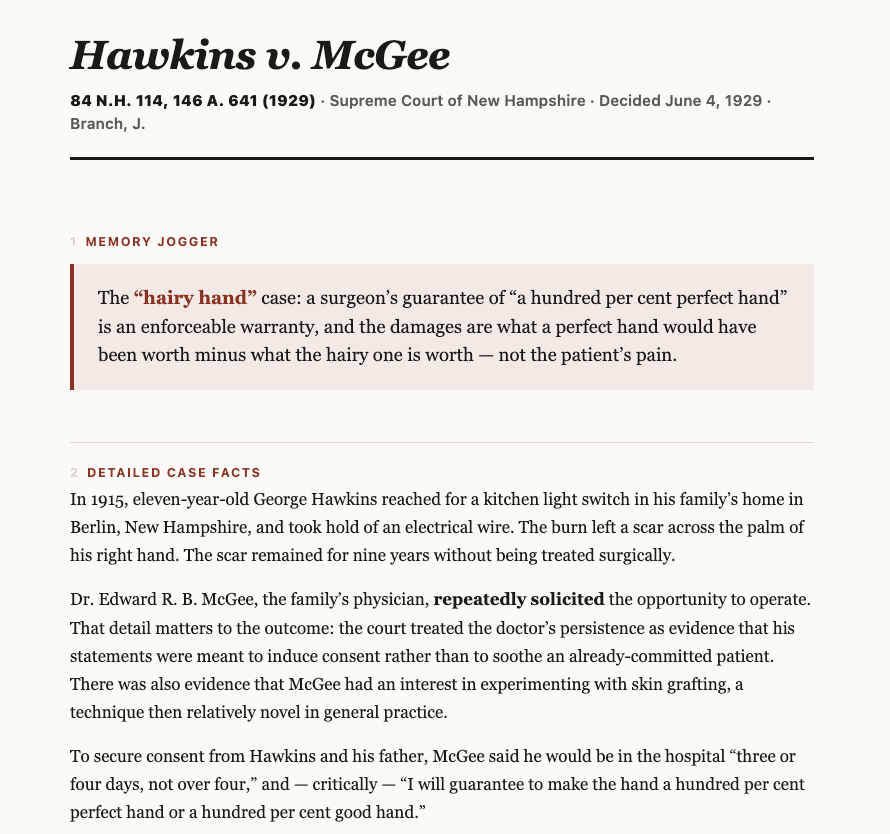
Case-briefer produces a nine-section case brief that summarizes cases in a structured way that, in my humble opinion, is extraordinarily useful: a one-line memory jogger ("Footnote 4 establishes justification for tiers of scrutiny"), facts, procedural history, votes, holding, opinion-by-opinion analysis, five hypotheticals, critique, and verified quotations. The hypotheticals follow a fixed recipe — two that come out the same way as the principal case, two that come out the opposite way, one genuine fence-sitter — which is the recipe for teaching a rule rather than a result. The verification rule is blunt: quotations and vote line-ups get checked against sources by web search, and anything unverifiable is marked or cut. Output lands as prose, a Beamer deck, or a LaTeX chapter for a casebook project.
Here's a screen capture of part of a brief of Hawkins v. McGee. It might have helped Mr. Hart in the original Paper Chase movie.
The briefing skill also anticipates various permutations of the original facts.
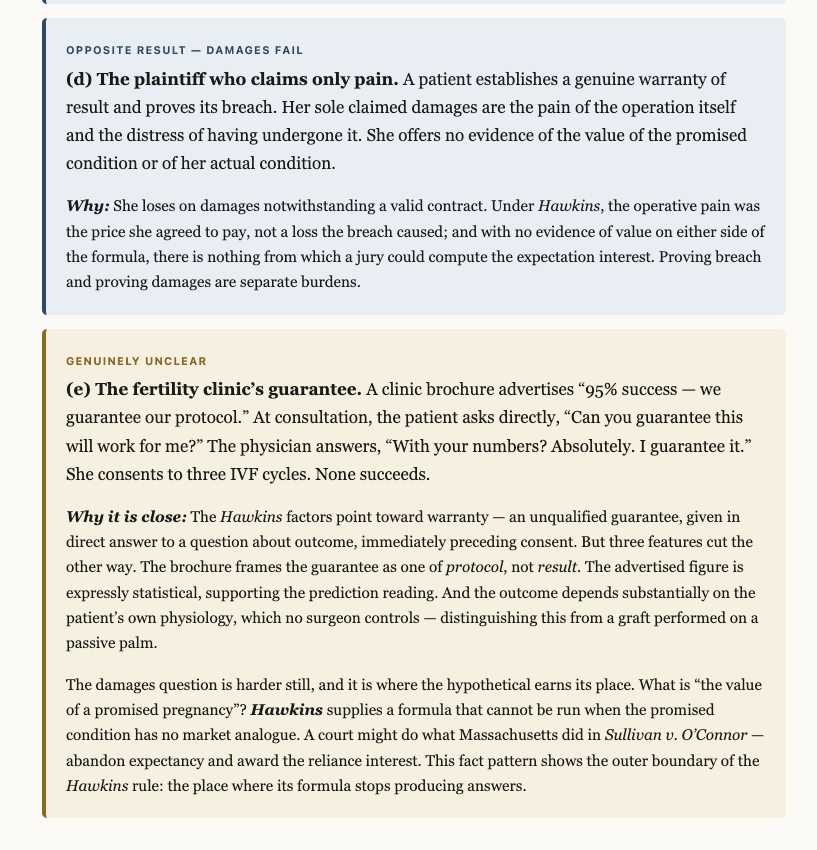
Here's the full brief both as a Markdown file and an HTML file.
Statute-briefer does for legislation what case-briefer does for opinions, using a framework I call MAPS + RULES: first a map of the whole act (citation status, purpose, structure, scope, definitions), then each operative provision rewritten as a rule-module — trigger conditions, legal effect, exceptions, procedure, consequences, enforcer, cross-references. Feed it a statute and a client scenario and it runs in scenario mode instead, block-quoting the exact provisions in play and labeling every element as met, unclear, or disputed on the facts given. Its cardinal rule is verbatim discipline: it never invents statutory language, and when a needed fact is missing it says "Fact needed," not something plausible.
Here's a screen capture of the infamous battle-of-the-forms UCC 2-207 as treated by the statute-briefer skill.
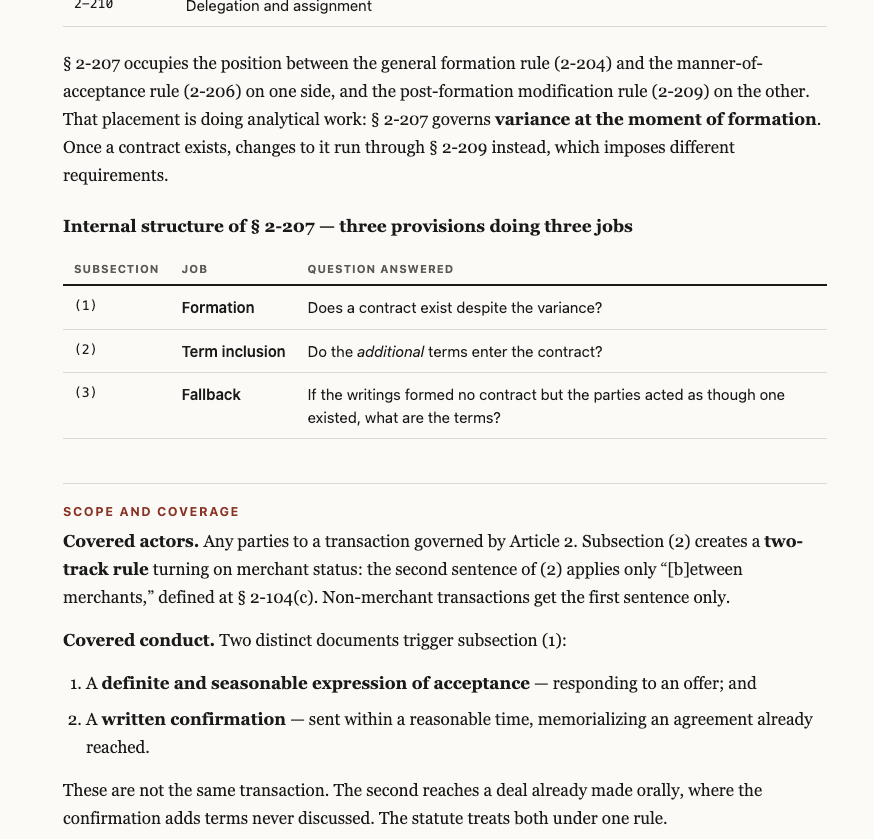
For those eager to relive horrifying moments of law school, the full Markdown and HTML versions of the briefs are here.
Apart from serving as a vehicle with which to torture 1L contracts students, is there any good reason for the ambiguities of that statute to go unamended for more than half a century?
Stress-testing
Ambiguity-stress-test reads a contract, statute, regulation, or judicial opinion and finds the seams where the people governed by it will later disagree about what it means. The detector is general; the resolver is modular — contract ambiguity gets resolved through the parties' bargain, statutory ambiguity through the canons, an opinion's through the doctrines of precedent, each via its own profile. The product is not a list of vague terms. It is disputes: for each seam, a concrete fact pattern, both sides' arguments, the likely outcome, and a proposed fix. The quality bar is that a competent tribunal could decide the scenario either way; anything the canons would dispatch in a paragraph gets dropped by what the skill calls a canon gauntlet.
Here I present a screenshot of output from the skill run on the famous "What is chicken" case that (I think) all 1L students still encounter.
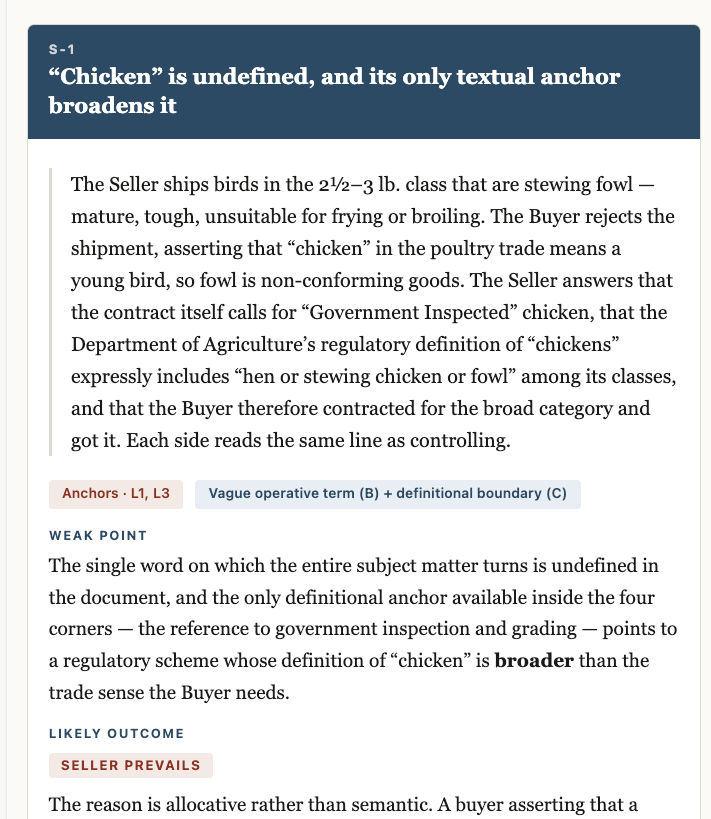
Again, for those who want to see what complete output looks like, the files are here.
Ambiguity-report complements the ambiguity-stress-test skill. It takes a completed audit and produces a multi-page website, a Word document, a slide deck, LaTeX source, or — where the host can't run code — a single self-contained HTML file you can email. It checks what your environment can actually produce before promising anything. Here, I take the output from the ambiguity-stress-test and use it to create a website devoted to the eternal issue of "what is chicken"?
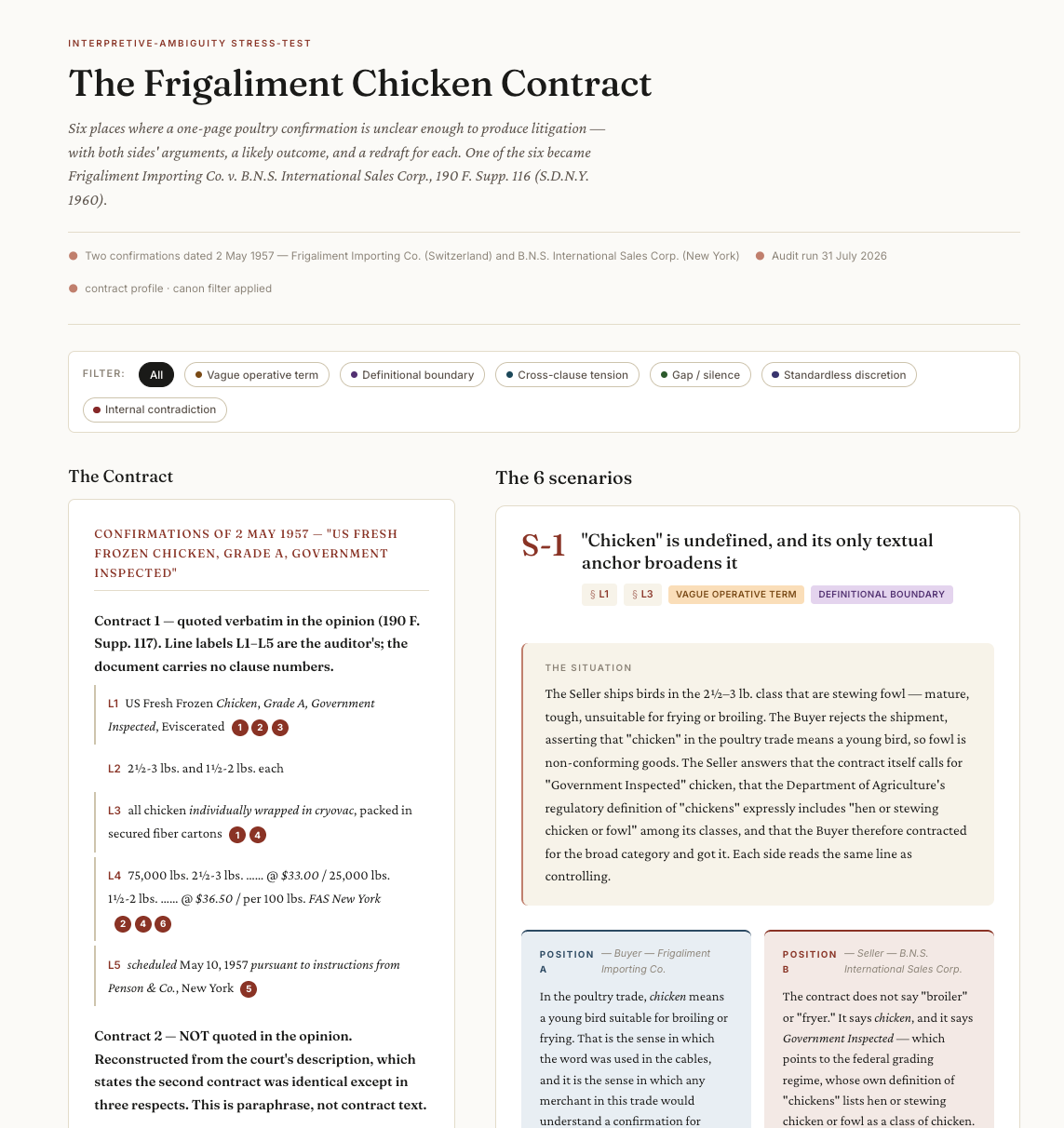
To see the entire website, which has now been pushed to the Netlify hosting site via a connector, click on what-is-chicken.netlify.app. Here are some screen captures.
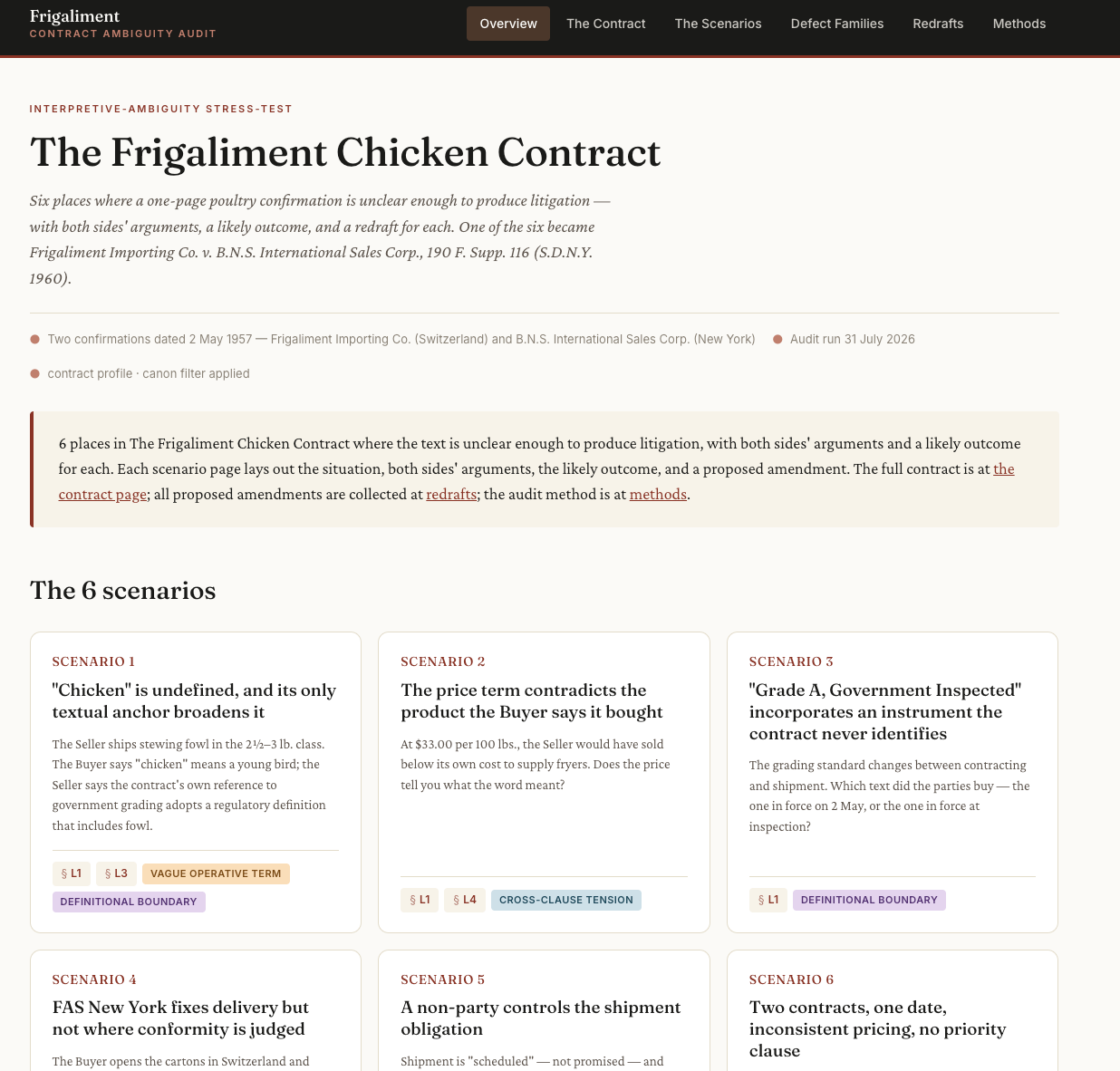
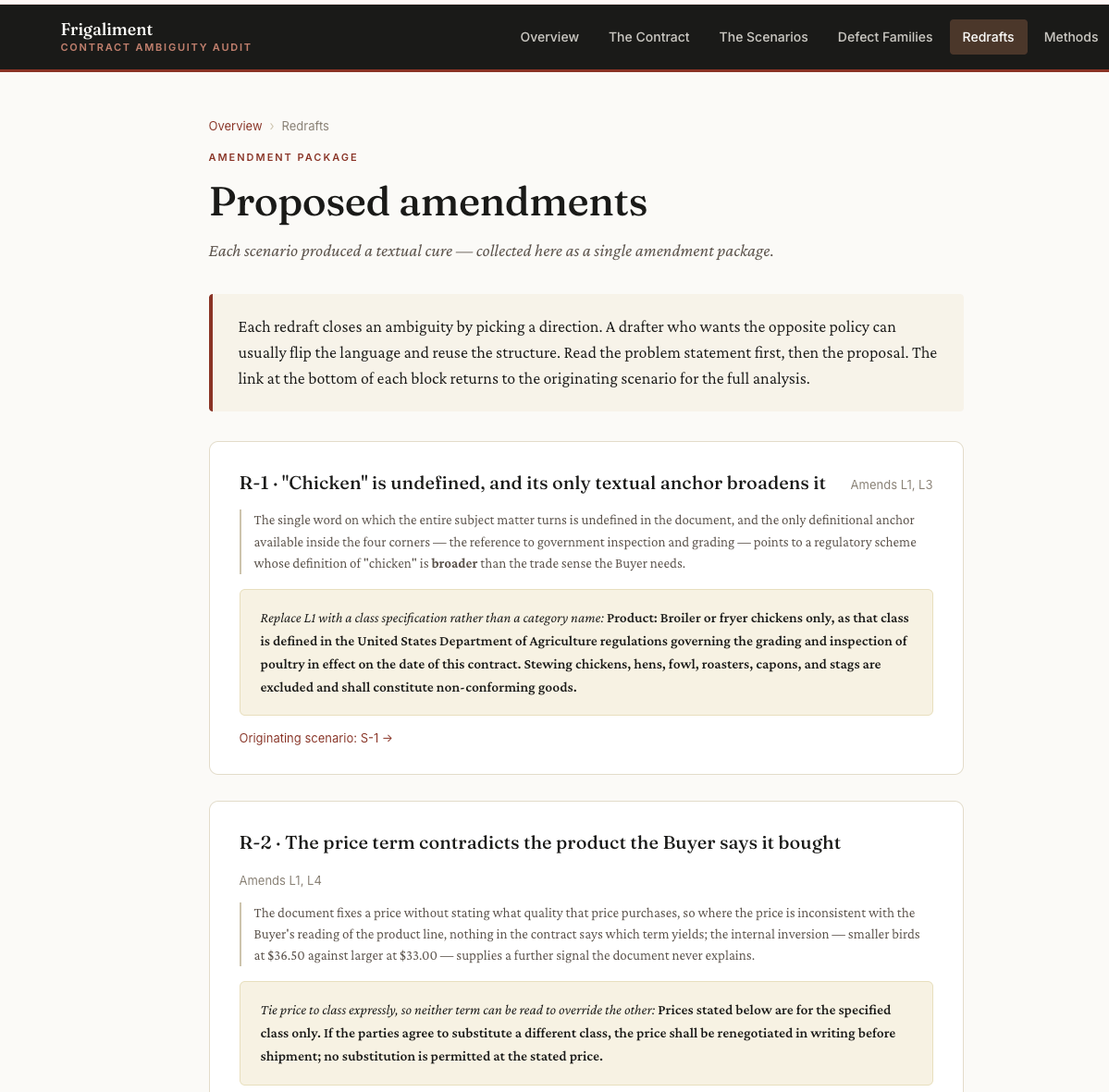
IMHO it's a great teaching and learning website and it took just a few minutes to construct using the skill and Claude's free connector to netlify.
Listening
Eardraft turns prose meant for the eye into prose meant for the ear — for text-to-speech, podcasts, CLE audio, or a brief you want to hear on the drive home. The general version handles six languages and three TTS markup dialects. The legal layer is the reason it belongs on Lawve: legal writing carries meaning in a print apparatus that has no audio equivalent. Read aloud by a synthetic voice, "Brown v. Bd. of Educ., 347 U.S. 483, 495 (1954)" is noise. Eardraft renders it "Brown versus Board of Education, decided in 1954," expands section symbols, deletes citation footnotes, folds substantive ones into the sentence, and marks quotation boundaries at both ends.
Here's an example taken from the recent TPS case of Mullin v. Al Otro Lado.
Original — written for the eye
Mullin v. Al Otro Lado, slip op. (2026)
We first consider respondents' non-constitutional claims and conclude that we are barred from reviewing them. A provision of the TPS statute, 8 U. S. C. §1254a(b)(5)(A), provides: "There is no judicial review of any determination of the [Secretary of Homeland Security] with respect to the designation, or termination or extension of a designation, of a foreign state under this subsection." This text is clear, and its plain meaning is very broad. We start with the key term "determination," which may mean several different things. It may be used as a synonym for "decision." See, e.g., 4 Oxford English Dictionary 548 (def. 2.b) (2d ed. 1989) (a "decision arrived at or promulgated"); Webster's Third New International Dictionary 616 (def. 4a) (1986) ("the act of deciding definitely and firmly"). The term may also be used to describe the chain of events leading up to a decision. See, e.g., American Heritage Dictionary 359 (def. 1.a) (1981) (the "act of making or arriving at a decision" (emphasis added)); Random House Dictionary of the English Language 541 (def. 1) (2d ed. 1987) (the "act of coming to a decision or of fixing or settling a purpose" (emphasis added)). Not only is it common to use the term "determination" in this broad sense, but other terms in the judicial-review bar—particularly the phrase "with respect to"—support this broad understanding. That phrase "generally has a broadening effect, ensuring that the scope of a provision covers not only its subject but also matters relating to that subject." Patel v. Garland, 596 U. S. 328, 339 (2022) (internal quotation marks omitted).
EarDraft — written for the ear
Citations stripped, quotation boundaries marked, emphasis performed
We take the claims that do not rest on the Constitution first, and our conclusion is that we cannot review them at all.
The Temporary Protected Status statute contains a bar on judicial review. It sits at title 8, section 1254a — subsection (b), paragraph (5), subparagraph (A). Here is the provision in full, with one substitution of our own, marked in our text by brackets.
Quote. There is no judicial review of any determination of the Secretary of Homeland Security with respect to the designation, or termination or extension of a designation, of a foreign state under this subsection. End quote.
That text is clear, and its plain meaning is very broad.
Start with the key word. Determination. It can carry more than one sense.
It can work as a synonym for decision — the outcome itself. The Oxford English Dictionary gives one sense as, quote, decision arrived at or promulgated, end quote. Webster's Third New International Dictionary gives, quote, the act of deciding definitely and firmly, end quote.
But determination can also describe the whole chain of events leading up to a decision. The American Heritage Dictionary gives, quote, act of making or arriving at a decision, end quote. Random House gives, quote, act of coming to a decision or of fixing or settling a purpose, end quote. In both of those, the words carrying the weight are act of — and that emphasis is ours. On this reading a determination is not only the endpoint. It is the arriving.
Using determination in the broad sense is common. It is also not the only language in this review bar pointing that way. One phrase in particular does the same work: with respect to.
We described what that phrase does in Patel versus Garland, decided in 2022. We said it, quote, generally has a broadening effect, ensuring that the scope of a provision covers not only its subject but also matters relating to that subject, end quote.
One rule overrides everything in this skill: quoted authority is never rewritten. That is because a misquotation of a holding is a professional problem, not a stylistic one. Cut by ellipsis, frame it verbally, or paraphrase openly and say so. The skill avoids silent and non-obvious transformations while attempting as best as possible to preserve meaning.
Editing and Reviewing
Sustainable-opposing-counsel-review is a derivative skill. It stands on the shoulders of a giant of the skill-building world: Larissa Meredith-Flister. She built opposing-counsel-review, already on Lawve, which supplies a six-part attack structure that exuberantly (at least by UK standards) finds a way to win every time. What I did was to recognize that some of the attacks pursued by opposing-counsel-review can be exaggerated or subject to easy rebuttal. So, I piggybacked on her work to create a skill that basically runs opposing-counsel-review against itself so that only the fittest attacks survive. The first pass is unrestrained — every weakness, every gotcha, every procedural quibble. The second pass turns the same adversarial instrument on the first pass and cuts every point that would collapse under one sentence of reply: attacks on facts your own side already conceded, objections borrowed from the wrong forum, gotchas with innocent explanations, assertions that refute themselves. What ships is only the attack that survives. Warning. The result is often a pretty humbling attack on whatever argument you thought was ever so clever. It is extremely useful in anticipating and then working to deflect strong opposing arguments. Use it on your own work as well as those of adversaries.
Here you can see sustainable-opposing-counsel-review working on Justice Sotomayor's recent dissent in the recent West Virginia v. B.P.J. case. The response is too long to conveniently fit inside this blog entry, but here is a summary. I attach the full critique below.
Against the Dissent — West Virginia v. B.P.J.
Justice Sotomayor's partial dissent asks for a remand while conceding, in terms, everything the remand would decide. It grants that males generally hold an inherent athletic advantage, that B. P. J. does not contest the existence of inherent physical differences, that sorting by sex identified at birth furthers the State's interests “in most situations,” that West Virginia “may well have satisfied its burden,” and that the dissent “takes no position one way or another on B. P. J.'s odds of success.” A dissent that declines to say the State would lose has not identified a constitutional violation. It has identified a preference for a longer route to the same destination.
Its best point deserves granting at the outset. Heightened scrutiny is not rational-basis review, and the majority does lean on Murgia and Skrmetti — both rational-basis decisions — for propositions about tolerable imprecision. That is a real methodological criticism. On this record it is also an academic one.
Four further lines of attack survive testing. Materiality is a question of law, and the Rule 56 framing borrows summary-judgment modesty for a merits quarrel about the content of intermediate scrutiny; a district court would face the identical question on remand. Footnote 9 is the fracture: asked whether the small, slow cisgender boy needs an exception, the dissent answers no, because he “still possesses the same athletic advantage that is inherent to his sex identified at birth” — the categorical reasoning it condemns thirty pages earlier. The proposed subclass is not administrable by a school, and footnote 6 concedes that administrative burden can justify refusing exceptions before deferring the question to findings never made. And not one of the dissent's authorities — Caban, Virginia, Trimble, Nguyen, Morales-Santana — remanded rather than decided.
Not contested: the Title IX holding, the sex classification triggering heightened scrutiny, and the dissent's account of the record and of B. P. J. herself. The argument is that the Clause supplies no remedy, not that the injury is imagined.
Law-review-editor is intended as a substitute for a human review of a law review article. It runs an article through six passes — structure, substantive critique, Bluebook citations, prose, fact-checking, and a synthesis memo — and returns its findings ranked critical, substantial, or minor, keyed to specific footnotes and paragraphs. It chunks a 50,000-word article on section boundaries so nothing gets skimmed, and it reads .docx files directly.
The pass that earns its keep is the pairing of citation review with fact-checking, because they catch different failures. Citation review checks form; a perfectly Bluebooked citation to a case that does not exist sails through it. Fact-checking checks existence. For drafts written with AI assistance — which is to say, an increasing share of the drafts any of us see — you need both, and the skill refuses to let a searchless session count as a fact-check. Unverified claims get marked unverified, not waved through.
Obviously, I can't reprint a full article and its critique here. But here is an excerpt of a vigorous critique of a 19,000-word article I wrote several years ago: Medicare for All: The Need for a Long Approach, 20 Hous. J. Health L. & Pol'y 1 (2020). The box below shows the "executive summary."
Executive summary
The Foreword does something forewords rarely attempt: it makes a sustained original argument rather than summarizing the issue. The fiscal analysis is careful, the risk-adjustment section is genuinely expert, and the central recommendation — lower the Medicare eligibility age gradually rather than transform the system at once — is a real proposal with an identifiable mechanism, not a gesture at moderation.
Three problems, in descending order of seriousness.
First, the argument's structure works against its thesis. The piece is titled The Need for a Long Approach. It runs 65 pages. The long approach gets its case made in the Conclusion, beginning at page 57, after thirty pages devoted to two alternatives the article rejects. Twenty-six pages pass before the first heading appears. The result is that a reader encounters the article's contribution last and its objections to other people's proposals first, which inverts the emphasis the title promises and makes the piece read as a critique of Medicare for All with a recommendation appended.
Second, the fiscal case is presented one-sidedly in a way that is unnecessary — the argument survives a fairer presentation. The $32 trillion figure is established with care; the counterfactual baseline (national health expenditure over the same period under current law) never appears, so a reader can finish the section believing Medicare for All costs $32 trillion more than doing nothing. The deadweight-loss discussion cites Feldstein's 32%–52% estimate without noting that it sits at the far end of a contested literature whose canonical review puts the central elasticity around 0.25. The Woolhandler/Himmelstein passage discounts a study partly by reference to its authors' advocacy history, immediately concedes that predisposition doesn't invalidate research, and then proceeds — while the article's own counterweights are drawn from Cato, Heritage, Pacific Research, Galen, AEI, and the Tax Foundation. None of these moves is necessary. The tax-shifting argument, the transition-shock argument, and the political-durability argument are strong on their own, and they are what a skeptical reader will remember if the one-sided passages don't cost the article their attention first.
Third, the article's best original contribution is split across two sections thirty pages apart and never assembled. At pages 31–33 the Foreword argues that the ACA worsened insurer competition, and that a public option is unlikely to fix a concentration problem it may deepen. At pages 55–56 it demonstrates — this is original, technical, and correct — that risk adjustment imposes a distinctive entry barrier, because a new entrant must estimate not only its own pool's risk but its competitors'. Those are the same argument. Joined, they yield a claim with real force: the ACA's stabilization machinery is itself a concentration mechanism, so adding a public option to a market whose entry barriers are regulatory rather than natural will substitute one dominant player for another rather than restore competition. That sentence is the article's thesis-within-the-thesis, it is defensible on the article's own evidence, and it does not appear anywhere in the piece.
On the record: the article's single best call was the state public options, and it was right for the right reason. See Part V.
The full 18-page (brutal) critique of the article converted to PDF can be found in the file linked below. I would have found the AI's work extraordinarily useful in revising the article and that following many of its recommendations would (a) not have been all that difficult and (b) improved the piece significantly. I was also impressed that the skill was smart enough to understand that a conventional editorial memo would be useless on an already-published article because nothing was correctable anymore. Instead the skill adapted to discuss "what a hostile reviewer would have said in 2020, and what a sympathetic one should have said." It further scored the predictions I made in the article: "The article makes a great many falsifiable claims about what would happen. Six years is enough to check. Part V does that, and it is where most of the value of this memo sits." As it turns out, I did pretty well on that front
The skill that ships the skills
Lawve-prep is the meta-skill, and it exists because I packaged the first seven by hand and noticed I was running the same pipeline every time: check that the skill belongs in a legal catalogue, establish whose work it is, apply the standard fixes, validate, zip, generate the form entries. So the eighth skill is that pipeline.
The skill exists because writing a skill and publishing one are different jobs. A skill I write for myself only has to satisfy me. A skill in a public catalogue has to satisfy a stranger who downloads it — someone with a different setup, no idea what I had installed, and no way to ask me. Lawve enforces that with rules, and a skill built for private use breaks them almost every time. For example, most of my skills live inside a plugin, so the folder Lawve wants isn't the folder I have and the upload is simply refused. Descriptions run past the length the form accepts. Directories have the wrong names. A research skill that calls Descrybe or the new Dingduff connector (highly recommended) by name works beautifully on my setup and does nothing whatever for a reader who hasn't connected them — no error, no explanation, just silence. A skill with no license leaves a reader unsure what they're permitted to do with it.
So the tool fixes both kinds. It reshapes the folder, trims the description, rewrites the tool calls so the skill asks for what it needs instead of failing mutely, and adds the license and attribution. Then it checks its work, zips it, and tells me what to type in each box on the submission form.
What this means for legal education
The publication asymmetry in our field has been absurd for a while, and it is worth stating plainly. If I want to share an argument about pedagogy, I have a law review, a peer network, and a citation system. If I want to share a method — the actual working instrument that briefs the case, attacks the argument, edits the article — I have had a blog post and a prayer that readers reassemble the pieces correctly. Lawve collapses that gap. The instrument itself ships, with an author's name on it, a license attached, and a review behind it.
Three consequences for people who teach law. First, teaching materials become, like software on GitHub, forkable. A colleague who wants case-briefer's structure but different critique perspectives does not necessarily email me; she installs it, reads the folder, and adapts it — the licenses are chosen to permit exactly that. Second, the craft of making these tools is itself teachable, and the gate in lawve-prep is a syllabus in miniature: what counts as legal work, what provenance requires, what honest disclosure of a tool's limits looks like. I can very well imagine a seminar where a final project is not a paper but a published skill or portfolio of them, security review and all. Third — and this is the one I would act on — the catalogue is young enough that individual professors can still shape its norms. The good news is that at least for me, the turnaround makes this practical rather than aspirational. A method you refined this semester can be public before your grades are due. If you have a prompt that works — really works, tested-on-students works — package it and submit it. The queue is short right now. Get out in front.
Notes
- Of course this post went through two of my own skills before publication — the legaled-voice pass for architecture and a Belcher-proof scrub for the flaws AI prose smuggles in while imitating a human voice. I then rewrote chunks of it by hand because some AI prose remains abominable or misdirected.
- Just to be super clear, sustainable-opposing-counsel-review is a derivative work. Larissa Meredith-Flister's opposing-counsel-review supplies the adversarial method and the six-part structure; the credit is in the frontmatter, the body, and the NOTICE file, which is where lawve-prep insists credit go.
- Packaging law-review-editor for publication exposed a bug I had shipped and never hit: the documented command for chunking a .docx crashed on every .docx, because the script read files as plain text. It works now, via the standard library. The lesson generalizes — packaging for strangers is the best code review your own tools will ever get.
- I am not sure I would vouch for the catalogue's long-term curation; it is young, and young catalogues drift. What I can vouch for is the present: real review, real categories, fast listing, and a licensing dropdown that takes attribution seriously. That is more infrastructure than legal craft knowledge has ever had.
These skills are getting traction. As of the morning of August 5, 2026, the skills have been up for about six days and have gotten 313 views and 84 downloads. So far law review editor is the most popular but I expect case-briefer to pick up as the word of mouth vector among students activates.