
AI Can Provide the Feedback Law Professors Never Get
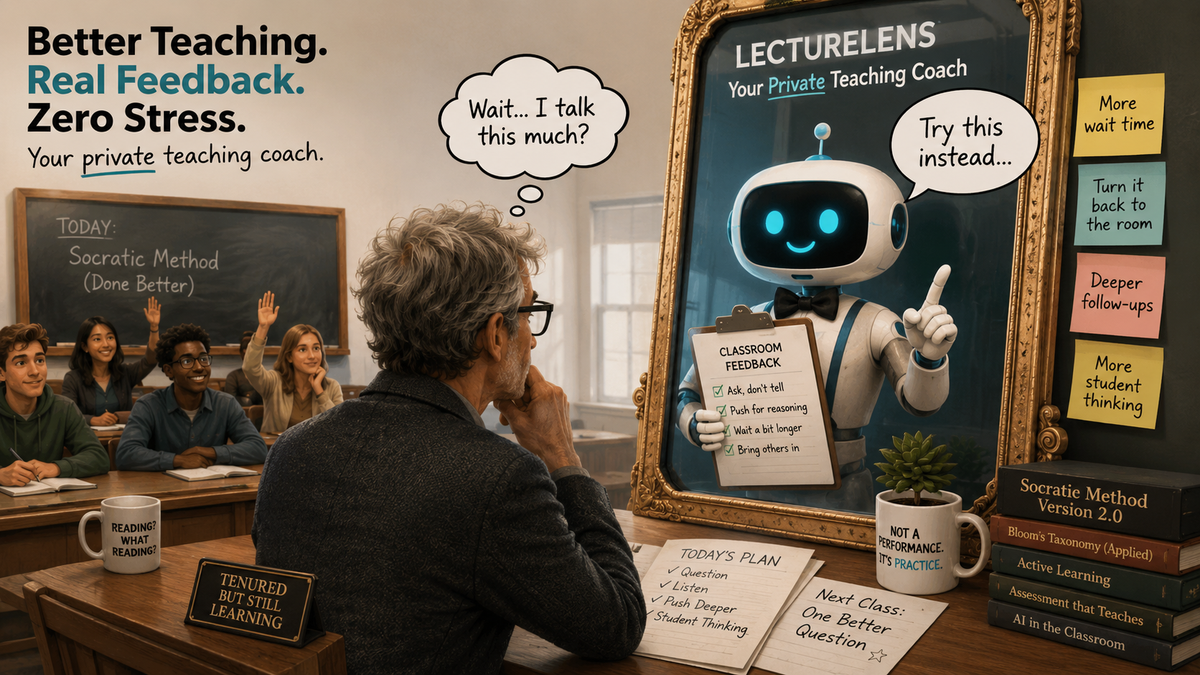
A guest blog post from Korin Munsterman, Professor of Practice and Director of the Legal Education Technology program at the University of North Texas College of Law
Sadly, law schools give little to no teaching training before a law professor enters a classroom. There might be a review of policies, or an occasional faculty workshop on general principles, but teaching how to teach typically doesn’t exist. Doctoral programs train people to teach. Law school trains people to think like lawyers, and then some of us go teach without anyone checking whether there’s any overlap of those skills. Adjuncts and practitioners-turned-professors are in the same position, minus even the three years of watching a Socratic method modeled at them from the other side of the podium. Most schools hand new faculty a syllabus template and a Canvas login and call that onboarding. Most teach the way they were taught, and for a lot of us that means channeling a professor from a decade or two ago, cold calls and all, with no conception of what a formative assessment is.
What can fix this is not another workshop. It's private, specific, individualized feedback delivered often enough to change behavior. A 2024 randomized trial gave 700 K-12 tutors real-time coaching suggestions during live sessions with 1,000 students. Students mastered lesson content at a meaningfully higher rate when their tutors had access to the coaching tool. The interesting part wasn't the average effect. It was where the effect concentrated: the lowest-rated tutors improved nine percentage points, the highest-rated tutors improved two. The tool didn't make good tutors better. It brought weaker tutors up toward what the good ones were already doing, mostly by getting them to ask students to explain their reasoning instead of just encouraging them generically and moving on. But even for strong teachers, there’s always room for improvement.
I built the law school version. I call it LectureLens.
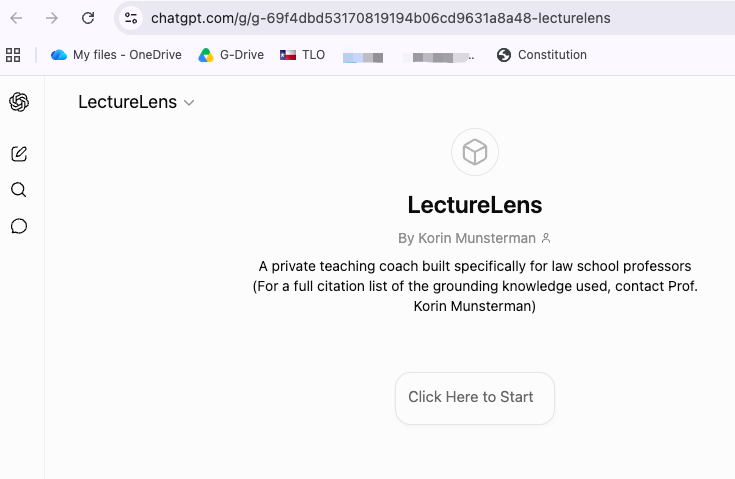
It's a CustomGPT, not a product, and I say that explicitly because I don't want anyone thinking I'm selling something. Indeed, it’s free, along with the book on Generative AI in Law School I just published with CALI: Click the button, “Click Here to Start,” and it will give you an idea of how it can help you.
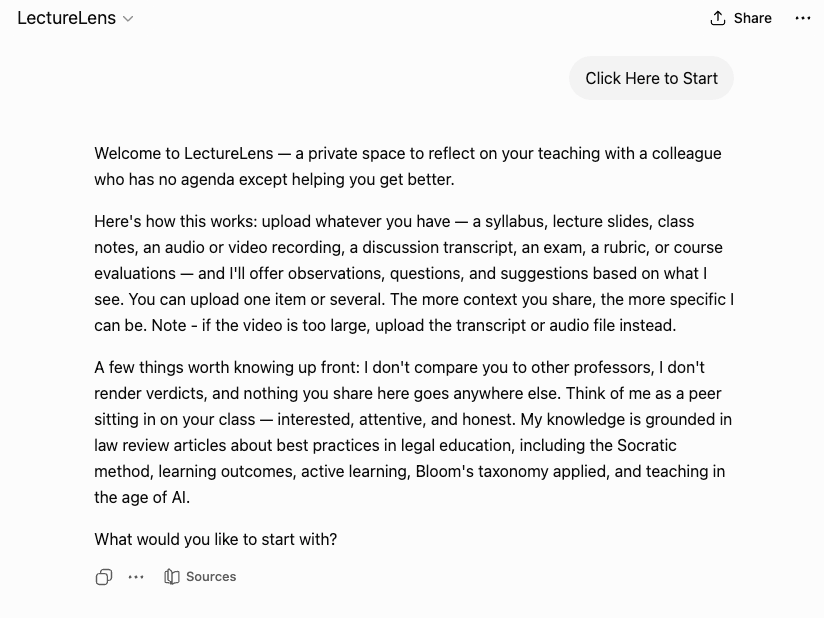
Here are the initial instructions.
Paste in a transcript of your class, and it reads for the moments a Socratic teacher would want back: the questions you answered yourself instead of turning back to the room, the correct-enough answer you accepted and moved past instead of pushing one level deeper. It doesn't tell you "consider redirecting this question." It gives you the actual sentence you could have said instead, pulled from your own transcript, in your own classroom, about your own students.
Here's what happened when I put in my own materials.
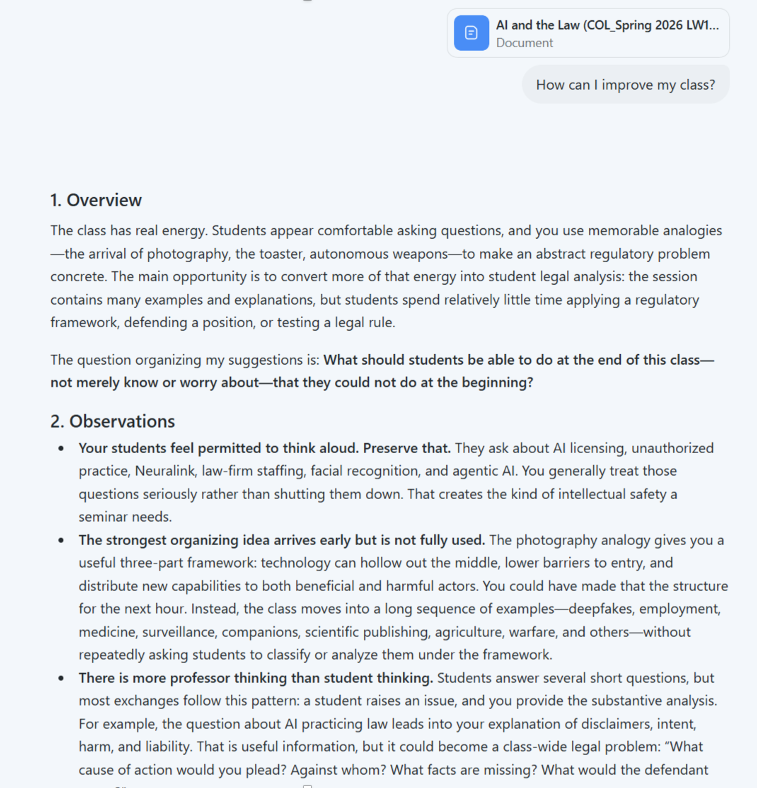
General advice is easy to ignore. A specific alternative to something you just did is harder to wave off. I have to admit, that last one hurt a bit.
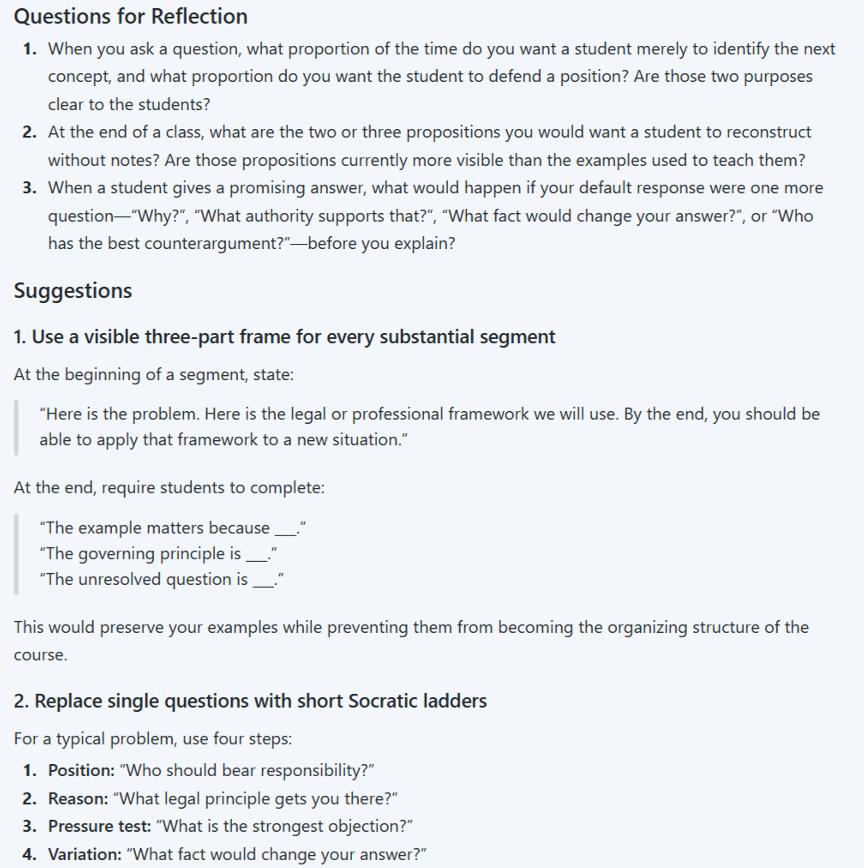
LectureLens then offered Questions for Reflection and Suggestions; here’s a snippet:
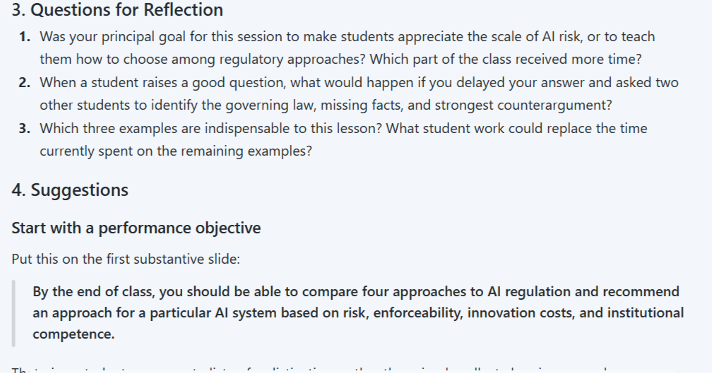
I've run full sessions with it that started as a syllabus review, moved through a class transcript, and ended with a restructured teaching plan, a sample exam question, a couple of scripted cold-call sequences, and a grading rubric, all from one conversation. You upload two files, answer a few follow-up questions, and let it work.
Here’s a snippet of a Syllabus review.
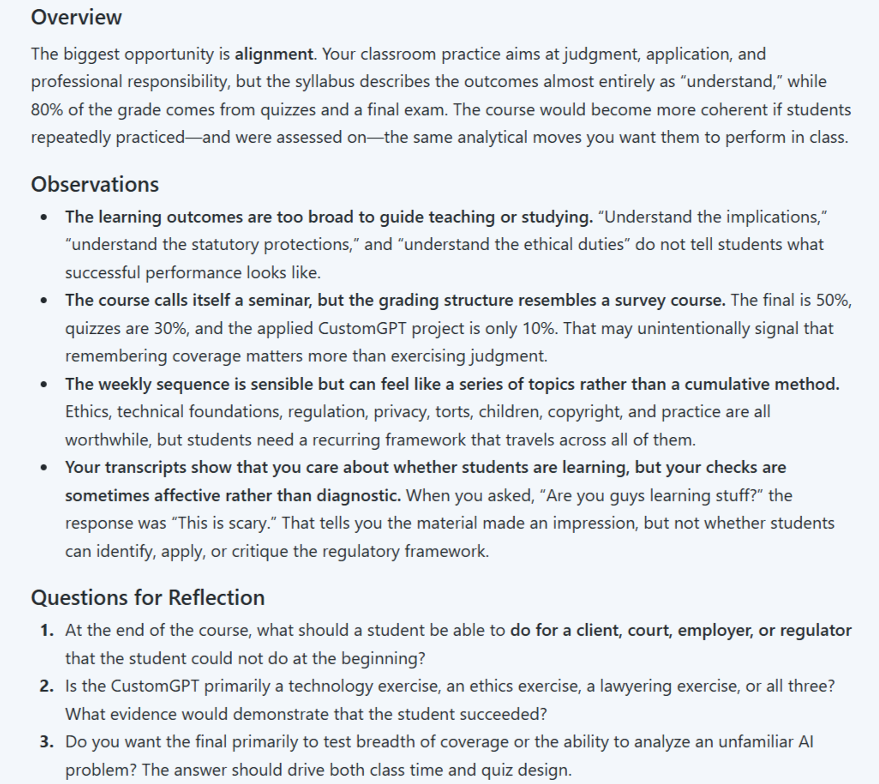
You're not limited to one transcript, either. Upload four or five class transcripts from across a semester. It'll tell you that you redirect questions well in Torts but answer your own questions in Contracts, or that your Socratic engagement drops every time you hit a topic you clearly find boring. A single class session shows you a moment, but a handful of them shows you a habit.
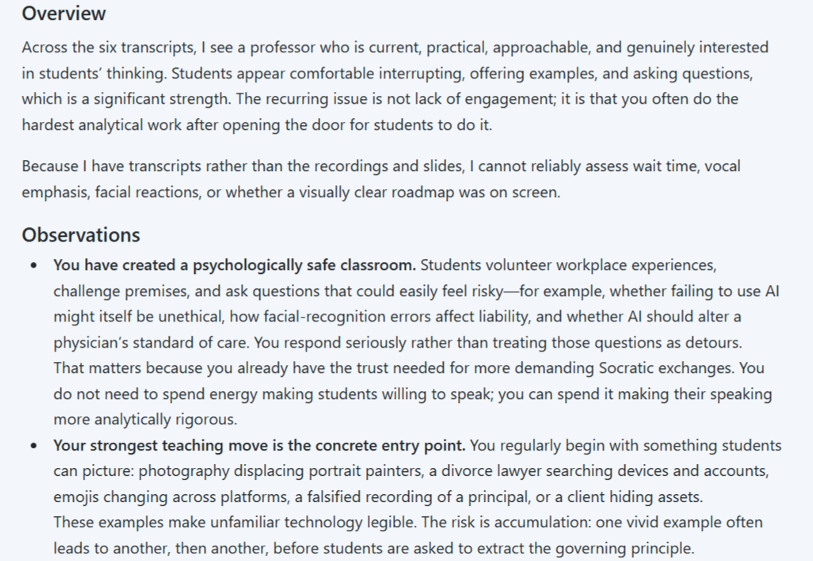
Here’s a response to 6 transcripts – 3 from AI and the Law and 3 from Law Practice Technology. It said some nice things:
But it also had some constructive critiques:
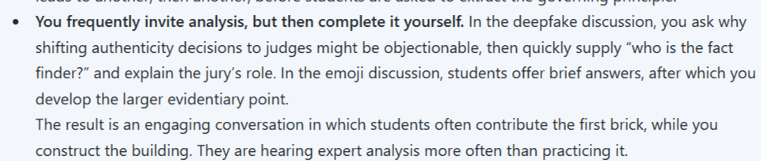
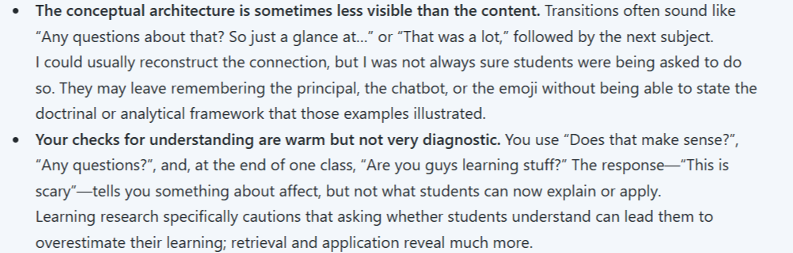
And it offers Questions for Reflection and Suggestions.
Compare that to the feedback most of us actually get. The standard model is a colleague sitting in the back of your classroom for twenty minutes, on a date you knew about weeks in advance, followed by a debrief meeting where the notes tend to land somewhere around "good energy, strong command of the material." You knew the visit was coming. So did your students, because you told them, and they showed up prepared and unusually willing to talk. What gets observed on peer review day isn't your teaching. It's a performance of your teaching, staged for an audience of one, on the best-prepared day of the semester. I've sat through this process from both sides of the classroom, and I've never once left a debrief meeting with something I could actually change on Monday. Whether twenty announced minutes tells anyone much about how you teach on the Tuesday in February when nobody did the reading is a question worth asking, and I want to know about that. And I want suggestions on how best to deal with unprepared students.
Speaking of which, it will always ask if you want more.

The part that really matters is that nobody else sees the output. No dean, no peer observer, no file in your tenure binder – and zero stress. The tool tells you what a knowledgeable colleague would tell you if that colleague had no agenda and no committee to report to, and you decide what to use and what to ignore. It’s the difference between getting coached and getting evaluated, and only one of those actually changes how you teach. Adjuncts would certainly benefit (I’d go so far as to require them to use the tool), and I'd guess plenty of tenured faculty would benefit, too. Most of us have habits we don’t know about, and an outside eye that keeps its mouth shut except to you tends to get a more honest hearing than one that reports up.
Finally, LectureLens does not easily get bored or have conflicting obligations. You can attempt to implement its feedback from a set of lectures and then run a new session that includes (a) the earlier feedback and (b) your new transcript, teaching materials itself. You can ask LectureLens not only for a commentary on the new materials but also on how well you implemented the suggestions. Maybe, for example, you went overboard. All but the most selfless human colleagues will not be similarly willing to sit through your iterative development as a professor.
LectureLens lives in Appendix G of GenAI in Legal Education (the appendices are on the CALI website), transcript and all, if you want to see a full session rather than take my word for it. The tool itself is here: LectureLens. It requires a ChatGPT Plus account, which is its own equity problem I've written about elsewhere and won't rehash here. If you want to get the most out of it, get a paid subscription. Don't have ChatGPT? The publisher of this blog, Professor Seth J. Chandler, has used ChatGPT to convert my CustomGPT into a .skill, which can be used not only by ChatGPT itself but also by Claude and Grok (at least with paid subscriptions). Here's the .zip file.
None of this replaces what law schools should be funding directly, of course. Things like real faculty development, real classroom observation, real mentoring from people who've done it well. But most schools aren't funding that, and won't start because a blog post told them to (although they should). In the meantime, a private tool that gets a new adjunct to ask one better follow-up question per class period is not nothing. Why not try it? I guarantee you’ll learn something.