What If the Last Bastion of Human Legal Superiority Is a Joke?
One of the strangest things about the AI-and-law debate is that we keep looking for human superiority in the most solemn places. Judgment. Wisdom. Empathy. Moral responsibility. Constitutional imagination. Professional identity. Deep knowledge of doctrine. The lawyerly “feel” for a case.
All of those may matter. Some may even last.
But after thinking about a recent blog post I wrote about University of Texas Law Dean Robert Chesney’s memo on AI and legal education, I found myself wondering whether we have been overlooking one of the most important human advantages in legal writing and legal thought: humor.
Humor is not decoration. In legal writing, teaching, advocacy, and institutional argument, humor is often a form of compression. It lets the writer say several things at once: that an idea is wrong, that it is wrong in a particular way, that the writer sees the social setting in which the wrongness occurs, and that the reader is invited to share a judgment without having it pounded into them.
A joke can do what a paragraph of exposition cannot.
The immediate trigger for this thought was my own post about Chesney’s memo. The post was mostly serious and admiring. I argued that the memo was the clearest law-school document I had seen on AI and legal education. I praised its structure: AI in the classroom, AI in research, AI in operations. I praised its separation of three problems too many schools blur together: the skills challenge, the assessment challenge, and the educational-rigor challenge. I praised the willingness to spend actual money on enterprise-grade AI access rather than leaving students to buy competence one subscription at a time.
But scattered through that serious analysis were jokes. Not jokes in the stand-up sense. More like legal-academic pressure valves: dry asides, institutional jabs, self-accusations, and bits of classical mischief.
For example, I wrote that many schools have treated AI as though the problem could be solved with an “honor-code paragraph.” That is not merely a joke. It is an argument. It says that the institutional response is too small for the scale of the disruption. It conjures an image of a faculty or administration reducing a civilizational technology shift to a paragraph in a syllabus. One could write three careful sentences explaining that. “Honor-code paragraph” does the work faster.
I wrote that teaching one AI platform as such is like teaching students “which buttons to push in one version of Westlaw — fine until the interface changes.” Again, the joke is doing analytic work. It distinguishes platform training from transferable professional competence. It mocks a tendency to confuse software familiarity with judgment. It also makes the point more memorably than a sober distinction between “tool-specific instruction” and “durable AI literacy.”
The funniest line, at least to me, involved Plato. Chesney’s memo referred to the a worry from Phaedrus: that writing would weaken memory and produce the appearance of wisdom rather than wisdom itself. Suspecting that the remark might bypass not just the author of my blog but also a large fraction of its less erudite readers, I added a little explanatory box for readers less steeped in the classics. In that box, after explaining that King Thamus rejected writing for fear that people would rely on external marks instead of internal memory, I wrote that Thamus “will probably now receive an honorary degree from Berkeley Law.”
That line is doing several things. It teases the dean about his learning. It explains the Phaedrus. It jokes about Berkeley’s restrictive AI posture. It suggests that anxiety about new cognitive technologies is ancient. It implies that today’s anti-AI maximalists are, in effect, reviving a very old complaint about writing itself. It does all this without saying, “Berkeley is acting like an ancient Egyptian king suspicious of literacy,” which would be accurate but much less funny.
Then came the parenthetical: “At least this is what AI reports.”
That may be the most important joke in the piece. The paragraph explains a classical warning against cognitive outsourcing, and then immediately raises the possibility that the explanation itself was cognitively outsourced. The joke is recursive. It is also fair. It puts the author under the same suspicion as everyone else. It's self-deprecating because it reveals that I had no clue who this Phaedrus person was or King Thamus, for that matter. It prevents the essay from becoming a simple denunciation of other people’s foolishness.
That self-implication matters. In another passage, I described how I had encouraged AI use in my own constitutional law seminar. The result was excellent student work, even an anthology. My law school received a national innovation award based partly on that effort. Then I asked whether I was entirely confident that this AI encouragement had not led to “brain rot.” My answer: “I am not.”
That line is funny IMHO because it refuses a clean victory lap. It admits that a pedagogical experiment can succeed and still produce unease. That is often where the truth is in legal education right now. We are doing things that work. We are winning awards for them. We are also not entirely sure what we are damaging.
Could AI have written those jokes?
Some of them, perhaps. “Panic and salesmanship,” a phrase I used to describe the legal academy’s bad modes of AI discussion, is exactly the kind of phrase a good language model can produce. It is balanced, abstract, antithetical, and op-ed friendly. The model has seen a million versions of “between fear and hype,” “between panic and boosterism,” “between alarmism and evangelism.” “Panic and salesmanship” is better than the average version, but it is within the current AI zone of competence.
Other jokes are farther away.
I do not think a model, left to its own devices, would likely have produced the Thamus honorary-degree line. Not because it cannot know Plato. It can. Not because it cannot know Berkeley. It can. The hard part is the mapping. The joke requires the writer to see that an ancient anxiety about writing, a modern dispute over AI, an elite law school’s institutional posture, and the cultural practice of honorary degrees can be fused into one sentence. That fusion is not merely semantic. It is social. It knows where the pressure point is.
The same is true of the Socratic-method joke. Chesney suggests that the supervised classroom may become more important in an AI age because it is one of the few remaining places where the professor can observe students doing analytic work unaided. He also suggests renewed attention to Socratic teaching. I responded that I was not sure the Socratic method was the rescue mechanism. It might have worked wonderfully when Socrates had only Xenophon, Antisthenes, Aristippus, Phaedo, Euclid of Megara, Alcibiades, Crito, and Aeschines in class. But I teach classes with seventy-plus students, where many students are passive spectators most of the time.
That joke depends on the collision between myth and scheduling. Socrates looks like a wonderful model if one imagines a tiny band of brilliant Athenians. He looks less administratively scalable when dropped into a modern law-school classroom with seventy students, laptops, attendance issues, and an exam curve. The list of Greek names is not necessary to the argument. Its comic function is to make the ancient model concrete enough to be ridiculous.
Could AI write, “The Socratic method may not scale well to a seventy-person law-school classroom”? Certainly. Could it write the Greek-name line in the right place, in the right rhythm, with the right degree of exasperated affection? Maybe after prompting. Probably not on its own.
This distinction matters because humor is a major rhetorical tool of lawyers.
Lawyers often operate in settings where direct accusation is costly. You cannot always say, “The other side’s position is absurd,” though occasionally you can and should. More often, you must show absurdity while preserving professional decorum. A well-placed joke can accomplish this. It can reveal the weakness of an argument without appearing merely angry. It can make a judge or reader feel the instability of a position before the formal refutation arrives.
A good joke can also organize doctrine. Consider the dry hypotheticals that populate law school classrooms. The hairy hand. The fox on the beach. The exploding package. The miraculous cow. The officious intermeddler. Legal education has always used comic compression (drawn from reality) to make principles memorable. Much of first-year law teaching consists of persuading students that apparently ridiculous fact patterns reveal something serious.
Humor is also central to oral advocacy and judging, though dangerous in both. A judicial quip can clarify. (See Rucho v. Common Cause, 588 U.S. 684, 728 (2019) (Kagan, J., dissenting) ("These are not your grandfather's — let alone the Framers' — gerrymanders") It can also humiliate. A good advocate may use mild humor to concede a weak point without surrendering the case, to defuse an impossible question, or to make an opponent’s theory sound overbuilt. But the humor has to be calibrated. Too much and the advocate seems unserious. Too sharp and the advocate seems disrespectful. Too cute and the judge recoils.
That calibration is exactly where AI remains weak.
Current AI can understand jokes and explain them. Is this the time to reveal that I let AI prove that by writing over 80% of this post, a far higher fraction than is normal for me? AI can write jokes. It can write puns. It can imitate sarcasm. It can generate “funny” hypotheticals. It can even produce elegant little antitheses. But much of what it produces sounds like someone who knows what a joke is supposed to look like but does not know why this joke should be told here, to this reader, at this moment, with this much edge and no more.
The problem is not merely that AI lacks consciousness or lived experience, though that may be part of it. The practical problem is that humor is social judgment under constraint. It requires knowing the target, the audience, the relationship between the writer and the target, the genre, the stakes, and the permissible level of cruelty. It requires not just a degree of creativity outside the range of current AI but also the wisdom to know whether the joke should be a dagger, a pinprick, a wink, or a sigh.
Legal humor adds another layer. It often requires doctrinal or institutional fluency. “Honor-code paragraph” is funny only if one understands law-school governance and the tendency to proceduralize moral panic. “Buttons to push in one version of Westlaw” is funny only if one knows how legal research training can decay into interface training. “Thamus gets an honorary degree from Berkeley Law” is funny only if one understands the ancient complaint about writing, the current complaint about AI, and the internal politics of elite legal education.
AI can be given all those facts. But humor is not just having the facts. It is selecting the right collision among them.
That said, I would not overclaim. AI is improving. It can already be a useful comic assistant. It can generate candidate analogies. It can produce lists of possible satirical formulations. It can help find the sharper noun. It can sometimes surprise the human writer with a phrase good enough to keep. “Panic and salesmanship” may be such a case. The future of humor in legal writing is therefore not that AI will contribute nothing. It will.
But I suspect the best legal humor will remain human-led for longer than many other aspects of legal writing.
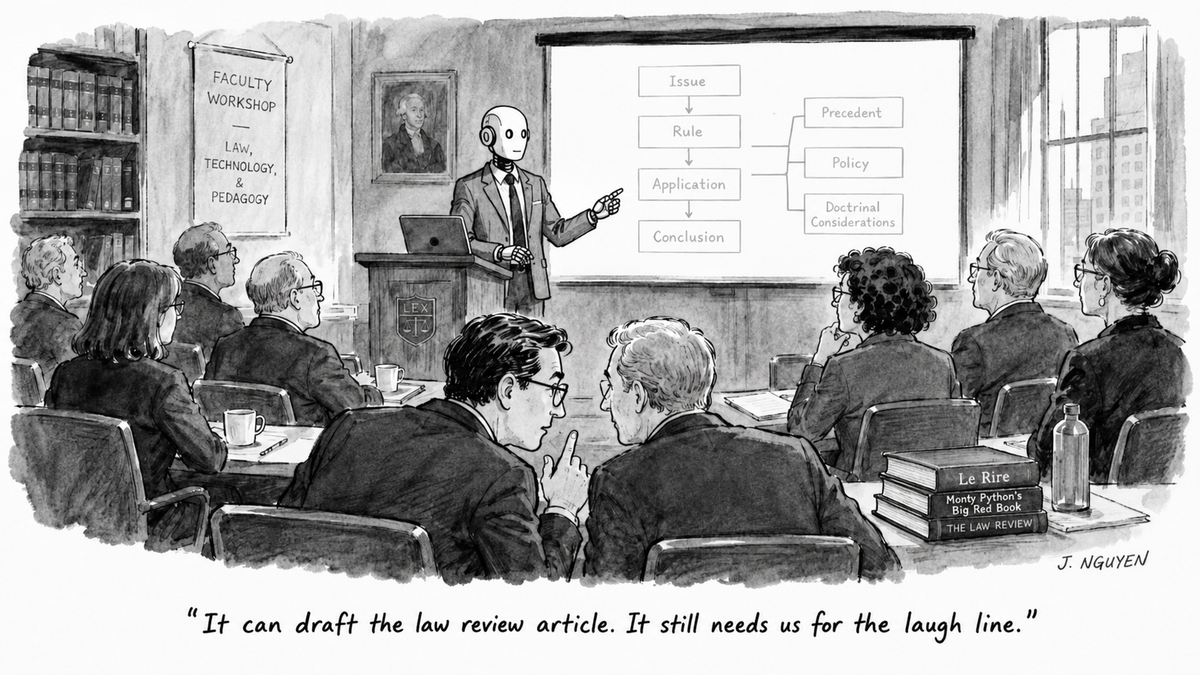
AI can summarize a case. AI can draft a competent memo. AI can compare clauses. AI can identify a doctrinal tension. AI can produce a first draft of a policy argument. It is beginning to be able to draft a law review article. Those are enormous achievements. In many settings, AI is already good enough to change the economics of legal work. But a joke that lands inside serious legal analysis requires more than competence. It requires taste. It requires knowing that this joke is fair, that one is too cheap, this one distracts, that one reveals, this one sounds like Twitter, that one sounds like a faculty lounge, this one will make the reader trust you more, and that one will make the reader wonder whether you have lost control of the piece.
The best human humor also carries responsibility. When I poke Berkeley, I know I am (partly) joking about a real institution and real colleagues. When I joke about brain rot, I know I am joking about my own teaching choices and my own uncertainty. When I joke about Socrates, I know I am joking about a method that has genuinely helped train lawyers for generations, even if it does not scale as cleanly as its admirers sometimes imagine. Those jokes work because they do not float above the subject. They are entangled with it.
So perhaps the future looks like this. AI will take over more and more of the competent middle of legal writing. It will draft, summarize, organize, compare, and translate. It will become increasingly difficult to identify the human contribution in ordinary professional prose. The human lawyer’s comparative advantage may move toward the parts of writing that require responsibility for tone, risk, and social meaning: the unexpected analogy, the devastating understatement, the concession that builds credibility, the joke that says what cannot quite be said straight.
It would be funny indeed if the last bastion of human legal superiority was a joke.
And no, although AI actually wrote much of this piece, it did not write that last sentence.