The Serious AI Memo Law Schools Needed
On June 16, 2026, Robert ("Bobby") Chesney, the dean of the University of Texas School of Law, sent his faculty an eight-page memo titled "AI and Legal Education." It is the most thorough, serious, and clear-eyed document a law school has produced on the subject; the rest of the legal academy should read it.
Texas Law carries weight. It is a major public law school with national reach and the institutional gravity to make other deans answer what it says. So when Chesney treats AI as a central problem for the whole school rather than a discipline question parked with a committee, that framing travels.
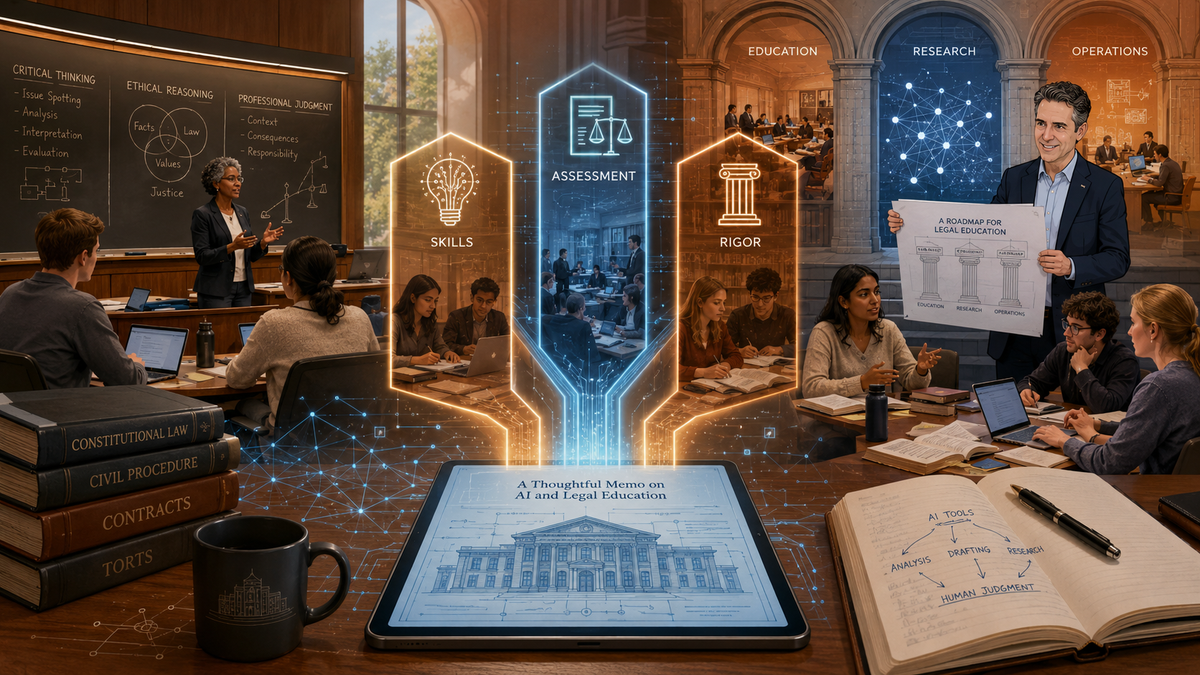
The framing is the first thing worth praising. Footnote one tells you the education memo is one pillar of a three-pillar strategy. The other two are research (how UT contributes to the law of AI) and operations (how the school uses AI to improve faculty and staff workflows). Most schools have collapsed the entire subject into an honor-code paragraph. Chesney has placed teaching inside a structure that also covers scholarship and the school's own back office, which matches how AI should actually enter a law school — through the classroom, scholarship, and operations alike.
Within the education pillar, he splits the problem into three challenges and names them: the skills challenge (what AI knowledge students need), the assessments challenge (how to keep graded work honest when every student has AI), and the educational rigor challenge (how to stop students from using AI to skip the cognitive work that makes them lawyers). Holding those apart is the analytical move other schools miss. A single ban tries to answer all three at once and answers none of them well, because it lets a school act as though the only question is whether a student touched a forbidden tool.
The skills objectives are specific enough to teach from
Chesney’s memo sets out two tiers. The first covers AI in general: how models are built and by whom; the options for accessing models and the judgment to pick a path for a given task; context layers and how to make them portable; connecting AI to outside tools and data sources, including where that breaks down; what agents are and how to build them; the discipline of verifying output; and, ever-more-critically, the cost structure of these services. The second tier covers AI in legal practice: command of leading use cases with a demonstrated ability to produce verified work product; the specific risks and limits of AI in practice; the comparative capabilities and economics of particular platforms; the ability to choose among tools in a given scenario and defend the choice on capability, risk, limitation, and cost; and how AI use implicates professional ethics, attorney-client privilege, work-product protection, court-specific rules, and data privacy and cybersecurity.
Read that list again and notice what is on it that most faculty have never thought to teach: context layers, portability, agents, the economics of token consumption. These are the things a practicing lawyer actually has to reason about, and they reflect close attention to how the tools work rather than a weekend of reading think pieces.
The economics item earns particular credit. Competent AI use turns on cost, latency, access path, subscription tier, enterprise terms, and the difference between a consumer chatbot, a legal platform like Harvey or Legora, a model with document access, and an agentic workflow wired into other systems. Chesney also flags, in the body of the memo, that rising passthrough of the full cost of token consumption may slow AI adoption — a level of specificity about the business of these tools that almost no other law-school document reaches. Lawyers make these calls daily. Students should graduate able to make them and explain them.
Just as important, Chesney refuses to confuse one platform for the skill. UT was in the first wave of schools to put students on Harvey and Legora, with more application-layer licenses coming and Westlaw and Lexis already in hand. But the objectives ask students to compare platforms and justify a choice, which is the transferable skill. Teaching one named tool in 2026 is teaching which buttons to push in one version of Westlaw — fine until the interface changes.
The equity move is real money against a real gap
Here Chesney spends, rather than only describing the problem. This is what a serious response to AI requires. UT expects to put every student, and all faculty and staff, on enterprise-grade licenses with leading frontier labs this fall. There is no discussion of rationing. His footnote two lays out the logic plainly: free tiers exist, so any student can reach some model, but students who can pay buy the premium tiers, and a school that supplies a high-quality tier to everyone levels that field. If a school tells students AI fluency matters professionally and then leaves them to buy their own subscriptions, it has built a tax on competence — better tools, more usage, and stronger privacy terms for the students with money.
The assessment response has already changed practice
Chesney does not pretend a take-home exam survives because a syllabus says "no AI." UT acted. After extensive faculty discussion last year, the school nearly eliminated take-home exams, sharply increased in-class exams run in lockdown software that blocks AI, and saw a surge of interest in class participation, live presentations, and even oral exams. That is a faculty changing its assessment methods to match what the technology made true, rather than asserting on a syllabus that the technology does not exist.
The Texas dean is candid about the case that remains unsolved: the writing seminar and any graded paper written outside class. The whole point of a traditional seminar paper has been months of solo brainstorming, research, drafting, and editing. AI makes the temptation to offload that work far stronger than a treatise or a classmate ever did. Maybe offloading is inevitable; indeed, that’s the choice I have made in my own constitutional law seminar. It led to an anthology of excellent student work being published. My school just received a national innovation award based partly on that effort. But am I 100% confident my encouragement of AI did not lead to at least some brain rot? I am not. Chesney names this as the live problem, plans a Chalkboard session on it, and points to colleagues who have flipped it — requiring students to document their AI use at each step and grading partly on the quality of that use. His one concrete ask of faculty teaching such courses this year: think hard about the integrity problem, and send any workable solution to him or his associate dean. That is a dean assigning homework to his own faculty, which is the right move.
The de-skilling section is the best thing in the memo
The third challenge is the hardest, and Chesney handles it with care.
He starts from the lawyer capabilities AI, he asserts, cannot supply: rigorous analysis, deep command of the conceptual structure of a body of law, discernment, persuasion in live and high-stakes settings, and judgment under genuine uncertainty. He is probably right, at least for 2026. He then asks whether ubiquitous AI threatens a school's ability to build those, and reaches for the right history. The worry traces to Plato's Phaedrus, in which the gift of writing was rejected because it would produce forgetfulness. Chesney concedes that not every such trade is a loss worth mourning — he offers his own book-based Shepardizing skills from the 1990s as a capacity nobody should miss. So the question is which losses matter, which he answers by walking through the actual processes of a single course: reading and note-taking, classroom dialogue, office hours, study groups, outlining, research and writing, practice exams, exams, and the post-mortem with the professor.
For those less versed in the classics than Dean Chesney, here is the back story of Phaedrus, as retold by Plato. In the myth, the Egyptian god Theuth presents his invention of writing to King Thamus, claiming it will make people wiser and improve their memory.
Thamus, who will probably now receive an honorary degree from Berkeley Law, rejects the claim, arguing the opposite: writing will produce forgetfulness, because people will rely on external marks instead of remembering from within. They'll have "the appearance of wisdom" without the reality — reading widely but understanding little, since they absorbed information without genuine instruction.
(At least this is what AI reports.)
He grants AI its genuine wins inside that list. It can generate practice exams from a professor's back catalogue. It can act as a patient, discreet, always-available Socratic tutor when it has the course materials and is told to question rather than answer, complementing office hours even as office hours keep what AI cannot give — a mentoring relationship and certainty that the answer tracks the professor's own understanding.
Then he locates the danger precisely. AI tempts students more than treatises, nutshells, or a friend's outline ever did, because of its availability, confidentiality, range, and capacity for back-and-forth dialogue, and the temptation reaches the foundational act of reading and synthesizing hard material before class. His response avoids the brain-rot cliché. New tools have always provoked these fears, and the fears do not always come true: calculators did not end mathematics, nor did computer algebra systems. Au contraire. They empowered a far broader class of people and opened up more profound questions to analysis, no longer thwarted by the sign errors, dropped terms, off-by-one indexing, and other frailties of human mathematical scrivening. Similarly, trust me, as someone old enough to have grown up without it, word processing did not end writing; WordStar and later Microsoft Word made revision nearly free, shifting the labor from re-quilling or retyping, often by someone else, to rethinking. Search did not end research. Trust me again as someone whose fitness often depended on trudging from one end of a library to another tracking down volumes whose location was vaguely suggested in a card catalog, AltaVista and later Google and the digital Lexis and Westlaw collapsed the distance to the obscure source, moving the bottleneck from finding to judging. The useful question is which capacities still matter and what teaching protects them.
His answer is the sharpest move in the memo. Because AI cannot be reliably excluded from any unsupervised setting, the supervised classroom becomes — at least for the next year or two — one place a professor can be fairly certain a student is doing the analytic and communicative work unaided. (Whether this confidence survives AI-glasses – should I start a GoFundMe so legaled.ai can test them? – and other technology being built right now is unclear.) The minutes of class become a more valuable asset as out-of-class rigor potentially erodes. That value goes unrealized if the professor lectures at the room or lets cold-call questions pass lightly; capturing it takes sustained, demanding dialogue. So he calls for a renewed Socratic method as infrastructure for the AI age, plus attention to keeping students off their screens during that dialogue — and he admits, disarmingly, that he would have had room to improve on this score himself when he was still teaching.
I’m less confident that the Socratic method is the mechanism for rescuing a class from the perils of AI. It’s an particularly inefficient method that might have worked well when you had only Xenophon, Antisthenes, Aristippus, Phaedo, Euclid of Megara, Alcibiades, Crito, Aeschines in your class. I teach classes with 70+ students as do many other faculty in which the many students not called on are essentially passive spectators for that particular day – or fortnite. I am giving additional thought to a flipped classroom and other methods. Still, I appreciate that Dean Chesney at least mentions the ironic potential of a technological revolution unleashing a Socratic renaissance.
Where it lines up with the field
The UT memo sits comfortably beside the best current work. Korin Munsterman's excellent new CALI book, GenAI and Legal Education: A Practical Guide for Professors and Students (reviewed extensively here), works from the same premise: teach students to use AI ethically, skeptically, and well rather than quarantine it until graduation, and design each assignment around the cognitive skill it is meant to build, with an eye to whether a rule can even be enforced. The empirical work agrees. Choi, Monahan, and Schwarcz, in Lawyering in the Age of Artificial Intelligence, found that GPT-4 gave law students large speed gains, smaller and uneven quality gains, and the most help to the weakest students — evidence that AI's value depends on skill, judgment, task, and verification, and therefore has to be taught. ABA Formal Opinion 512 points the same way, treating AI use as a question of competence, confidentiality, communication, supervision, and fees. A school that graduates students who cannot exercise judgment about AI has deferred professional responsibility to the first client who pays for the lesson.
The contrast with Berkeley sharpens the point. Berkeley's defenders make a real argument: a default ban forces students to do the cognitive work themselves, which serves the same skill-building goal Chesney cares about. But Berkeley answers the worry by making prohibition its baseline — barring AI for conceptualizing, outlining, drafting, revising, translating, or editing graded work, banning it in exams, limiting research use to identifying sources, and forbidding students from uploading course materials into AI systems unless faculty show the courage to opt out. Chesney protects the same thinking by a different route: name the settings where thinking can be observed and demanded, and make those settings count. If students can use AI everywhere outside the room, the room matters more.
The work is just beginning
None of this is finished, and the memo is honest that it is a snapshot. It is a statement of intentions and a set of requests to faculty, and the distance between a dean's framing and a faculty's habits is the whole game. Lockdown exams are now policy, but the writing-seminar problem is openly unsolved. A renewed Socratic method only works if individual professors actually run their classrooms that way once the doors close. And reinvigoration of the Socratic method in a 70-person class may not be the right answer either.
A school that begins from a document this specific — written by a dean who plainly understands the tools, the practice, and the pedagogy — starts far ahead of one still debating whether AI counts as cheating. The legal academy has spent too much of this debate swinging between panic and salesmanship. Texas has shown what the grown-up version looks like.