Synthetic voices and real ones: Notes from a Supreme Court preview interview
I had a long form interview today by the local public media radio station on the upcoming Supreme Court term. Some of the cases Hello Houston! told me they wanted to discuss were in my wheelhouse such as ones on freedom of religion, the second amendment, limitations on federal jurisdiction, or procedural due process. Others, however, were progressively further away from areas of my expertise: the binding effect of consent decrees entered into by states, the preemptive effects of the Clean Air Act, and implied rights of action under funding statutes like Title IX. For a moment, I again felt like a law student confronting scary mountains of unfamiliar material.
What follows walks through each stage of how I used AI to prepare, which tool handled it, and then what happened when I compared the outputs of my AI efforts (a synthetic lecture) with the real interview. Grok did the initial research, Claude turned it into a crib sheet and a radio script, Cartesia turned the script into audio in my voice, and Gemini 4 Argon in its debut moment helped me download the YouTube transcript, prepare it for analysis, listened to the actual interview afterward and told me what I did well and badly. The post should have value for law professors, law students, and, at the end, for advocacy coaches thinking about how to present information effectively.
Preparing: research, briefing document, crib sheet
I decided to prep for the interview the same way I would tell my students to prep for class. Use AI, absolutely, but at some point (for them, the exam; for me, the interview), it needs to be in your head. So I engaged in a funnel of activity going from broad research to briefing documents to crib sheets to synthetic lectures (in my own voice) I could listen to in the car en route to the interview. Here's the interview. I'll let you judge if you think it went well.
And here's the briefing document. It was the result of research by Grok, which I am playing around with currently. (I've been using GrokBot and have been getting some very promising results from my Researcher Bot and my Writer Bot).
And here's the crib sheet, the result of a lengthy parallel conversation with Claude. (Yes, I did some duplicate work.)
The synthetic lecture
But what I want to focus on now is the synthetic lecture. It is the end product of my conversations with Claude about the cases involved, and the following prompt, which called for use of the eardraft skill discussed on this blog in November of 2025:
Take the document and apply /eardraft and make it into a radio script. No need for visuals as this will be pure radio. We just need to make it a little more appropriate to be read in a way that sounds spontaneous, like a great Ted talk or lecture. Create it as a new document. Keep the old one too.
Here is the script:
I then had Claude collaborate with Cartesia.ai to produce something I could listen to in the car. I know that I absorb material best listening to it more so than just reading it. The prompt was again simple:
OK. Produce an audio file (mp3) from the radio script using Cartesia and the Seth Chandler voice. Regular speed.
You can listen to the resulting audio here.
What my most dedicated readers should now do is compare the actual media interview with the synthetic lecture. Here's what I think you will find that has implications beyond this particular saga.
- Synthetic voices have gotten good. Synthetic Seth Chandler sounds an awful lot like real Seth Chandler. And that was after only about 20 seconds of training. Good job, Cartesia. (Note to friends and family: verify my identity through means other than my voice if you get phone calls asking to be bailed out or for money!)
- Synthetic voices do not yet "emote" as well as live voices. The intonations of the synthetic voice are far better than they were a few years ago and Cartesia is, from what I can see, at or close to the current frontier in sounding "human." But it is not there. Real me is just more interesting than synthetic me.
The interview
- To prove just how fascinating I am verbally, I fed a downloaded version of the YouTube recording into Gemini Argon 4 – first use! – and asked it to describe the verbal techniques. It produced an amazing report, which I now share. The green boxed material below is a verbatim transcript of Argon's output. I show this not to brag – truly – but to show (a) the remaining advantages of humans over synthetic voices and (b) the ability of AI to analyze verbal performance (litigators take note!).
In the audio, however, you use a distinct set of paralinguistic and prosodic techniques that turn complex legal architecture into an engaging, accessible narrative. Here is a breakdown of the specific vocal techniques you use across the segment.
1. Structural Prosody: “Sonic Paragraphing” and Pivot Markers
In a written essay, a reader relies on paragraph breaks, italics, and headings to see the structure of an argument. In this radio segment, you create that architecture acoustically using elongated pivot words, pitch resets, and deliberate micro-pauses.
- The Dramatic “But” as a Fulcrum: Look at how you introduce the conflict in the Colorado preschool case (St. Mary Catholic Parish v. Roy) at 04:30, and again in the Title IX case at 09:10. In both instances, after laying out the baseline rule in a steady, measured cadence, you hit the word “But” with a sharp increase in volume, a slight pitch rise, and an immediate post-word pause (“…or secular. [pause] But… [pause] Colorado says…”). That single syllable acts as a sonic hinge, signaling to the listener that the legal complication has arrived.
- The “So” Reset: At 04:12 (“Right. So, Colorado has a program…”) and 08:50 (“All right. So, here’s the issue…”), you draw out the vowel in “So” while dropping your pitch back to a grounded baseline. It functions as an auditory “clear the chalkboard” moment, letting the radio audience know you are about to build the next legal framework from the ground up.
- Acoustic Contrast for Doctrinal Tension: When explaining the Second Amendment tension at 06:21–07:08, you physically separate the two competing doctrines with your voice. You punch “One thing” (06:21) with a crisp, forward-leaning attack (“in common use”), and then at 06:56 (“on the one hand… but on the other hand…”), you modulate your cadence to contrast the ubiquity of 20 million AR-15s against the prohibition of military M16s.
2. Theatrical Voicing and Prosodic Quotation Marks
Instead of reciting the parties’ briefs in third-person legalese, you frequently step into the shoes of the litigants and the state, shifting your vocal persona to dramatize the dispute. A raw transcript shows words; your voice supplies the attitude behind each legal position.
- Voicing the State vs. the Plaintiffs (04:32–05:22): In the Colorado preschool case, when you voice the state’s condition (“Well, we will give you the money, but we need you to pledge…”), your tone is measured and bureaucratic. When you switch to the Catholic preschools’ position at 04:45 (“Well, we want to tell parents that unless you support the church’s teachings… we don’t want your kids”), your cadence becomes firm, blunt, and unapologetic. Then, at 05:08, when Colorado replies (“Colorado says, ‘Oh no, first of all, this law applies to anyone’”), you jump into a higher, lighter, almost innocently defensive register on “Oh no.” That two-syllable pitch jump instantly communicates the state’s legal posture of neutral, general applicability (the Employment Division v. Smith defense) far more vividly than doctrinal terminology could.
- The Rhetorical Setup in Title IX (09:51): After explaining that students can sue and coaches can sue under Title IX, you set up the plaintiff’s intuition with a rising, singsong inflection on “Well, then surely…” (09:52). The elongated, upward-gliding “Well” signals to the listener that this seemingly obvious logical extension is the exact trap the Supreme Court is about to examine.
3. Dry Wit, Understatement, and Deadpan Escalation
Your humor in this segment never relies on telegraphed punchlines or laughing at your own jokes. Instead, you use a classic deadpan academic delivery—maintaining a serious, authoritative baritone while dropping in vivid colloquialisms or dry understatements.
- The “Polar Bears” Bathos (01:31–01:37): You spend thirty seconds building a high-level federal preemption and tort framework regarding Exxon and Conoco (“liable on a theory that they were deceptive, that they didn’t tell people adequately…”). Then, without changing your serious cadence, you finish the sentence with: “…that when you buy gasoline, you’re also killing the polar bears.” The humor comes from the sudden register shift—from formal appellate terminology to a blunt bumper-sticker image—delivered completely straight, which immediately draws an audible chuckle from the host at 01:37.
- Litotes and Understatement (03:41): When describing the environmental tort allegations against energy companies, you accelerate slightly and drop your pitch into a dry, conversational aside: “…from what many people think is not very nice conduct with respect to the environment.” Calling alleged global climate deception “not very nice conduct” is classic rhetorical understatement (litotes); on a transcript it could look flat, but vocally the dry inflection signals the irony.
- The Parenthetical Correction on “Even More Illegal” (08:10–08:24): When the host brings up the argument that an age-21 purchasing law would have prevented the Uvalde shooting, you navigate a sensitive topic with razor-sharp precision. You say, “and so it might have made it illegal for the Uvalde shooter—even more illegal for the Uvalde shooter to do that…” The self-correction, putting vocal stress on “more,” highlights the logical flaw in deterrence arguments (mass murder is already maximally illegal) with a dry, analytical edge rather than a partisan lecturing tone.
4. Conversational Generosity and Live-Radio Agility
A transcript cannot capture the interpersonal warmth or the split-second timing of how you manage the hosts and your own real-time recall.
- Graceful Host Rescue (08:42–08:49): When the host misreads the Roman numeral “IX” as “Title IV” (“Title 4”) at 08:42, there is a potential for awkward on-air friction. You step in at 08:44 with a warm, gentle downward inflection (“Okay, it’s Title IX…”), immediately followed by a reassuring, shared laugh and a quick off-ramp: “That’s okay, Roman numerals… That’s fine.” Your tone is protective of the host rather than pedantic, which keeps the studio energy relaxed before you pivot back to authority at 08:50 (“All right. So, here’s the issue”).
- Turning a Memory Blank into Conversational Authenticity (09:31–09:37): While trying to recall the exact year of Cannon v. University of Chicago (1979) or Franklin v. Gwinnett County Public Schools (1992), you stretch out “back in theeeee…” with a wavering, searching pitch, and then briskly pivot: “…earlier, sometime before 2000, I’m blanking on the date for the moment, that students could sue…” Instead of stumbling or losing momentum, you own the blank in a quick, lower-pitched parenthetical aside and immediately punch the operative word “students” at 09:38 to get the train right back on the tracks. It makes you sound like a human talking to the audience rather than someone reading talking points.
- Tactile Verb Stress: Throughout the clip, you give physical weight to key verbs and adjectives so the listener can feel the mechanics of the law—stretching out the vowel on “haul in” (03:28) to make jurisdiction sound heavy, punching the plosive “bite” in “happens to bite one religion more” (05:25), and drawing out the eerie, low-pitched “shadow” in “sort of shadow… laws” (05:45).
AI as an advocacy coach
And what could I do better? As it turns out, a lot! Gemini Argon is quite the advocacy coach.
Listening back to the recording with a critical ear—the way an appellate advocacy coach or a broadcast producer would—reveals a few areas where your vocal mechanics and habits slightly undercut the authority and clarity of your delivery. Because your baseline presentation is already strong, the adjustments here are about refining micro-habits that creep in when you are synthesizing complex doctrine in real time.
1. Eliminating “Sort Of” and “You Know” Before High-Impact Verbs
When you are translating dense legal concepts for a lay audience on the fly, you occasionally use hedge phrases—specifically “sort of” and “you know”—right before your strongest, most vivid words. Vocally, these act as speed bumps that bleed energy out of the sentence just before the punch.
- The “Haul In” Dilution (03:27–03:39): While explaining personal jurisdiction and federalism in the Boulder climate case, you say: “…whether, for example, liberal enclaves can sort of haul in uh giant multinational corporations into their forum, apply their law, or whether the federal government is going to sort of step in…” “Haul in” and “step in” are great, muscular verbs. Preceding both of them with “sort of” softens the acoustic impact, making a sharp constitutional conflict sound tentative.
- The “Shadow Laws” Hedge (05:44–05:47): In the St. Mary Catholic Parish segment, you reach for a striking metaphor (“shadow laws”), which is a great way to describe neutral laws of general applicability that burden religion. However, you preface it with a double hedge and a vocal stumble: “…this form of sort of shadow—uh, laws that have a disproportionate effect…” If you trust the metaphor and land cleanly on “shadow laws” without the “sort of,” the phrase becomes a memorable soundbite rather than a hesitant aside.
- The Fix: Replace “sort of” and “you know” (which appears twice in quick succession at 02:21 and 02:42, and again at 02:48) with a 200-millisecond silent pause. In broadcast and oral argument, a silent micro-pause before a vivid verb (“can [pause] haul in”) builds anticipation and makes the speaker sound deliberate, whereas “sort of” sounds like an apology for using a colorful word.
2. Audible Breath Management and Clause Length
Because you are accustomed to lecturing and thinking in complete, multi-clause legal sentences, you frequently pack 25 to 35 words into a single breath group. On a sensitive studio condenser microphone, this creates two acoustic side effects: running out of air at the end of a long clause, and sharp, audible recovery inhales right into the mic.
- The Marathon Opening Sentence (00:58–01:15): Your very first substantive sentence in the segment runs for 17 seconds without a true syntactic stop, stacking multiple subordinate clauses (“…the extent to which states and juries are going to decide the liability of energy companies for their alleged contributions to climate change or whether it’s going to be left to the federal government and federal law”). Because you are pushing through a long breath, you have to take a quick, audible gasp at 01:04 right after the word “juries” in the middle of a prepositional phrase, and another sharp inhale at 01:15.
- Breath-Starved Closings (03:18–03:44): In your second answer on Boulder County, you string together a 26-second explanation bridged by “and,” “though,” and “or whether,” punctuated by audible inhales at 03:23 and 03:30. By the time you reach the end of the thought at 03:41 (“from what many people think is not very nice conduct with respect to the environment”), your subglottal air pressure is low, causing your volume and vocal resonance to drop off on the final four words.
- The Fix: Practice syntactic chunking—breaking compound-complex sentences into two shorter declarative sentences. Instead of bridging with “and it raises the issue though of whether,” come to a full period, drop your pitch, close your mouth to breathe silently through your nose (or slightly off-axis from the microphone), and start a fresh sentence. Shorter breath groups give your baritone more resonance at the end of sentences, which is where English listeners expect authority to land.
3. Managing the “Host-Acknowledgment” Reflex (“Right” / “Yes, So”)
In four out of your first five turns, you begin with an identical two-beat reflex to the host’s prompt:
- 00:57: “That’s right, it’s a climate change case…”
- 02:01: “Right, well, it makes it a little bit more…”
- 04:11: “Right. So, Colorado has a program…”
- 06:15: “Yes. So, we have a sort of a tension…”
In a classroom or polite conversation, saying “Right” or “Yes” validates the questioner. On radio—or at an appellate podium—starting every answer with “Right. So…” becomes a repetitive verbal tic that delays your thesis by two seconds. Worse, when a host’s setup is slightly muddled (as at 04:05, when the host describes the preschool case as whether “taxpayer money can go towards discrimination requirements or what have you”), saying “Right” validates a confused premise before you actually clarify it.
- The Fix: Vary your entry points. Sometimes, drop the acknowledgment word entirely and launch straight into the narrative hook (“Colorado funds universal preschool for four-year-olds…”). When you do use a transition, vary the cadence so the listener does not hear the same “Right. So…” drumbeat at the top of every case.
4. Smoothing Out Mid-Phrase Disfluencies When Switching Frames
When you are deciding in real time how technical to get, your brain occasionally switches tracks mid-sentence, producing a brief vocal collision (a false start, a throat-clearing glottal stop, or a filler vowel).
- The Alito Transition (02:04–02:09): You start with “and actually sort of is a precursor to what might happen if uh Justice Alito resigns…” The cluster of “actually sort of is uh” happens because you are pivoting from the immediate 4–4 recusal math to a broader political hypothetical about Senate confirmations.
- The AR-15 / Uvalde Pivot (06:34 & 08:05): At 06:34, there is a slight vocal catch/throat clear right between “AR-15” and “rifles.” At 08:05, when responding to the host’s Uvalde comment, you have a brief false start (“Yes, ex—I mean, one of the questions is…”) before delivering your sharpest analytical point of the segment.
- The Memory Blank Recovery (09:31–09:37): Your recovery on the Title IX date (“back in theeeee… earlier, sometime before 2000, I’m blanking on the date for the moment”) was charming and human. However, from a pure broadcast-polish perspective, drawing out “theeeee” for a full second while searching your memory draws attention to the gap. If you don’t have a date on the tip of your tongue on live radio, bypass the decade entirely (“The Supreme Court ruled decades ago that students could sue…”) so the listener never even knows a date was missing.
5. Pacing the “Setup” vs. the “Payoff”
Your speaking rate averages around 155–165 words per minute, which is an ideal, energetic pace for public radio. However, your tempo is sometimes too uniform between the background setup and the core legal takeaway.
- The end of the Alito recusal answer (02:29–02:49): When you explain the consequence of a 4–4 tie (“the Colorado Supreme Court decision would stand, but it wouldn’t serve as a form of precedent for the rest of the country”), you deliver that crucial procedural rule at the exact same clip as the surrounding commentary. For a lay listener who doesn’t know what an affirmance by an equally divided Court means, slowing down by 15% on the words “would stand, [pause] but wouldn’t serve as precedent” lets the legal rule sink in before you accelerate into the practical takeaway (“Nonetheless, Colorado can impose…”).
How This Translates to Legal Pedagogy and Advocacy
What we just did here—bypassing the transcript to audit breath groups, hedge clusters before verbs, prosodic pivots, and vocal persona shifts—is a clinic in why transcripts are a poor proxy for oral advocacy. A moot court student, a trial lawyer, or a faculty member can have a flawless written brief or lecture outline and still lose the room because their breath runs out before the period, or because they undercut their strongest verb with “sort of.” Using multimodal audio analysis as an automated “voice mirror” lets a speaker see the exact timestamps where their acoustic delivery diverges from their rhetorical intent.
I prepared for this interview the way I tell my students to prepare for an exam. With collaboration from me, AI did the research, built the briefing document and crib sheet, turned them into a lecture I could listen to in the car, and afterward critiqued the recording with timestamps. But the interview itself had to come from my own head, live, and as of October 2026, the live version is still better than the synthetic one. We will see if this is still true a year from now.
Postscript: an alert I did not ask for
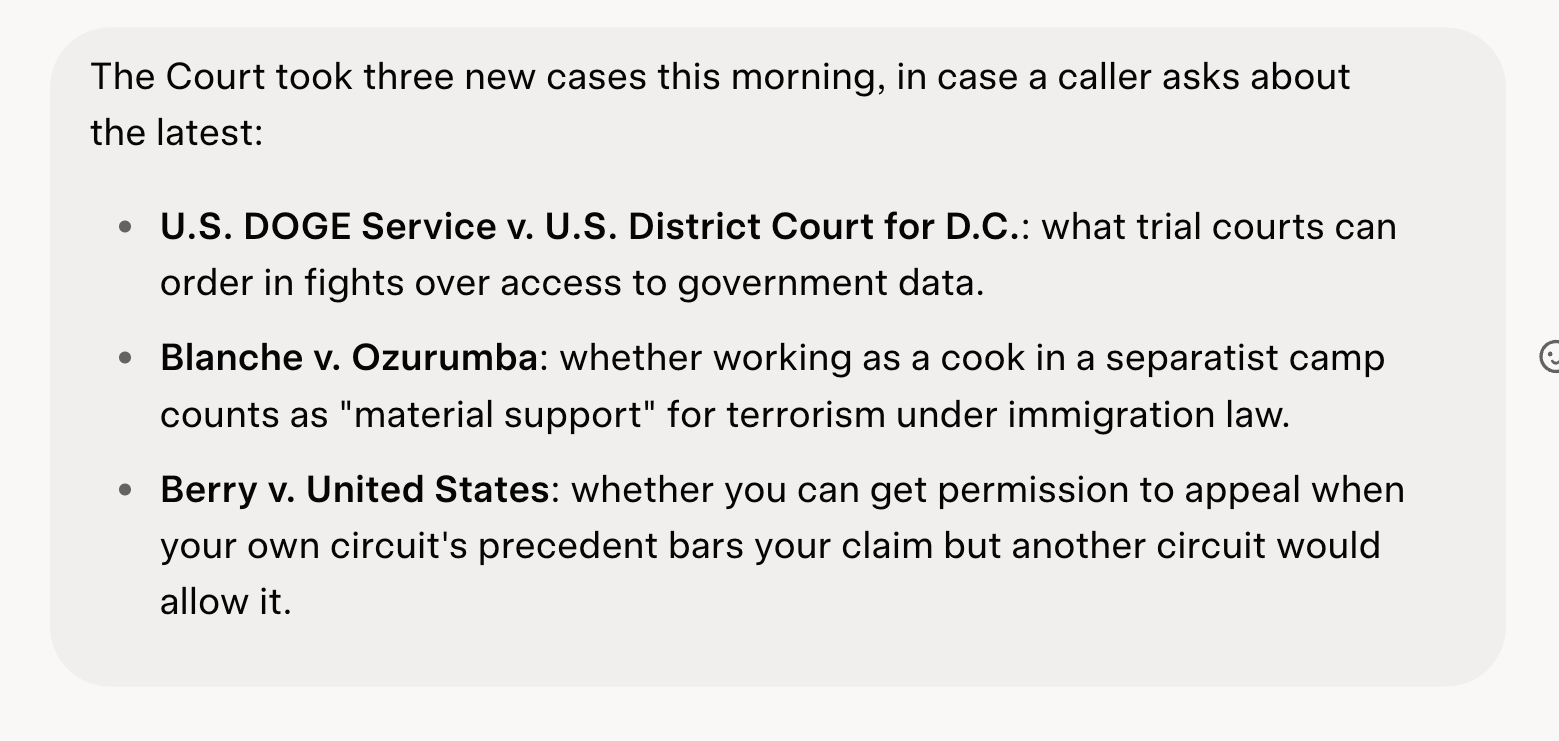
Everywhere else in this post, AI did something because I asked: research before the interview, a lecture in the car, coaching afterward. As I was writing this blog entry, however, I discovered a new feature of GrokBots. It knew from some prompts that I was giving an interview on Hello Houston! this morning. Without any prompting from me, it gave me the following notification. Somehow it knew to check what the Supreme Court was up to this term, that I was being interviewed, and that I might want to know about new cases on which cert was accepted. I told my class a few days ago that the difference between these "bots" like GrokBot, Hermes Agent, and Dots was that they monitored the world and took action based on information that came to it, but I honestly did not expect this sort of spontaneous, uninvited but welcome alert. Cool!