
Make a legal video with a push of a button
Paul J. Lipsky posted a YouTube video on November 17 titled "Claude Now Creates Cinematic Animations (Free Skill)". He built the skill mostly with video games or similar visualizations in mind and gives away its instructions as a block of text you paste into Claude. The text supplies a default "Storybook" look, with a specified palette of sky blues and tomato reds, and tells Claude how to build the film: write it as a single web page in WebGL, render every frame in a headless browser, assemble the frames and a soundtrack with ffmpeg, and set the sound to a standard loudness. Before delivering anything, Claude must check one frame per second for defects common in AI animation, such as arms that bend the wrong way and feet that float above the ground.
Nothing in those instructions concerns law. But why not? I pasted the Lipsky instructions into Claude and added one line: "Create an animation explaining the constitutional issues in this case. 2 minutes." I followed it with a link to the page for Nielsen v. Watanabe on scotus-arguments.netlify.app.
Readers may remember that site from an earlier post. A scheduled Claude task checks supremecourt.gov each day, and when a new argument transcript appears, it adds an analysis of each side's position, the questions the justices pressed, and the likely outcome. When I tested the method on three past terms, its forecasts were right in 167 of 170 scored cases. But the site has many uses. Here the site gave the animation a structured account of the case built from the official transcript.
Nielsen v. Watanabe, argued November 9, asks whether a former federal prisoner may sue a prison official for damages when he alleges that officials left a fracture without an X-ray for two years. The claim rests on Carlson v. Green, the 1980 decision recognizing an Eighth Amendment damages remedy against federal officers. Claude read the analysis, wrote a list of scenes, built the sets and characters in code, rendered 2,880 frames, and checked its own contact sheets.
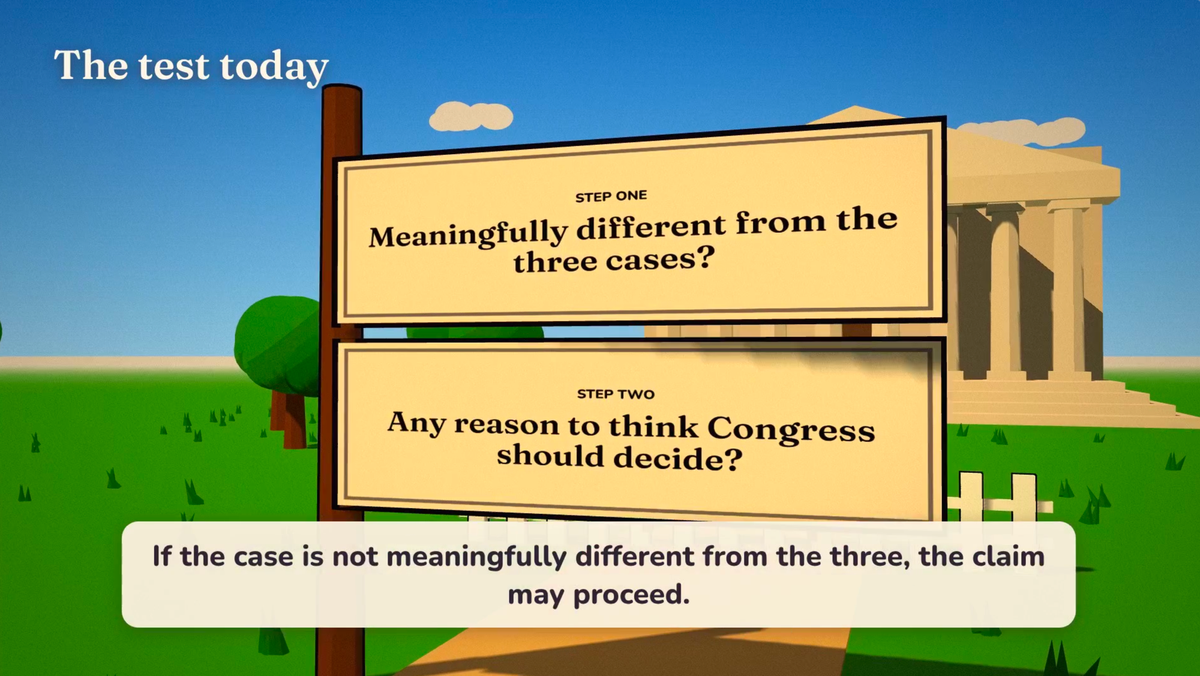
The cinematic masterpiece opens with the alleged facts in a prison yard, where a wall calendar flips through 24 months. Bivens, Davis v. Passman and Carlson then land on the courthouse lawn as three oversized books. A signpost carries the two-step test from Ziglar v. Abbasi and Egbert v. Boule. A balance scale holds Carlson on one side and this case on the other, and blocks drop onto it for each difference that Nielsen and the United States say makes this a new context. Watanabe answers in front of the Capitol with the Westfall Act and the Prison Litigation Reform Act. The bench appears as nine empty chairs, with thought bubbles carrying three questions the justices asked. The video closes by noting that the argument pointed toward reversal and that the decision is pending.
Claude made several choices without asking me. It used captions rather than a narrator, because the instructions add a voiceover only on request. It generated the music and sound effects in code. It drew the justices as chairs rather than as caricatures of real people. After looking at its first stills, it also fixed three problems on its own: a signpost blocked the title shot, a flipping calendar page showed mirror-image text, and Nielsen was standing inside a guard booth.
The job took about an hour, most of it spent rendering on two processors. That is a good deal of electricity. Sorry, Earth. The result has flaws, such as small lettering on some props. My own contribution, though, was one sentence and a URL. I could not have made anything comparable by hand.
Quimbee, I am sure, pays attorneys and script writers to produce its case brief videos. I typed one sentence, went to lunch, and came back to a two-minute animated explainer of a case the Supreme Court heard ten days ago. Somebody at BARBRI, which bought Quimbee in 2025 for an undisclosed and presumably not small sum, may want to dust off a résumé. There are certainly more elaborate ways of producing legal videos, and I’ll be posting another entry on that subject shortly. But with the Lipsky skill, a case argued this month can have a short animated explainer the same day, built from a source the professor trusts, for the cost of a sentence and an hour of machine time. Students meeting the Bivens cases for the first time could see three precedents, a two-step test, and both sides’ arguments in two minutes before class discussion begins. Lipsky wrote his instructions for people who make games. His skill worked on a Supreme Court case without a single change. Cool!