
How AI Could Have Improved Justice Sotomayor's Recent Dissent
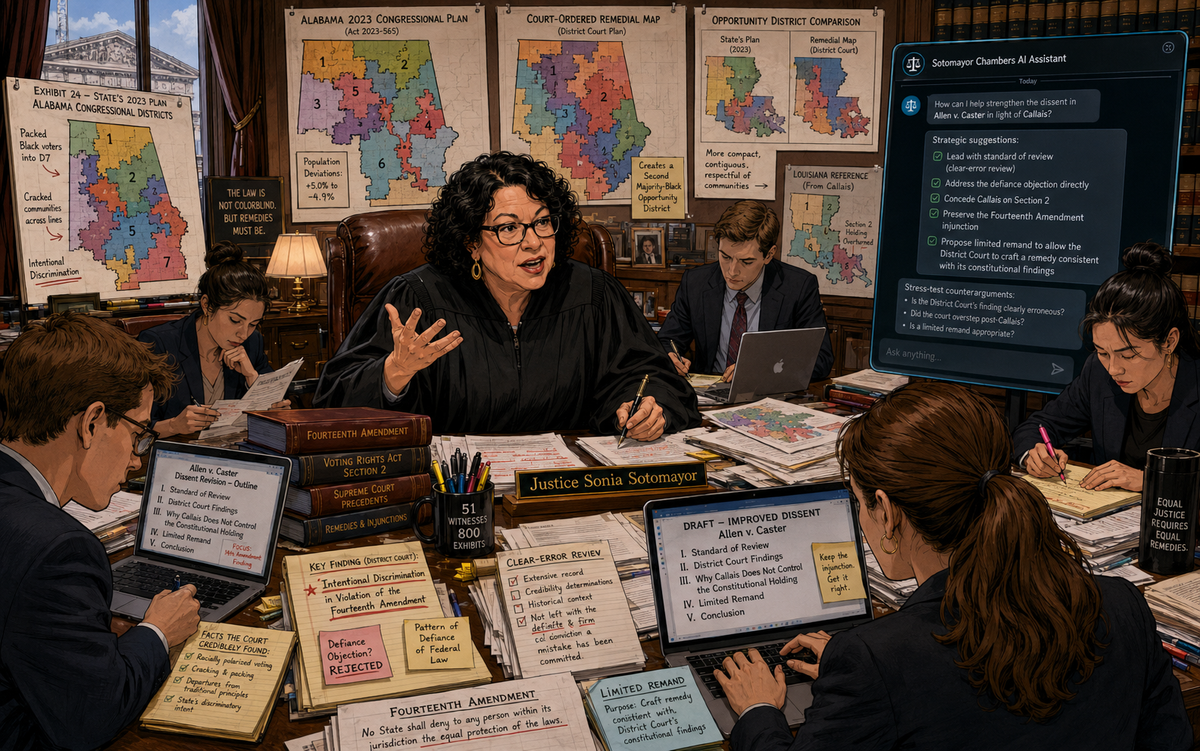
A case study in collaborative legal critique
On May 11, 2026, the Supreme Court issued a brief order in Allen v. Caster vacating a District Court judgment that had enjoined Alabama's 2023 congressional redistricting plan. Justice Sotomayor, joined by Justices Kagan and Jackson, filed a dissent. The dissent is forceful, but I think it makes a strategic choice that weakens what could have been a much stronger opinion. This post is about how I worked through that problem with Claude, and what the exercise suggests about the future of judicial drafting. The short version is that the liberals on the bench could have issued a more forceful opinion if they'd proceeded with an open mind and invited AI into the conversation. You can see the "AI-improved" dissent in the gray box at the bottom of this post.
The background, in brief
For readers who don't follow voting rights litigation closely, a few words of context are necessary. It may still be incomprehensible to the uninitiated but my hope is that it gives such readers a fighting chance.
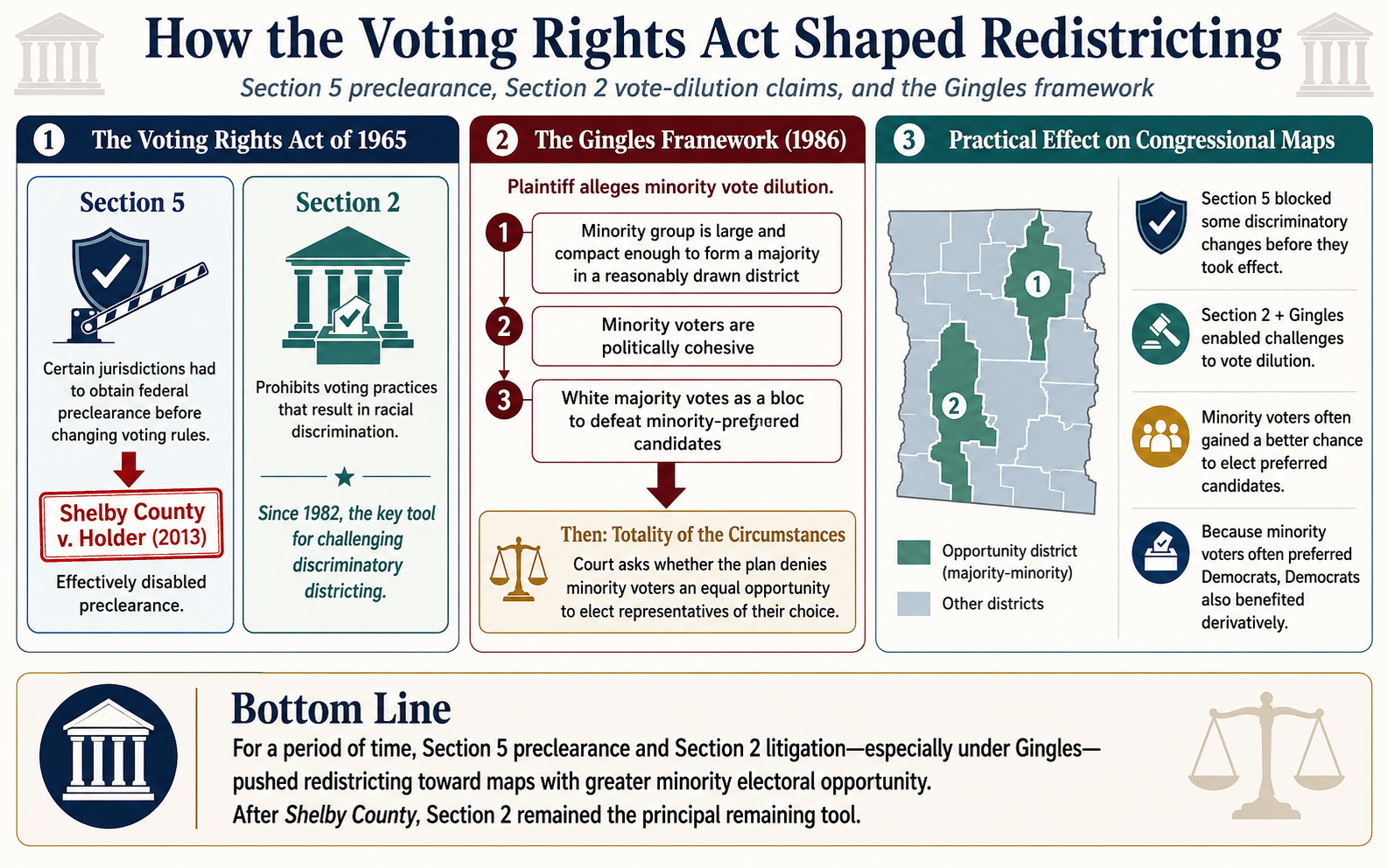
The Voting Rights Act of 1965 contains two operative provisions for present purposes. Section 5, which required certain jurisdictions to get federal preclearance before changing voting rules, was effectively nullified by Shelby County v. Holder in 2013. Section 2, which (since 1982) prohibits voting practices that "result in" racial discrimination, remained the principal tool for challenging discriminatory districting. Under the framework as interpreted in Thornburg v. Gingles (1986), a plaintiff alleging that a districting plan "dilutes" minority votes had to show three things: that the minority group was large and compact enough to form a majority in a reasonably drawn district, that the minority voted cohesively, and that the white majority voted as a bloc to defeat minority-preferred candidates. If those preconditions were met, a court would assess the "totality of the circumstances" to decide whether the plan denied minority voters equal opportunity to elect representatives of their choice. At least for a while, section 5 as interpreted in Gingles resulted in Congressional maps in which minority voters – and derivatively Democrats – had a much greater opportunity to elect their preferred candidates.
In 2023, the Supreme Court applied that framework in Allen v. Milligan and held that Alabama's congressional map violated Section 2 by including only one majority-Black district where the geography and demographics could have supported two. The Court ordered Alabama to draw a remedial map with a second opportunity district.
Alabama refused. It drew a new map—the 2023 Plan—that still contained only one majority-Black district. After an 11-day trial, a three-judge District Court issued a 268-page opinion in a case captioned Allen v. Caster, finding that Alabama had not merely failed to remedy the prior violation, but had affirmatively engineered new districting criteria designed to make a second opportunity district mathematically impossible. The court found procedural irregularities, manufactured legislative findings, and pretextual criteria invented for the occasion. It concluded that Alabama had violated the Fourteenth Amendment through intentional racial discrimination, and it enjoined the 2023 Plan.
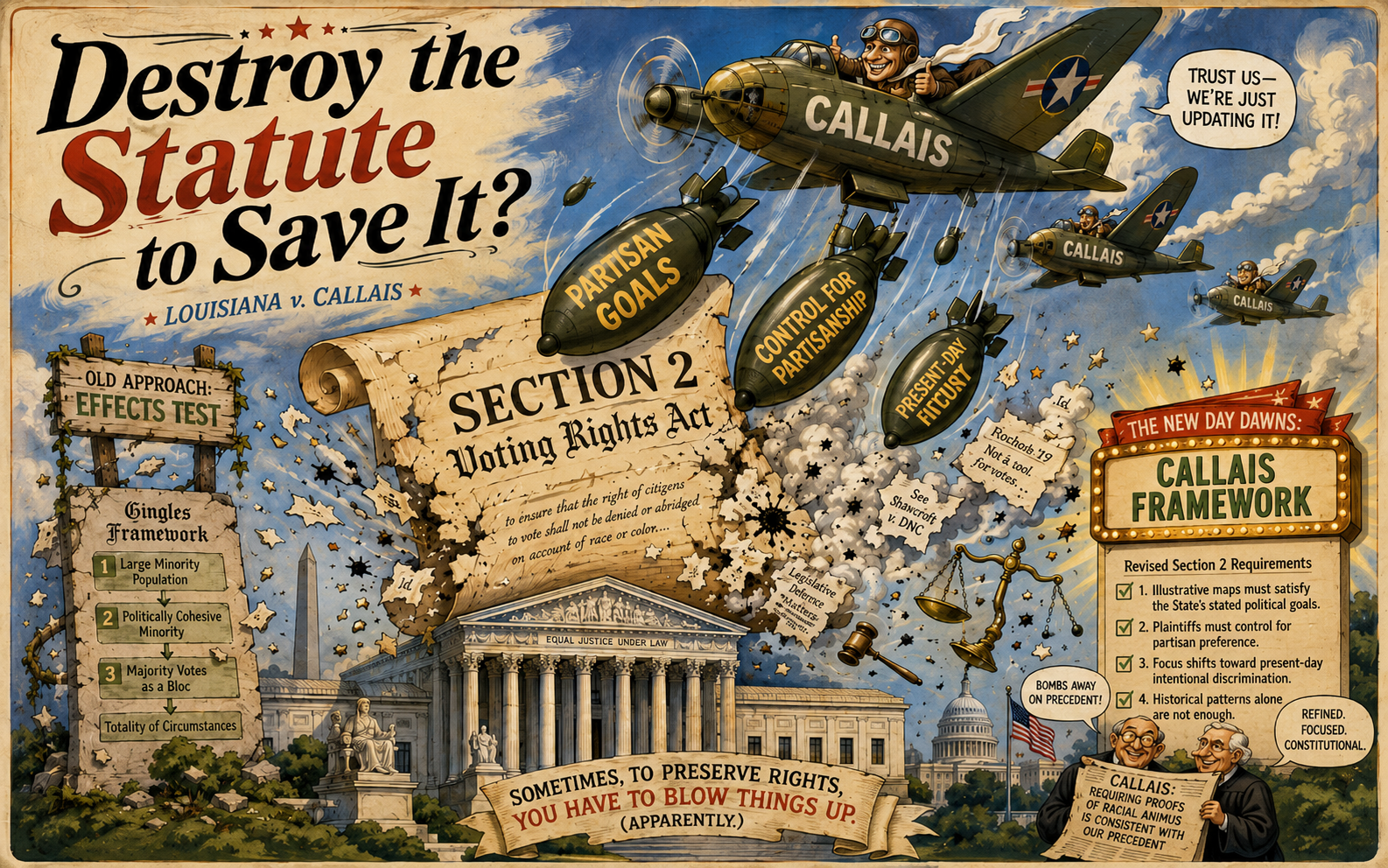
Then, on April 29, 2026, the Supreme Court decided Louisiana v. Callais, and substantially rewrote Gingles. The Court reasoned that the old framework was on a collision course with the colorblindness the Fourteenth Amendment requires, and that legislation enacted under Section 2 of the Fifteenth Amendment had to be "congruent and proportional" to the constitutional violation it remedied. From those premises, the Court derived a series of new requirements. Section 2 plaintiffs must now show that their illustrative maps satisfy all of the State's stated political goals (including partisan gerrymandering objectives), must control for partisan preference when proving racially polarized voting, and must focus the totality-of-circumstances inquiry on present-day intentional discrimination rather than historical patterns. The practical effect, as Justice Kagan explained in her Callais dissent, is to convert Section 2 from an effects test into something close to an intent test. The majority in effect had to destroy the statute in order to save it. It is a blockbuster decision whose sequelae may well determine whether the Democrats can regain a majority in the House of Representatives following the 2026 midterms.
And today, just twelve days later, the Court vacated the Alabama judgment in Allen v. Caster and remanded "for further consideration in light of Callais." That is the order Justice Sotomayor dissented from.
The dissent's problem
Justice Sotomayor's dissent makes two main arguments. The first, and the one she leads with, is maximalist: Callais is entirely irrelevant to the Alabama case because Callais construed Section 2 while the District Court's finding rested on the Fourteenth Amendment. The second, tucked in near the end and introduced with the words "if the Court must act now, it should at least," is that the intentional-discrimination finding should be affirmed under clear-error review because the District Court's factual findings are overwhelming. A stronger version of the dissent would have inverted the order and built the opinion around a concrete affirmative ask: a limited remand on Section 2 in light of Callais, with the Fourteenth Amendment injunction left intact pending the District Court's reconsideration. That disposition would have rested on the same clear-error point but reframed it as supporting a specific remedy rather than as a fallback objection.
The second argument is much stronger than the first. The first argument invites the obvious response that Alabama's conduct was framed as defiance of a federal decree, and if Callais has narrowed what that decree could properly have required, then the inference of racial motive is at least partially weakened. A justice writing in response could draft something like this:
A State that declines to do what federal law does not require has not, by that refusal alone, betrayed a racial motive.
That sentence does real damage to the maximalist position, because it operates at a level of abstraction where it sounds unanswerable. The only way to defeat it is to refuse the abstraction and force the argument back onto the record—to show that Alabama did not merely refuse, but acted affirmatively, through pretext and procedural irregularity, in ways that violate the Fourteenth Amendment regardless of what Section 2 demands. That move depends on the District Court's factual findings, and those findings are protected by clear-error review. Which is exactly why the dissent's buried argument is the stronger one: it cannot be answered by abstraction because it does not operate at the level of abstraction.
Working through it with Claude
I worked through this with Claude across several exchanges. The process was iterative and, I think, instructive.
I started by asking Claude to draft a hypothetical Alito concurrence responding to Sotomayor's dissent. This was useful as a stress test. Claude produced something that I described at first glance as being "frankly, pretty telling." The hypothetical concurrence pressed exactly the abstraction problem above: it framed Alabama's conduct as a "refusal to do what federal law did not require," which made the intent finding look derivative of the Section 2 ruling.
I then asked Claude to draft Sotomayor's response to that imaginary concurrence. Claude's response identified the right move—the "refusal alone" framing is not a description of this case, because the District Court found affirmative manipulation, not mere inaction. But the exercise revealed something important: Sotomayor's actual dissent had not made that move with the clarity it deserved. The response I asked Claude to imagine was, in effect, the dissent Sotomayor should have written.
The next step was the most useful. I asked Claude who had the better argument, with the constraint that we had to accept Callais as binding even if we thought it was wrongly decided. This constraint matters. A dissent that rejects the controlling precedent will be dismissed as resistance. A dissent that works within the precedent and shows its limits is much harder to answer. Claude's analysis—that Sotomayor wins on balance but that her own framing makes the win harder than it should be—matched my own reaction, but with sharper articulation of why.
I then asked the question that produced this post: would the dissent have been stronger if Sotomayor had pressed only her alternative argument? Claude's answer was unequivocal yes, and the reasoning was about opinion craft rather than doctrine. Maximalist framings invite the strongest possible counterresponse. Disciplined framings deny the counterresponse purchase on the actual case. The phrase "at least," used to introduce the clear-error argument, is what Claude called "the tell"—it signals concession rather than confidence, and tells the reader this is the fallback.
Finally, I asked Claude to draft an improved dissent that could not respond to the hypothetical Alito concurrence (because that concurrence is imaginary) but had to anticipate the strongest counterarguments and address them within the structure of the opinion itself. The result opens by naming a concrete alternative disposition the Court could have chosen—a limited remand on Section 2 with the Fourteenth Amendment injunction left intact pending reconsideration—and builds the entire opinion around that proposal. It leads with the standard of review and the District Court's factual findings, concedes Callais's authority over Section 2 in order to locate the constitutional finding outside its reach, addresses the "defiance" objection head-on rather than ignoring it, and frames the Court's actual disposition as aggressive rather than cautious by showing how easily a narrower disposition would have accommodated every legitimate concern. I've added Claude's opinion as an appendix to this post.
What the collaboration actually looked like
I want to be clear about the division of labor, because I think it matters for understanding what AI can and perhaps cannot contribute to this kind of work.
I did not permit Claude initially to identify the strategic flaw in the dissent on its own. I came to that view through my own reading of the imaginary opinions, and I directed the exchange toward testing it. What Claude contributed was rigorous adversarial pressure on each step of the argument. When I proposed that Sotomayor's maximalist framing was overreach, Claude did not simply agree. It first wrote the strongest possible Alito response, then wrote Sotomayor's strongest possible counter, then assessed both with the constraint of accepting Callais. The discipline of forcing Claude to argue each side in turn produced sharper analysis than I would have generated working alone.
The drafting itself was genuinely collaborative. I directed structure and emphasis. Claude executed prose and identified counterarguments I had not surfaced. When the improved dissent addresses the "defiance" objection directly—conceding that the argument has "surface appeal" before showing why it fails on the record—that move was Claude's. I would have ignored the objection, which would have made the dissent weaker. Claude's instinct to address the strongest counterargument rather than avoid it is, I think, a genuinely useful contribution to legal drafting.
A suggestion
The dissent reflects a strategic choice, and one can imagine reasons for it: a desire to make a broader doctrinal point about the relationship between Section 2 and the Fourteenth Amendment, a calculation that the maximalist framing better serves future litigation, perhaps even deep anger at a Callais decision that threatens to cement the incumbency of a political party that generally despises her ideology and that of her liberal colleagues. But on the merits of this particular opinion, in this particular procedural posture, the choice was unimpressive. The clearest evidence is what the majority did not do: six justices vacated the District Court's judgment without writing a word in response. No concurrence, no engagement, no felt need to answer. That silence is not proof of the dissent's weakness—the press of a late term and the shadow-docket posture both counsel brevity. Moreover, the silence could just be a contemptuous flex by those whose power now goes unchecked. But it is suggestive. A dissent that had pressed the clear-error point as its lead argument, and had forced the majority to confront a 268-page factual record reviewed under the most deferential standard in our jurisprudence, would have been harder to ignore. The majority might still have vacated. The Callais-inspired rush to partisan gerrymander from sea to shining sea would likely continue unabated. But perhaps a more telling dissent would have impelled the majority to at least engage.
What the collaboration with Claude demonstrates is that just as AI can help even seasoned Supreme Court advocates like Neal Katyal, an adversarial AI interlocutor can stress-test a justice's draft in ways that even a team of a justice's clerks can not. An AI likely lacks loyalty to a particular justice's ideology. Asked to do so, it will write the strongest possible counterargument, then write the response, then assess both honestly when constrained to do so. That is a different kind of useful than what a clerk provides, particularly where justices select them in part for ideological compatibility, and I see no reason justices should not have access to it.
I predict that the Supreme Court will not be the first institution to adopt AI in this manner. I further predict that it will not admit doing so for a very long time. District courts and circuit courts will, however, I suspect. Solicitors general and appellate advocates already are. But the highest court in the country, whose opinions shape the law for decades, would actually benefit from the same adversarial testing that the rest of the legal profession is beginning to take for granted. The dissent in Allen v. Caster should have been the dissent Claude and I produced in an afternoon. That it was not is a small loss for the Court and a larger loss for the litigants and voters whose interests the dissent was meant to defend.
I am not (quite) suggesting AI should (yet) write Supreme Court opinions. I am not suggesting that a Houston law professor knows better than a Supreme Court justice what to say. I am suggesting, however, that the gain in persuasive power created by combining knowledgeable voices with a powerful AI is telling. Modern AI has gotten good enough to deserve a seat in the room when important opinions are drafted.
Afterthought 1: A Preemptive Response to Criticisms
After I read this post, I recognized that it might be controversial. So I decided to preemptively tackle at least a few of the anticipated blasts.
First, on coalition management. A Supreme Court Justice writing in dissent is not just trying to win the rhetorical contest of the moment. She is writing for a bloc that has to hold together, for future litigation that has to be preserved, for the historical record, and for the press. What looks from outside like a craft failure may be a deliberate choice to keep a broader doctrinal argument alive even at the cost of immediate persuasive power. The maximalist framing I criticize—that Callais is wholly irrelevant to the Fourteenth Amendment finding—may serve future cases in ways the narrower clear-error argument would not. This post is about craft narrowly construed. It is not a claim that I understand the strategic calculus better than the chambers that made it.
Second, on hallucination. The objection that AI cannot be trusted in legal writing because it invents citations is serious, and it would be disqualifying if true of this exercise. It is not. Every citation in the improved dissent was verified through Midpage, the legal research tool I rely on for citation accuracy. The verification took less time than the drafting did. The lesson is not that AI is reliable on its own. It is that AI plus a competent lawyer doing verification work produces output that is at least as accurate as a draft produced by clerks alone, and considerably faster. Responsibility for accuracy remains with the lawyer. That is exactly where it should be.
Third, on loyalty. I do not claim AI is unbiased. Claude has been trained by a company with its own commercial and ideological incentives, and those incentives shape its outputs. The point is narrower. Modern AI should be able to be directed, on demand, to argue any side of a question with comparable rigor. That is a different kind of useful than what an excellent clerk provides. Clerks are excellent. AI is differently excellent. The two are complements, not substitutes.
Afterthought 2: What this means for legal education
The narrow lesson here is about one dissent. The broader lesson is about teaching. Most discussion of AI in legal education focuses on summarizing cases, finding authorities, drafting memos, and editing prose. What I did with Claude on the Sotomayor dissent was something else: I used the model adversarially. I asked it to generate the strongest attack on an argument, then the strongest response, then to assess both under the constraint that Callais binds. That sequence resembles what a good moot-court judge or skeptical appellate partner does. It does not resemble what a research assistant does.
Legal education has long treated strategic judgment as something students absorb after enough Socratic questioning. The exchanges I had with Claude suggest a more explicit approach. Which argument should lead? Which should be conceded? Which invites a devastating response? Which constraint changes everything? A student can practice these questions directly, with an interlocutor that will argue any side on demand.
The pedagogy follows. Students should learn to argue under constraint—to accept a hostile precedent as binding and ask what remains, rather than denouncing the precedent and changing the subject. Faculty should use AI to generate alternative structures of an argument and then ask students to compare them. Assignments should shift from "write a dissent" to "submit your initial theory, the strongest AI-generated attack on it, your revised theory, and an explanation of what you changed and why."
The danger is not just hallucinated citations. It is fluent strategic nonsense—an AI argument that sounds elegant but collapses on contact with the record. That risk does not defeat the pedagogical use. It defines it. AI output is not authority. The question is never whether the AI wrote well but whether what it wrote is true, supported, strategically sound, and appropriately constrained.
The shift I am describing is from product to process. Old assignments asked for the memo, the brief, the rule statement, the exam answer. The new ones ask how the student got there—what alternatives were considered, what counterarguments were tested, what was verified, what was rejected, and why this version is better than the plausible others. The interesting thing about my exchanges with Claude was not that the model could draft an improved dissent. It was that the back-and-forth showed why one argumentative structure beat another. That is what teaching is supposed to do.
Justice Sotomayor's "Improved" Dissent in Allen v. Caster
JUSTICE SOTOMAYOR, with whom JUSTICE KAGAN and JUSTICE JACKSON join, dissenting.
There was a disposition available to the Court today that would have respected Louisiana v. Callais, 608 U. S. ___ (2026), respected the District Court's independent constitutional findings, and respected the Alabamians who are casting ballots as I write. The Court could have ordered a limited remand—directing the District Court to reconsider its §2 holding in light of Callais while leaving the Fourteenth Amendment injunction in place pending that reconsideration. That disposition was compelled by the standard of review, supported by the record, and consistent with everything Callais actually held. The Court chose otherwise. It vacated the judgment in its entirety, displacing a court-ordered remedial map mid-election in favor of a plan a federal court has found to be the product of intentional racial discrimination. The choice was not required by Callais. It was not required by anything the Court has identified. I respectfully dissent.
I
A district court's findings of historical fact, including findings of discriminatory intent, "must govern" when "plausible in light of the full record." Cooper v. Harris, 581 U. S. 285, 293 (2017) (quoting Anderson v. Bessemer City, 470 U. S. 564, 574 (1985)). That standard is among the most settled in our jurisprudence. It applies whether or not the legal landscape has shifted since the trial court ruled. It applies whether or not this Court has revised a related doctrine. It applies because trial courts, not appellate courts, see the witnesses, weigh the evidence, and assess the record as a whole.
The District Court here did not merely satisfy that standard; it exceeded it. After hearing 51 witnesses and reviewing nearly 800 exhibits, the court found that Alabama had engineered new districting criteria designed to entrench, rather than remedy, racial vote dilution. It documented "sharp departures from (and some outright conflicts with) Alabama's traditional districting guidelines," 782 F. Supp. 3d 1092, 1343 (ND Ala. 2025); criteria "fashioned from whole cloth" that the State had "never previously employed," id., at 1343–1344; legislative findings conjured "out of thin air," id., at 1345, "in the dead of night," id., at 1117; and criteria calibrated with such precision that a second opportunity district became "mathematically impossible to create," id., at 1340. The court considered Alabama's asserted partisan justifications. It applied "extreme service of the presumption of legislative good faith." Id., at 1117. And it concluded that if this record could not rebut that presumption, then "it is unlikely that the presumption is ever rebuttable." Id., at 1346. Those are not the words of a court overreaching. They are the words of a court that knew what Village of Arlington Heights v. Metropolitan Housing Development Corp., 429 U. S. 252 (1977), demands and met that demand with care.
II
Given those findings, the path forward was straightforward. The §2 holding below was reached before Callais, and Callais has now altered the framework governing §2 claims. A remand to allow the District Court to reconsider that holding in light of the new framework is unobjectionable, and I would have joined such an order. What is objectionable—what is, in fact, indefensible on this record—is the Court's decision to vacate the Fourteenth Amendment injunction along with it.
The Fourteenth Amendment finding rests on independent grounds. Arlington Heights directs courts to consider procedural irregularities, departures from normal substantive criteria, the legislative record, and the historical background of a challenged decision. 429 U. S., at 266–268. The District Court considered each of those factors and made detailed factual findings about each. Those findings concern what Alabama did, how it did it, and what its own contemporaneous record reveals about why. They do not depend on §2 requiring any particular remedy. They depend on Alabama's manipulation of its own districting criteria—criteria the State itself purported to apply—to entrench a racial result. A State that invents pretextual criteria to perpetuate racial dilution violates the Equal Protection Clause regardless of what §2 demands. The Fourteenth Amendment does not wait on the Voting Rights Act for its force.
Nothing in Callais says otherwise. Callais did not address Arlington Heights. It did not address what evidence supports an inference of discriminatory purpose. It did not address what procedural irregularities or manufactured legislative findings reveal about legislative motive. It did not alter the standard of review for findings of discriminatory intent. And it did not authorize de novo reweighing of Arlington Heights evidence on appeal. Callais is a statutory decision about §2. It is not a constitutional decision about what counts as intentional racial discrimination, and the Court today cites no authority suggesting otherwise.
The limited remand I describe would have accommodated every legitimate interest at stake. The District Court could have reconsidered its §2 analysis under Callais and reached whatever conclusion the new framework requires. The Fourteenth Amendment injunction would have remained in place pending that reconsideration, ensuring that the election now underway proceeds under the map a federal court has found constitutional rather than the map a federal court has found unconstitutional. If, on remand, the District Court concluded that Callais somehow undermined its Fourteenth Amendment findings as well—a conclusion I find difficult to imagine but would not foreclose—it could have said so, and the injunction could have been modified then. Nothing was lost by waiting. Much is lost by not.
III
The Court's contrary disposition is not merely unnecessary; it inverts the equitable balance that should govern an order of this magnitude. Alabama's congressional primary is next week. Voting has begun. Vacatur immediately displaces the District Court's remedial map and restores the 2023 Plan—the plan a federal court, after an 11-day trial, found to be the product of intentional racial discrimination. "[W]hen federal courts contemplate equitable relief" like vacatur, they "must also take account of the public interest." U. S. Bancorp Mortgage Co. v. Bonner Mall Partnership, 513 U. S. 18, 26 (1994). The public interest is not served by restoring, mid-election, a districting plan a federal court has held unconstitutional, on the strength of an intervening statutory decision that does not address the constitutional ground of decision. The proper baseline pending reconsideration is the map that emerged from full adversarial proceedings and detailed factual findings—not the map those proceedings condemned.
The Court might respond that a State's duly enacted plan carries a presumption of legitimacy, and that the presumption reasserts itself once the legal premises underlying the injunction are called into question. The argument has force as a general matter. It has no force here. The presumption of legislative good faith was specifically rebutted by the District Court on a record the Court today does not engage with. A presumption rebutted by trial-level factfinding does not spring back to life because this Court has revised a related statutory doctrine.
I joined JUSTICE KAGAN's dissent setting out our disagreement with Callais, and I will not rehearse it here. Callais, 608 U. S., at ___ (Kagan, J., dissenting). The point of this dissent is narrower. Even taking Callais as binding, and even taking it as fully applicable to the §2 holding below, the District Court's separate finding of intentional discrimination under the Fourteenth Amendment was supported by exhaustive evidence, reviewed for clear error, and unaffected by anything Callais held. The proper response was a limited remand. The Court chose a broader one—and in doing so, displaced a constitutional finding it has not engaged with, on the strength of a statutory decision that does not reach it, in the middle of an election that is already underway.
That is not orderly appellate administration. It is the use of Callais as a solvent. The findings the Court discards deserved better. So do the voters whose ballots are being cast under them as I write.
I respectfully dissent.