
What one legal filing in a death penalty case taught me about integrating AI into legal writing
A guest blog post from Jeffrey Newberry, Senior Legal Clinic Supervisor
Director, Death Penalty & Criminal Appeals Clinic at the University of Houston Law Center. Mr. Newberry was not an avid user of AI until recently.
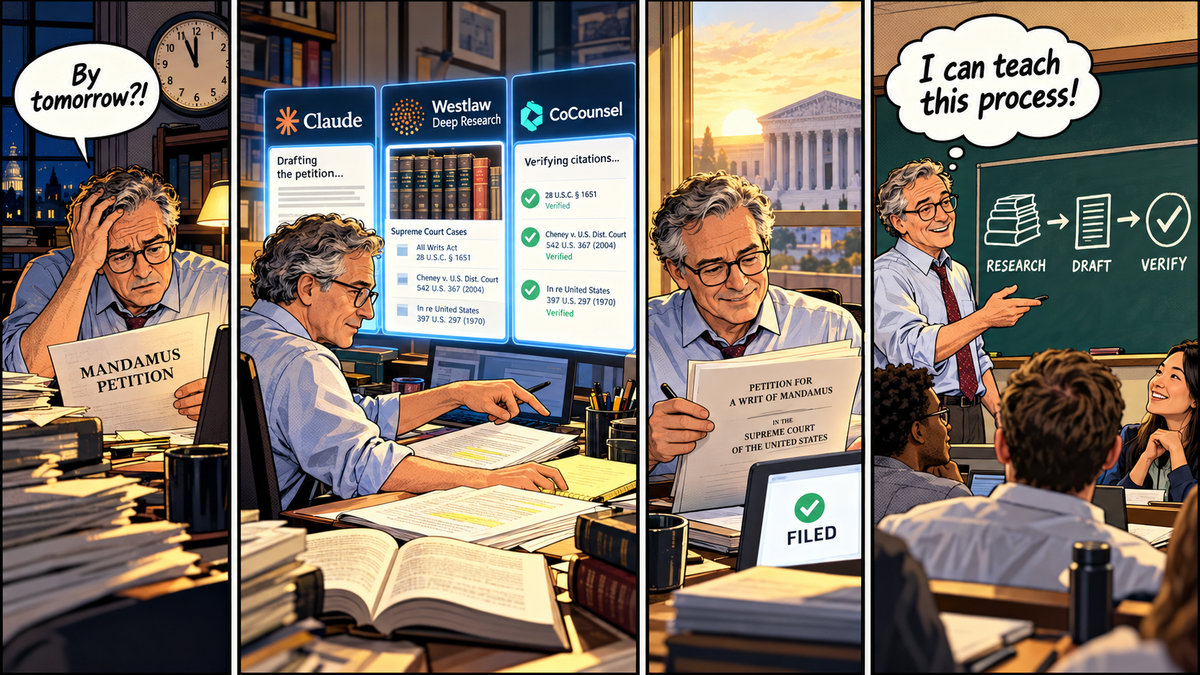
Most of what law professors hear about AI and legal writing is a warning: made-up citations, sanctioned lawyers, and students who stop thinking. The warnings are fair. But they leave a gap, because we seldom see what careful, effective use looks like on a real filing with real stakes. I supervise students in a clinic that files in actual courts, and I teach a course on writing for criminal defense. Recently I drafted a petition for an extraordinary writ (i.e., a petition for a writ of mandamus) in the United States Supreme Court in about a day, using Westlaw’s Deep Research and CoCounsel for research and verification and Claude for drafting. The question was one of federal habeas procedure: what a court of appeals may decide when it screens a second petition. This post describes the process and what it suggests about how legal writing could be taught.
The work
The deadline was set by forces I did not control, and it left no time for the usual cycle of drafting, waiting, and revising. I had an adverse order, a record, advice from colleagues I trust, and a research memo a student in my clinic had written earlier in the semester on the question we needed to brief. It was a death penalty case and the execution date had been set so the pressure was most definitely on. By the next morning, the petition was filed.
What I gave the AI and what I kept
I did not start from a blank page, and neither did Claude. A colleague and I had written a petition for an extraordinary writ in the Supreme Court a few years ago. I gave Claude that petition and told it to use it as a model in two ways: for what this kind of document should look like, and for how I write. I also gave it briefs from lawyers whose work I trust completely, who had raised the same issue in the same kind of filing almost twenty years ago. Their reasoning held up; their authorities were dated.
Updating that law was a research job, so it went to a research tool. Westlaw’s Deep Research traced what had happened to the key authorities over the following two decades: which ones still stood, which had been limited, and what newer decisions had said about the same question. That work grounded the petition in a legal database rather than in a language model’s memory. Claude drafted from what the research produced; it did not supply the law on its own.
I did not ask either tool to find the argument. The argument came from people, and in the end, it turned on two words in a statute. Whether an AI would have seen the argument on its own turns out to be a closer question than I expected. Choosing which of many possible arguments to press is still, I think, a human skill, and it is the one most worth teaching. [1] What Claude received was everything a good junior associate would need: the order, the briefing so far, the record, the model petition, the older briefs, the updated research, and my colleagues’ advice.
The student’s memo came in last. I uploaded it and gave Claude two jobs. The first was to list every case the memo cited that was not already in the draft. The second was to flag any place where the memo said something about a case we had already cited that conflicted with our reading, or used that case for a different point. Both took only minutes. Then Claude and I went through what it had found and decided together what belonged in the petition. A student’s research could strengthen a Supreme Court filing on this deadline only because a machine could check the memo against the draft, in both directions, faster than any supervisor could.
Then I read the draft the way I read student drafts. Some of my changes were about substance: a complaint we should not make, a section that should be shorter, a long statute that belonged in an appendix. Others were about voice. Until two weeks ago, I had used Claude only a handful of times, but in the days since, I have written my style down as rules the AI follows, things like “lead with the strongest point” and “concede the obvious, then pivot.” That list began as a way to make drafts sound like me. It turned out to be the clearest description of my writing I have ever had, and I wrote it for a machine. I dictated all of these edits to Claude in the Claude app, and Claude returned each of three or four drafts as a Word file, so nothing was cut and pasted. That approach worked here, but I will work differently next time. I now think the most efficient route is to make the edits in Word and paste the revised text back to Claude in one pass. [2]
Before the petition was final, it went through CoCounsel, which checked the citations and reviewed the draft independently. I took its suggestions back to Claude, we discussed each one, and the ones that improved the petition went in. Having a second system, built on a legal database, check the work of the first is the single most important safeguard in this process.
Automating the finish and the companion documents
Every filing has a finish, and lawyers spend hours on it. Headings cannot be stranded at the bottom of a page. Entries in a table of authorities cannot split across pages. Page numbers in the tables must come from the final pagination. Every citation needs a verified pincite. None of this requires judgment, so it can be written down once as a standing set of instructions and handed to the AI. The AI then follows those instructions the same way on every filing.
The same goes for the companion documents that travel with a pleading: the certificate of service, the motion to proceed in forma pauperis, and the other papers a court requires. These are derived almost entirely from the main filing and the court’s rules. Once the process is set up, the AI can prepare them on its own, and the lawyer only has to review them. There is no longer a good reason for a lawyer to spend time drafting them. That time belongs to the main pleading, where judgment matters.
Implications for the future of legal writing instruction
None of what follows is how legal writing is taught today, including by me. It is how I think it could be taught soon.
Grade the process along with the product. If students are going to draft with AI, as they will, then teaching them to use it well becomes part of our job. That means looking at how a document was made as well as how it reads. A student could turn in a process document with each major assignment, listing what went to which tool, what the student decided, what was verified, and how. The document should be generated from the record of the work itself, such as the session transcript (of which there are two examples linked in this entry) or the version history, rather than written afterward. An AI can then check whether the student’s account matches that record, which makes a retrofitted process document hard to hide.
Not to fear, legal writing teachers will still have substantial work to do. Some of it will look different: teaching students which process most reliably produces the best work and showing them where that process breaks down. A student who can describe that process precisely understands the work. One who cannot is outsourcing it.
Teach students to ground drafting in reliable research. The line between drafting tools and research tools is blurring. Connectors now let a drafting model reach legal databases directly: Claude can search case law through services like Midpage and Descrybe, and lawyers whose firms subscribe to Thomson Reuters’ CoCounsel Legal can have Claude hand research off to CoCounsel and get back reports grounded in Westlaw. What students need to understand is where the law in a draft came from and how it was verified, whatever interface produced it. In this filing, the law came from Westlaw’s Deep Research and the verification from CoCounsel, while Claude did the drafting. Students should learn to divide the work that way, to build from models, and to update old models with current law before trusting them.
Have students write their own style rules. Asking a student to write the rules an AI would need in order to write like them asks the question every writing teacher wants answered: what makes this writing yours? Few students could answer it at the start of a semester. It would be worth finding out whether they can by the end.
What has not changed
In this filing, no tool chose the procedural vehicle, decided what to concede, or judged how hard to push. Those decisions make someone a lawyer, and they are still ours to teach. AI can inform them, to be sure, but in 2026 I am not willing to take my hands off the wheel. What changed is everything around them. Research came from a legal database, verification came from a second system, drafting and finishing were done by AI, and a single lawyer turned good judgment and good research into a finished, cite-checked filing in hours instead of days.
When the draft was finished, I was pleased with it. I believed it was good, and it had come together quickly. That speed had practical value: the time we saved went to additional filings for the client, and in that moment we needed every one of them. Efficiency does not guarantee a result, but in a case with a deadline, time is what a lawyer most needs.
One more thing changed along the way. Throughout the process, I could ask Claude how to use all of these tools more efficiently and at lower cost, and it advised me: which work to hand to the Westlaw tools, which filings to draft in separate sessions, and which steps could be written down once and reused. By the end, the process was faster and cheaper than when it began. That matters for teaching. The tool can help teach students how to use it well, including how to use it economically.
Supervision has always meant telling students what to do and then checking that they did it. It can now also mean showing them, step by step and in writing, exactly how their clinic supervisor or legal writing teacher created a document with the tools now available, combined in whatever way that supervisor, that teacher, or the law school faculty considers best. Then it means asking students to do the same.
Footnotes
[1] To test this proposition while writing this post, I twice asked Claude what could be filed in the Supreme Court based on the order. The first time, in an ordinary chat in which I asked it to set aside everything we had discussed about the petition, it identified possible vehicles but missed the issue we raised. I then ran the test again in an incognito chat (opened with the ghost icon in the Claude app), which draws on no saved memory or past conversations. I confined it to the order and general law and barred it from reading anything about the case. This time, it found both the issue and the vehicle: it proposed a petition for a writ of mandamus on the theory that the panel had exceeded its gatekeeping role by deciding limitations. The transcript of that second session is available here.
[2] The more efficient approach is a hybrid: dictate the changes that apply to the whole document, such as audience, tone, and emphasis; make line edits directly in Word; and paste the revised text back to Claude in a single pass. (Uploading the Word file instead lets Claude see tracked changes and margin comments.) Dictating small edits one at a time is slow, and regenerating whole drafts accounts for most of the usage.