
Use AI to make your writing persuasive

A Lawve skill compresses the writing of Justice Elena Kagan, David Boies, Ted Olson, and Ross Guberman into a single long instruction file — and turns a mediocre Fifth Circuit dissent into something that would stand a chance of persuading.
[Note: I received some pushback on an earlier version of this blog entry from a colleague whom I respect. This is an edited version.]
The best legal writing programs teach persuasive writing carefully — worked examples, named moves, and detailed feedback on real drafts. The trouble is that even at those programs, intensive instruction often lives in 1L and ends there. The student then writes for the next two years, and the next forty, without anyone in the room to apply the same care to the sentence she is writing now. In less stellar programs and in much of the world after the first year, the advice given is true but uselessly compressed. “Be clear.” “Sound confident.” “Lead with your strongest point.” “Write with rhythm.” “Use examples.” “Do not sound like a machine.” All correct. None of it, standing alone, tells a student how to move the next sentence from bad to better.
That is because craft knowledge is often tacit. We recognize good legal prose before we can fully explain how it works. Asking a student to write like Justice Kagan, attorneys David Boies or Ted Olson, or writer Ross Guberman is not so different from asking an aspiring painter to paint like Van Gogh or a novice composer to compose like Bach. The model matters, but admiration is not method. Students continue to need the craft broken into moves they can see, imitate, test, and revise.
This is where AI skills become interesting. Legal writing is not algorithmic. But a good algorithmic approximation can still do real pedagogical work. It can turn style into a checklist of moves, convert vague praise into diagnostic categories, and give students a disciplined way to emulate excellent lawyers without pretending that excellence itself has been reduced to code.
So when something concrete arrives that can operate at scale and teach writing skills law students and many lawyers actually need, I want to write about it. The Lawve marketplace shipped a skill earlier this month — Larissa Meredith-Flister’s Persuasive Legal Writing — that distills techniques from Justice Kagan’s opinions and dissents, the advocacy of David Boies and Ted Olson, and Ross Guberman’s analytical framework into a single instruction set of roughly 6,000 words. The structure is straightforward: a section on architecture, including openings, sequence, signposting, and endings; a section on craft, including clarity, examples, parallelism, quotation, and voice; and a third section that may be the most distinctive piece — a long catalog of AI-prose tells, with diagnoses and fixes for each. This skill and many others have been made more accessible as a result of the Claude for Legal initiative described in an earlier blog entry.
I wanted to see what the skill would do, so I gave myself an awkward but realistic assignment.
I asked ChatGPT to write a deliberately mediocre hypothetical dissent to a real Fifth Circuit opinion — Louisiana v. FDA, the May 1 decision granting Louisiana's § 705 stay of the 2023 mifepristone REMS pending appeal. You don't really have to know about this complex and important case or understand what the Fifth Circuit did in order to understand this blog post, but for those who are interested it's a case about medication abortion, which has become the predominant form of abortion in the United States following the 2022 Supreme Court decision in Dobbs v. Jackson Women's Health Organization leaving abortion issues primarily up to the states. The Fifth Circuit declared 3-0 that the State of Louisiana had standing to challenge a decision made back in the Biden years of COVID-19 to permit mifepristone (a medication primarily used for abortion) to be prescribed without the doctor laying hands on the patient. Having so found, the Fifth Circuit then "stayed" that liberalization of abortion pill use not just within the Fifth Circuit's territory but nationwide. As I write this, Justice Alito of the United States Supreme Court has in turn temporarily stayed the Fifth Circuit's stay (!) pending study of that the latter court had done.
Take this opinion and write a mediocre and not particularly well written 2000 word dissent. The flaws should be mostly in argumentation and structure. use the consensus and midpage connectors to help you do research.
ChatGPT wrote it the way most of us write first drafts on deadline: too much hedging, too much self-narration, the strongest argument buried in the middle, the ending a formulaic "I respectfully dissent."
Then I asked Claude, working with the skill loaded, to improve it. You can see the result in the file below.
The before-and-after is, I think, a more useful introduction to what the skill does than any abstract description. So that is most of the rest of this post.
The Opening
This is the section where the skill matters most. The original began with the standard apologetic move:
I respectfully dissent, although not because I am indifferent to the concerns raised by Louisiana, nor because I think the Food and Drug Administration has behaved with ideal administrative care in this matter. It seems to me that the agency has not done everything that it should have done, and perhaps not everything that it now says it will do. But a stay pending appeal is not a device for courts to express impatience with an agency.
You have read this opening before. Every judge has written one like it. It does almost nothing — except tell the reader the judge is balanced and reasonable, qualities the rest of the opinion will demonstrate without announcing them.
Here is what the skill produced for the introduction:
A § 705 stay is an extraordinary interim remedy. Louisiana asks us to grant one against a federal drug regulation while the agency is actively reviewing that regulation, on a record the district court already weighed, and through a remedy whose practical reach extends to every prescriber, pharmacy, and patient in the country. The district court — closest to the record and to the parties — found Louisiana likely to succeed on the merits, said so plainly, and concluded that the equities and public interest favored allowing FDA to complete its work. That balanced judgment is what § 705 leaves to the trial judge. The majority displaces it today on a standing theory the Supreme Court foreclosed in Alliance III, on an APA analysis that converts agency candor into a near-admission of liability, and on an equities discussion that collapses the third and fourth Nken factors into the first. I would affirm.
This is what the skill calls a syllogistic opening. State the issue, state the opposing position, state the principle that defeats it — all in one paragraph. The reader has absorbed the conclusion before the argument starts. The skill's own gloss on the move is precise: "Kagan does this in Florida v. Harris: issue, lower court holding, governing standard — done. The holding sounds unreasonable before she has argued a word against it." That is what happens here. The majority's holding is named in three short clauses ("a standing theory… an APA analysis… an equities discussion…") and is allowed to discredit itself.
The Causal Chain
The original handled standing competently but not memorably:
Its theory depends on several separate actors: out-of-state prescribers, pharmacies, mail carriers, patients, emergency rooms, and Medicaid billing systems. The State says these things are predictable. Maybe they are. But predictability is not the same as Article III causation.
That sentence about the "several separate actors" is the heart of the dissent's standing argument, and it does not look like the heart of anything. Six entities, comma-separated, named generically. The reader skims past it in three seconds.
The revision uses what the skill calls the narrative hypothetical — make the reader feel the attenuation before you name it:
The State's theory of injury runs through a chain of independent actors: an out-of-state physician decides to prescribe; a mail-order pharmacy decides to fill the prescription; a private carrier decides to deliver it; a Louisiana woman decides to obtain the drug in defiance of state law; and, in a small fraction of cases, that woman ends up in an emergency room paid for in part by Medicaid. Every link in that chain is a private actor the FDA does not control.
The parallel construction does the work. Five "decides" verbs in a row, each clause structurally identical to the last, accumulate into an unsustainable causal chain. The reader has felt the Allen v. Wright–y, Lujanesque, Clapperish Article III problem before the next paragraph names it. That is not a stylistic flourish. It is the substantive point — Alliance III's attenuation concern — converted from a citation into an experience.
The Parade of Horribles
The original dispatched the sovereign-interest theory with abstraction:
The majority says Louisiana has a sovereign interest in enforcing its laws. Of course it does. But that proves too much. Every State has laws, and many federal policies make enforcement of some state laws harder.
This is a reasonable point. It is also unmemorable. "Every State has laws" is true, and inert.
The revision applies what the skill calls the parade of horribles:
By that logic Louisiana has standing to sue the Postal Service every time contraband crosses its border, the IRS every time a federal tax credit makes an out-of-state purchase cheaper, and the Department of Transportation every time the interstate highway system makes it easier for residents to travel to a neighboring State and do things Louisiana law would forbid at home.
Three concrete examples, parallel structure, each more uncomfortable than the last. The technique is older than the skill — Boies and Olson used it in the Prop 8 briefs to show that the State's argument would justify prohibiting marriage by senior citizens, by felons in separate prisons, and by couples using contraception. The skill operationalizes it: when you have an opposing argument that proves too much, pick three examples, stack them, make them parallel. The reader does not need to be told the original argument is overbroad. The reader has just watched it be overbroad.
Agency Candor
The original tried to defend administrative-law deference and ended up hedging itself into mush:
Agencies reconsider things all the time. They supplement records. They revisit prior judgments. They sometimes admit that earlier reasoning was incomplete. If that alone required immediate judicial suspension of agency action, agencies would be punished for candor.
The thought is right but the prose is hedging at the wrong moments. "Agencies reconsider things all the time" sounds like a shrug. "Sometimes admit" is a hedge inside a hedge. "Would be punished for candor" lands a beat too late.
The revised passage keeps the substance, sharpens the diction, and lets one short conclusion-sentence carry the load:
Agencies revise their work for many reasons. They supplement records. They reweigh evidence. They sometimes acknowledge that earlier explanations were incomplete. If that kind of admission became a near-confession of present unlawfulness, an agency facing close review of an earlier rule would have every incentive to defend yesterday's reasoning rather than improve it. That is not the regime the APA contemplates.
Two changes are doing the work. First, the list of three things ("supplement records… reweigh evidence… acknowledge that earlier explanations were incomplete") is in parallel form, so the rhythm builds. Second, the conclusion is short, declarative, and quotable: That is not the regime the APA contemplates. The skill is explicit about this: "Short sentences for conclusions; longer sentences for reasoning. The punch lands harder when the sentence is short."
The Closing
This is where the original was most clearly a draft:
I would affirm the district court's denial of a § 705 stay. The FDA should complete its review promptly, and Louisiana may continue to press its APA arguments. If the agency cannot justify the 2023 REMS, then appropriate relief may follow. But at this preliminary stage, on this record, and with these complicated issues of standing, medical evidence, federalism, and national relief, I would not issue the stay. For these reasons, I respectfully dissent.
"For these reasons" is what the skill calls the wasted opportunity — a formulaic conclusion that lets the reader put down the opinion without taking anything away from it.
The revision ends by reframing the case at its highest level of generality:
The majority does something else. It converts a State's policy disagreement with a federal regulation into Article III standing, an agency's candor about its own past work into proof of unlawfulness, and an emergency motion for a stay into a national medical-access ruling. None of those moves was necessary. None is consistent with the cases that should govern this appeal. Their cumulative effect is to tell district courts that emergency appellate relief is available to any State that can plausibly say a federal rule "facilitates" private conduct it forbids, and to tell agencies that admitting past errors is more dangerous than concealing them. I would affirm.
Three parallel "converts X into Y" clauses, capped by two short sentences naming the larger institutional consequence. This is the sentence the law clerk reads back to the judge while drafting the bench summary. It is, in the skill's language, the sentence "the judge remembers when summarising your position to colleagues."
What This Means for Teaching
I want to flag what I think is interesting here, because it goes well beyond making one dissent better.
Persuasive legal writing is hard to teach across a career, and not because the people teaching it lack the right vocabulary. Good legal-writing faculty already break the moves apart and name them — Garner's The Winning Brief, Guberman's Point Made, and the legal writing workshop tradition are catalogues of exactly the moves the Lawve skill operationalizes. But even the best faculty can find themselves overwhelmed by the depth of need. Moreover, a lot of legal education occurs after the legal writing course ends. The intensive instruction is concentrated in 1L, on a handful of assignments, under the eye of faculty trained in the canon. The student may then spend two more years writing journal notes, clinic memos, seminar papers, and moot-court briefs — and then a career writing briefs, memos, and motions — without detailed, on-demand craft feedback on any of it.
What this skill does is operationalize the canon used by the best legal writing instructors. It names the moves — syllogistic opening, binary opening, recruited-intuition analogy, parade of horribles, short sentences for conclusions — and gives each one a description precise enough that a model can apply it on demand. The student can take her own draft, run it through the skill, and see — in the same document, side by side with her own prose — what each move looks like applied to her work. Not Kagan's work, where the move is invisible because the result is fluent. Her own.
I have been arguing for some time that AI tools can shift legal education from telling students about good writing to letting them see what their own writing becomes when good-writing principles are applied to it. The persuasive-writing skill is a specific example. The instructor's role does not disappear. Someone still has to teach the student which moves the prose called for, when the skill's defaults are wrong for the document, and why a judicial dissent demands a different posture than an advocacy brief. But the distance between I read Kagan and admired her and I can do what Kagan does — that distance, which used to require years of supervised drafting and rewriting — just got shorter.
The skill also has a third section that I did not focus on above but that may be the most useful section for student writers in particular: a long catalog of AI-prose tells. In what follows. For present purposes. It is worth noting that. The narrower concern is. The doctrinal fit is strongest where. The right use of section X here is modest. Real lawyers do not write these phrases. Frontier models produce them constantly. Students who use AI assistance — which is to say, students — will produce them constantly. The skill names each pattern, explains why it sounds machine-generated, and shows the fix. It is somewhat similar to the Belcher-Proof skill I created and discussed in a prior blog post. If I were redesigning a legal-writing syllabus this summer, that section would be assigned reading the second week.
An Additional Skill
One of the great things about using skills is that you can build on them. To be sure, it is useful for students if they can compare their own original draft and the draft after AI improvement such as that provided by the Persuasive Legal Writing skill. But it would be even more useful if they could essentially see a markup of their original draft that would show not only what had changed but the reasons for the change. I now have a skill that does just that. You can find it on Github for now; when I have a little more time, I may try to add it to Lawve's repository. It should be used when the changes made by an AI (0r human, I suppose) are so significant that a traditional redline would be inscrutable.
Here's some sample output. You can see a color coded display of the change plus a discussion of the techniques employed. Note: the skill may produce "TeX" output. If so, you can either ask the AI to convert the tex to a PDF file or you can put the raw tex output into an editor like overleaf.com or https://prism.openai.com/. You can then ask one of those editors to convert it to PDF.
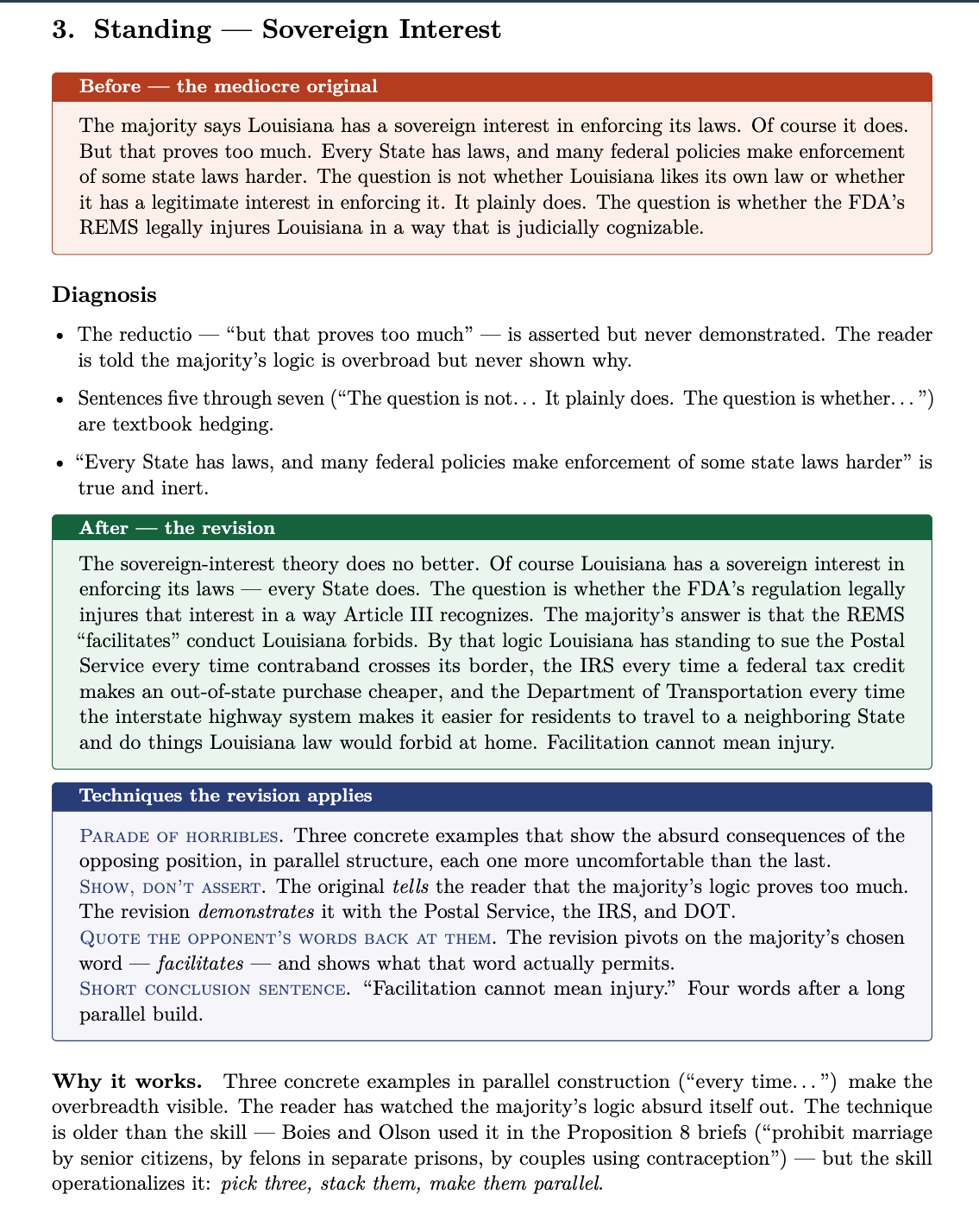
Here's the entire revision file for those who want to examine it.
A Note on the Larger Pattern
I have written before about how the Lawve marketplace and the Claude for Legal release are pushing legal-AI tooling away from monolithic chatbots and toward small, sharable, named skills that encode specific craft. The persuasive-writing skill is the same pattern again. Someone with deep expertise in legal writing — Meredith-Flister has clearly read Kagan and Guberman the way you read scripture — wrote down what she knew. The result is a file you can install in thirty seconds and apply to any draft you have open. Moreover, even if Meredith-Flister were not so expert, or wanted to emulate a different author — say Justice Neil Gorsuch, Judge Richard Posner, or a non-legal stylist like George Orwell — I suspect she could ask AI to analyze the work and produce a rough first-draft emulator. One of the nice things about skill.md files is that they are very human editable.
The legal-education question is not whether this changes how persuasive writing gets taught. It does. The question is whether faculty will incorporate it into the curriculum before students start arriving in our offices having discovered it two years ago and used it ever since. Let's get out in front.
Notes
- Of course I put a draft of this blog post through the persuasive writing skill before publishing it.
- I also put the post through a Lawve fact checking skill also written by the industrious (and skillful) Ms. Meredith-Flister.
- There's a deeper problem lurking here. The old pedagogic sequence was: write badly, get corrected, develop an ear, and only then become able to recognize what makes a Kagan paragraph work. The ear came out of the years of producing red-lined prose. If students now produce serviceable prose on day one, they never serve the apprenticeship that built the recognition capacity. The skill is the floor; the ceiling has not moved; the ladder has been removed from the middle.
So what do you teach? The layer above the moves — judgment, taste, diagnosis. What is this case actually about? Which move does it call for, and why is the default wrong here? Where is the skill confidently producing something a real judge would find boilerplate or overreaching? Perhaps those questions used to be taught implicitly, as a byproduct of producing prose. Now they have to be taught directly, one level of abstraction up from anything a traditional syllabus addressed. Doing so will not be easy.
- There are a lot of ways of getting the persuasive writing skill. If you follow the instructions in my last blog post, you can use it from Claude directly. But you can also go to this website and download the skill.md file. You can then tell Claude or ChatGPT and possibly other large language models to read in the skill.md file and use it to improve a piece of prose you have provided.