
Make law interactive the easy way
One deficiency of traditional legal education is that it is too passive. Students are called to read a lot of stuff and remember it. But too often, unless the student is one of the few who might be called on in a large socratic class or the student is motivated to engage in activities such as outline construction, problem solving, or thinking about legal issues while reading the news, their brain does not engage with the material in an intense way. It doesn't feel like the practice of law – where reality can make learning very intense – or even simulations where at least some degree of emotion merges with abstract theorizing to improve retention. It's kind of like sports. Think of it this way: few learn how to play baseball by reading the rulebook. They learn through the intensity of active practice, making mistakes, and doing better the next time.
Much as I love AI, I acknowledge that all this technology has the potential of making the situation worse. Now, instead of building an outline themselves, the student just gets AI to do the job for them. The act of construction is replaced by a new act of memorization, perhaps on better organized materials but still in a way that is very passive. But AI also has the potential to make learning more active. You can use AI to construct interactive exercises that test your understanding of the material. Traditionally (meaning over the past few years), this might consist of building flash cards or quizzes. And you can certainly do this with NotebookLM from Gemini and other apps. But I now want to show you how easy it is to create a variety of engaging "widgets" that have the potential to improve learning, particularly in subjects test on the bar examination such as constitutional law. It's at least an alternative.
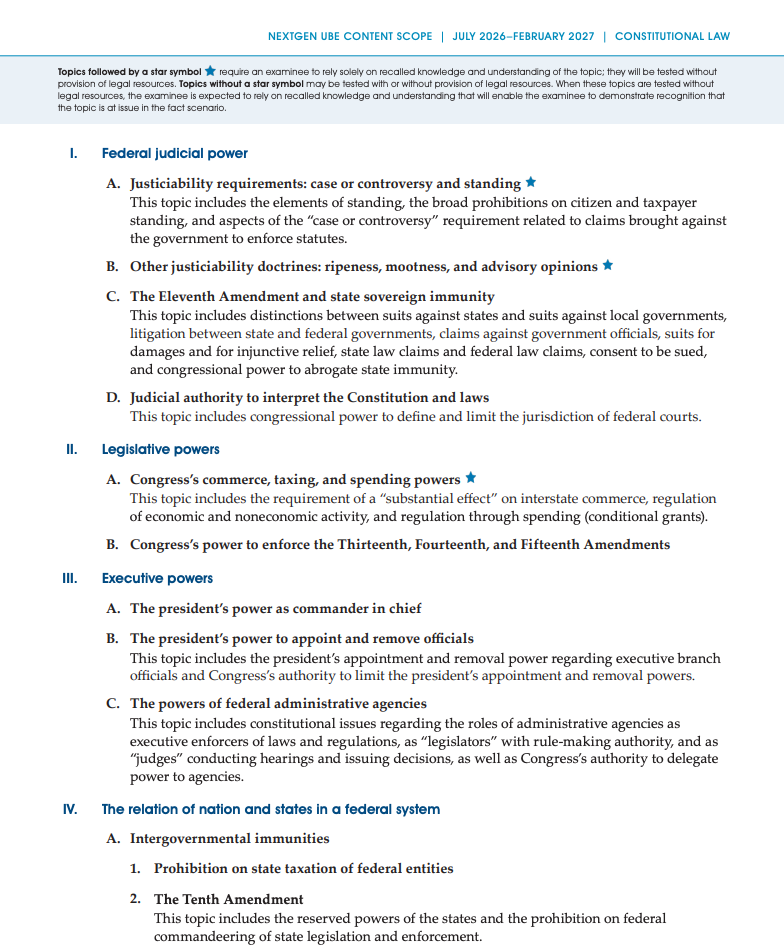
The input data I use here to make law interactive comes from the coverage document provided by the National Conference of Bar Examiners (NCBE) for the NextGen bar exam that many current students will need to pass in order to become licensed. In the field of constitutional law, which is a main area of my current teaching, the NCBE provides a list of roughly 25 topics that the student needs to know, some simply from memory (starred recall items, somewhat akin to memory items a pilot needs to know), others with the aid ofmemory-jogging materials that the examiners provide as needed.
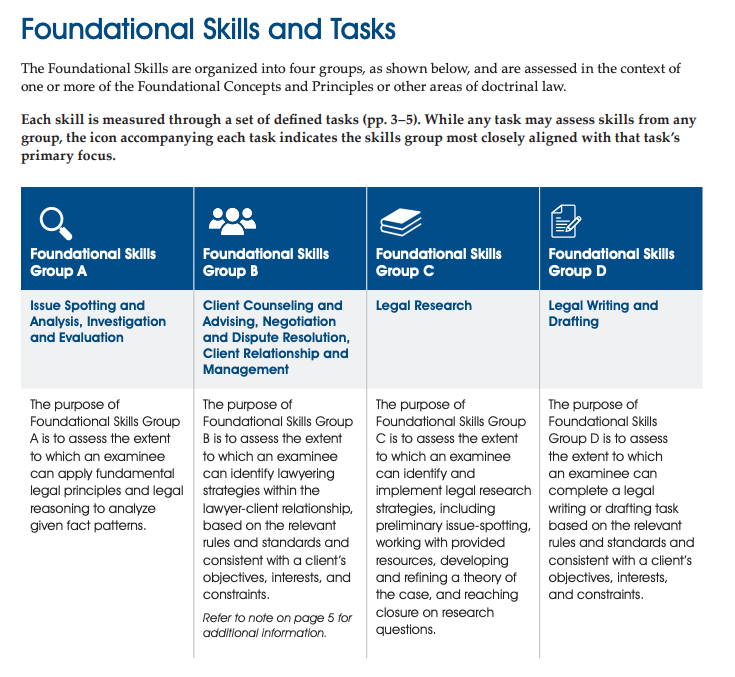
The idea, which I find a significant improvement over the bar exam as it has been traditionally given, is to test on four "Foundational Skills" via 28 different potential tasks.
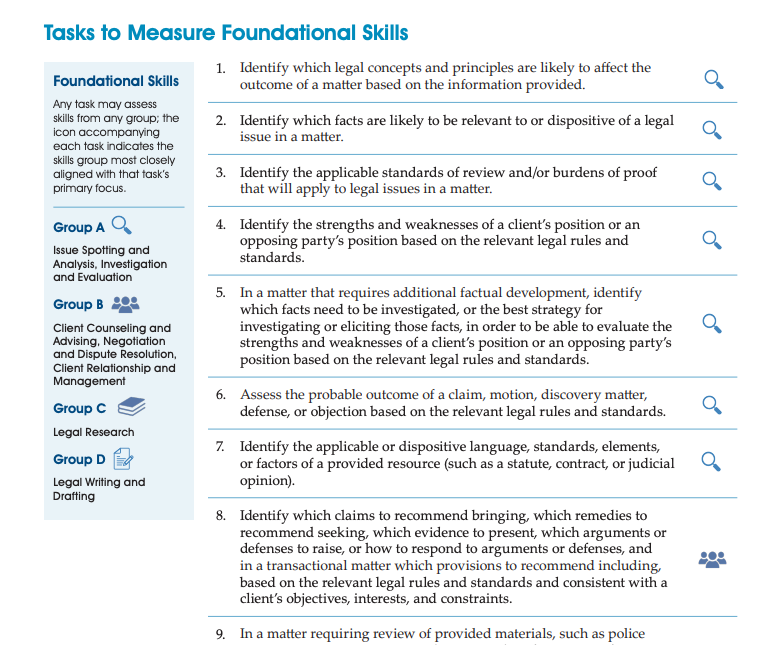
One way to practice for the NextGen bar is to create questions whose skill and task(s) fall into at least one cell of the 4 x 28 matrix implicitly formed by this coverage document. And I may well, at some point in the future, discuss how AI can definitely help in the creation of such questions, particularly when grounded by access to reputable legal databases. I've done some significant preliminary work in this field. But today I have a more modest ambition. I want to show how we can create interactive widgets that at least cover the basics, that orient the student to the type of material they will need to know.
My weapon is Claude Cowork and traditional Claude Chat, along with the newly buffed "custom visuals" feature they provide. But, in the spirit of "show me, don't tell me," let's explore the end product first. Once that's done we can discuss how this material was produced and how you could adapt my methods to your own pedagogic needs.
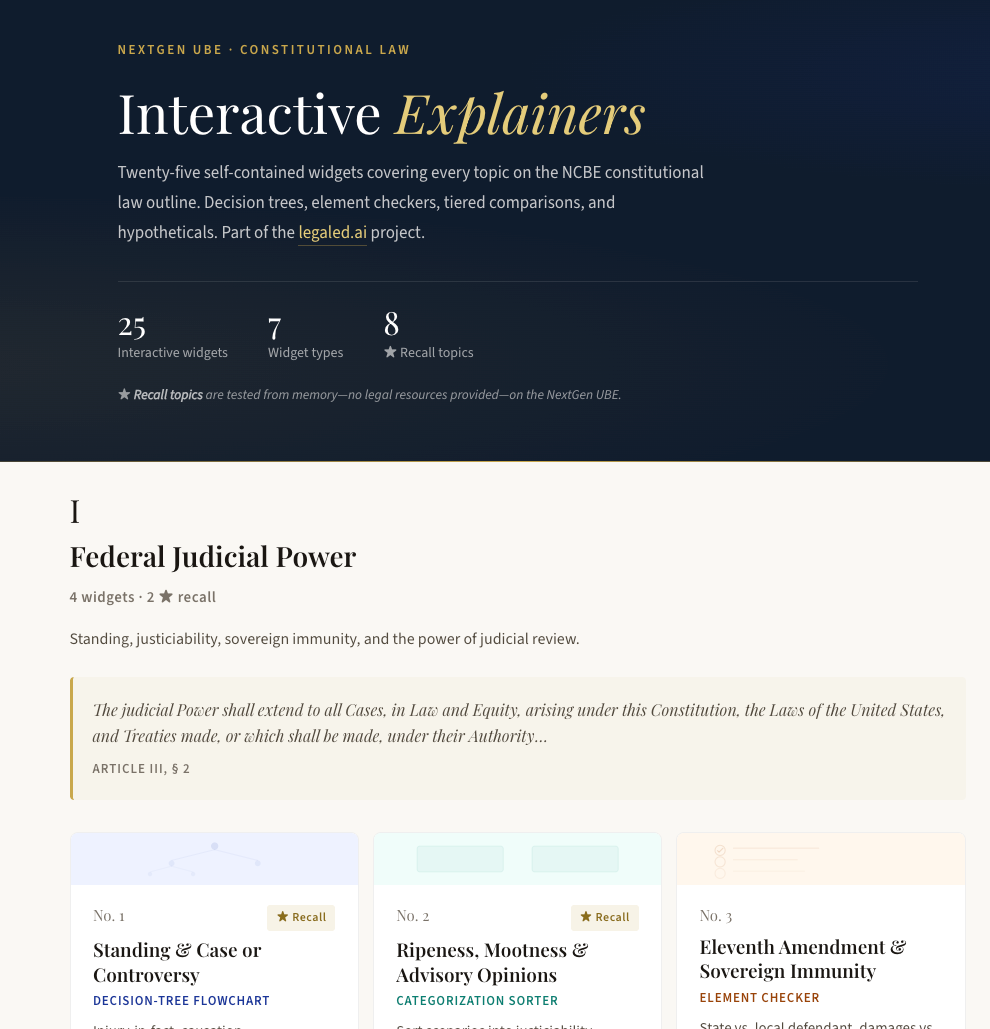
Here's a screenshot of the website Claude and I built together.
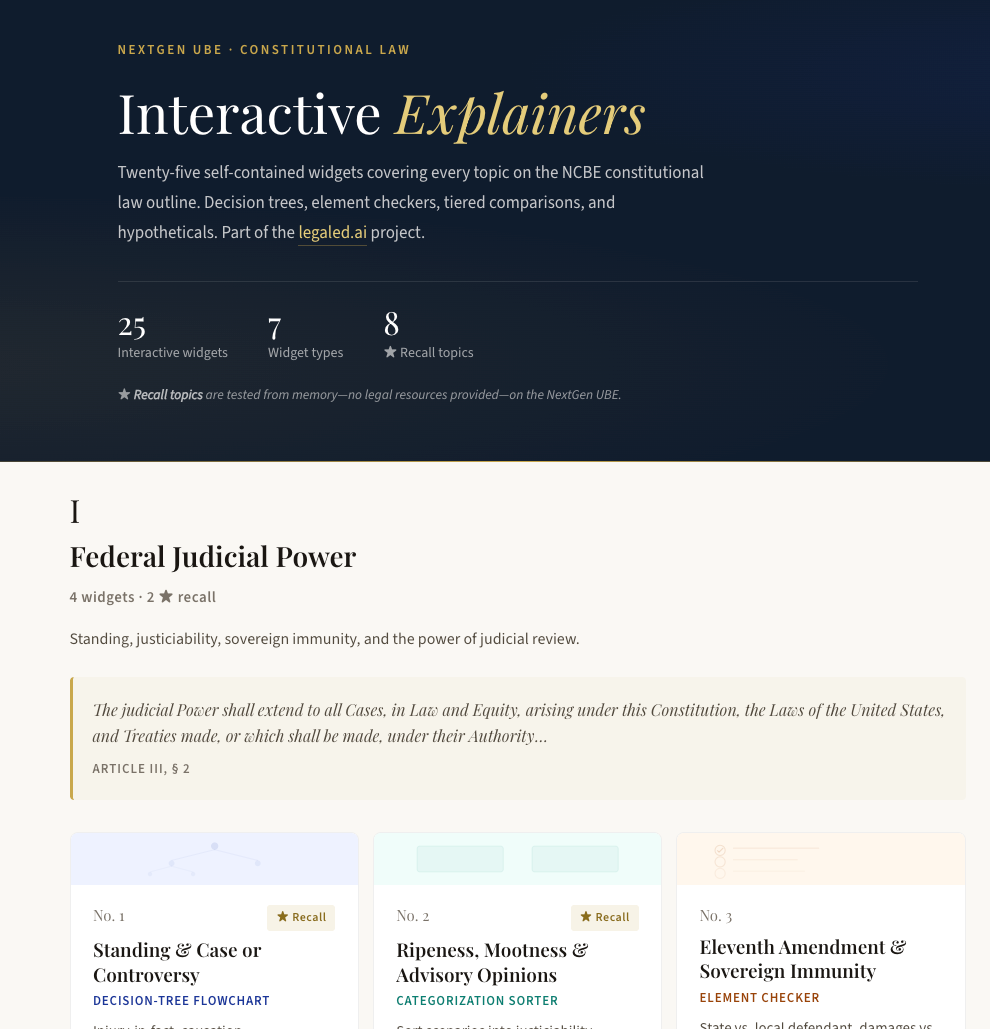
As you can see if you scroll down the actual website, we have a splash page and then visual elements grouped to correspond with the areas of constitutional law contained in the NextGen taxonomy: Federal Judicial Power, Legislative Powers, Executive Powers, Relation of Nation & States, and Individual Rights. And for each of these groupings, there are various widgets: the Relation of Nation & States grouping contains State Taxation of Federal Entities, Tenth Amendment & Anti-Commandeering, Supremacy Clause & Preemption, and Dormant Commerce Clause & Market Participant. When you click on one of these numbered items you are taken to one of the widgets. Let's click on Dormant Commerce Clause & Market Participant. You should see something like this:
You then get a brief instruction segment:
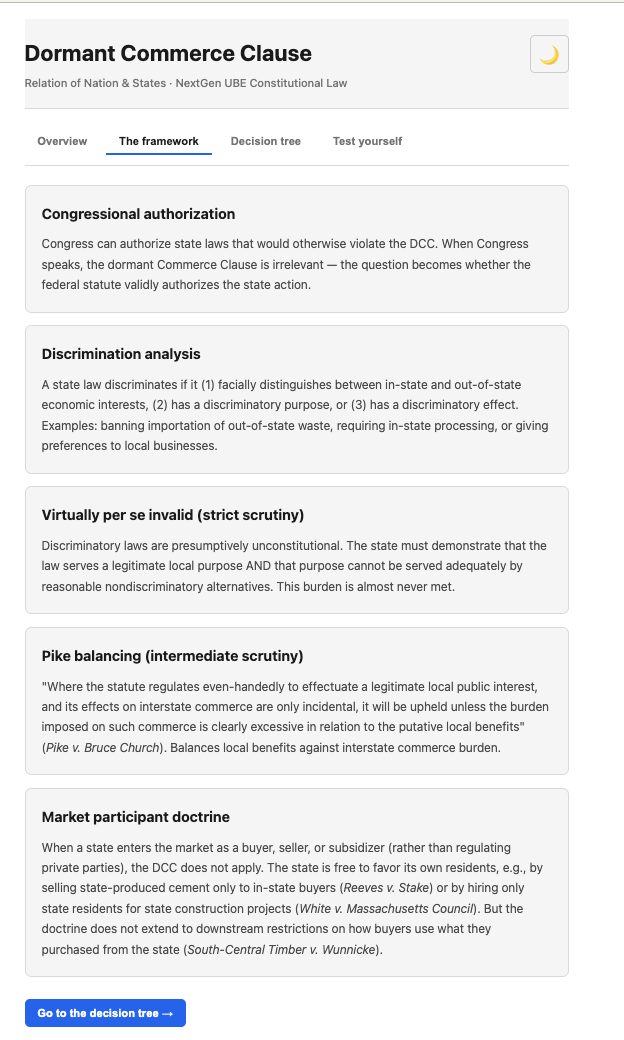
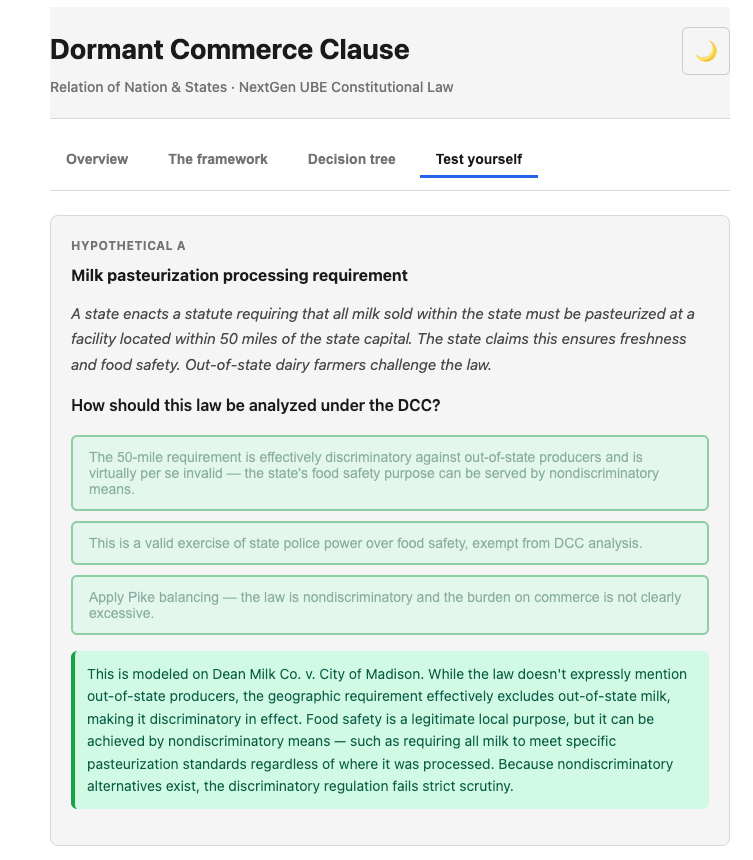
And then you get an opportunity to test your understanding. First you can practice going through a well-ordered decision tree that examines whether Congress has authorized the discrimination (Prudential v. Benjamin fans, take note!) or whether the state is acting as a market participant rather than as a regulator, only then to consider whether the regulation is even handed and, if so, whether the burden on interstate commerce clearly exceeds the putative local benefit. Once you've practiced this a few times, you're ready to test your understanding against some of the provided hypotheticals.
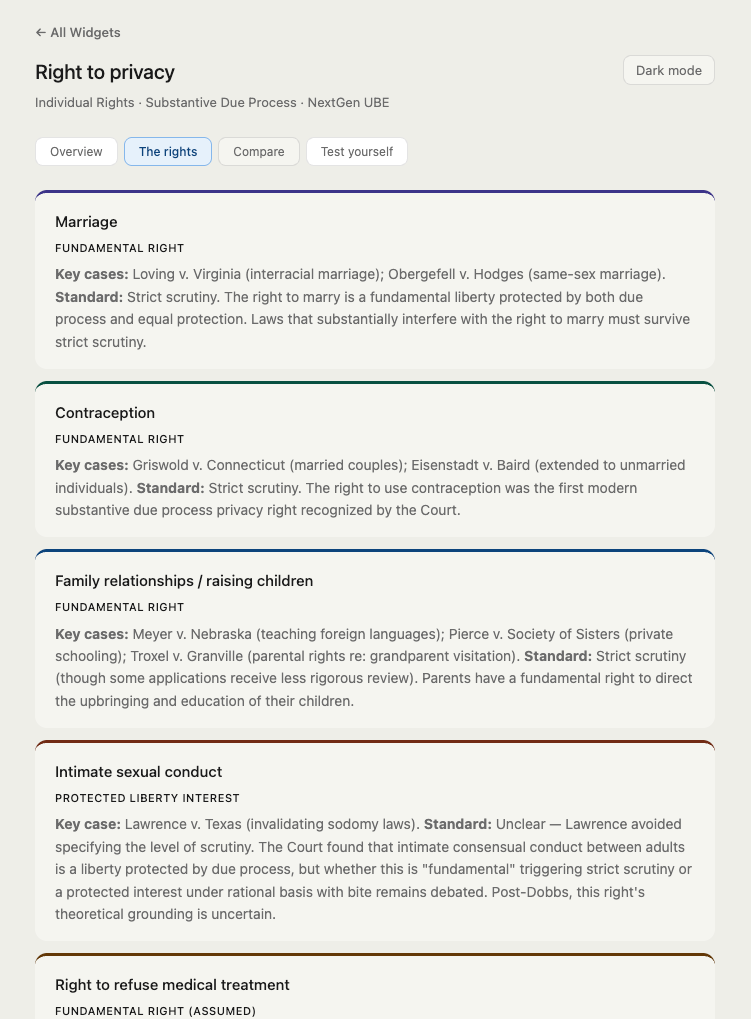
Different topics employ different teaching and testing techniques. The substantive due process topic, for example, identifies key cases for the user.
It then creates a quick summary table ...
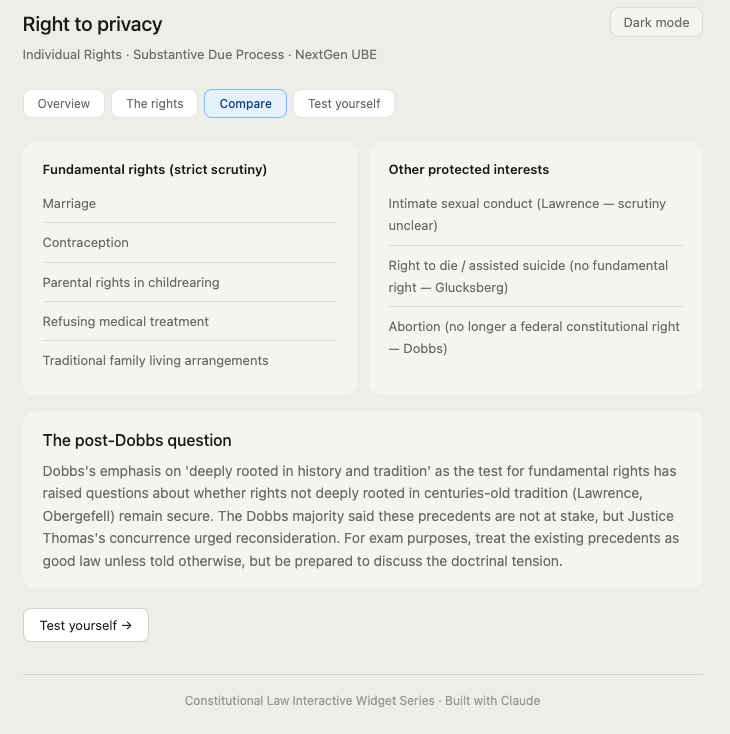
... before taking you to a quiz. Here you can see it providing feedback when I deliberately choose a wrong answer.
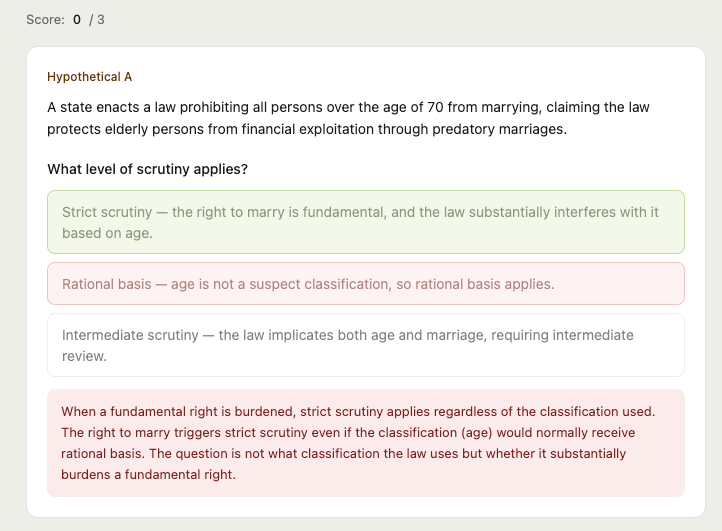
Please note that the widgets are not intended to provide comprehensive instruction nor are the questions intended to be difficult. They are intended to make very basic information available and diagnose areas in which the student's learning may be deficient. Moreover, the real point here isn't the particularities of the widgets or web site created here, it's how you can use this technology in a flexible way whatever your pedagogic purpose. It's another arrow in the AI quiver.
The How To
Artifact creation
Let's now go through how this website was created. First, I imported into Claude the NCBE outline document. I then asked it something like the following: "Suppose I wanted to build a portfolio of interactive educational apps in the field of constitutional law. I don't want to build them one at a time. And I think Claude Cowork is the right tool. How could I do this. Could I upload a syllabus and just say "build interactive educational widgets for each topic in the syllabus or, instead of my syllabus, could you use the content scope outline here for constitutional law and skip all the other topics."
After some back and forth, Claude came up with a "build plan." For better or worse, I did not intervene much in Claude's decision making. I just periodically explained what I was looking for. Here's an excerpt:
Constitutional Law Interactive Widget Build Plan
NextGen UBE Content Scope (July 2026–February 2027)
Each entry maps a topic from the NCBE outline to a widget type and explains the pedagogical rationale. Topics marked ★ in the NCBE outline require recall without legal resources — these especially benefit from interactive drilling.
I. Federal Judicial Power
1. Standing and Case or Controversy ★
Widget type: Decision-tree flowchart
The three-part standing test (injury-in-fact, causation, redressability) plus the prohibitions on citizen/taxpayer standing form a natural sequential checklist. Students work through a fact pattern clicking yes/no at each node; the tree routes them to "standing exists" or "standing fails" with explanation of which element broke down. Hypotheticals test edge cases: taxpayer challenges under Flast, organizational standing, procedural-rights injuries.
2. Ripeness, Mootness, and Advisory Opinions ★
Widget type: Categorization sorter
Students are given 8–10 short scenario cards and must drag-sort them into three bins: "not ripe," "moot," or "advisory opinion." The core pedagogical task is distinguishing these three justiciability barriers, which students frequently conflate. Feedback explains why each scenario fits its category, with attention to the mootness exceptions (capable of repetition yet evading review, voluntary cessation).
I then asked Claude to walk through the build plan and create the widgets in batches and in parallel. Claude basically complied, though due to context window limits and other factors, it took a few sessions and a few corrections along the way. Once the widgets were produced, I saved them as "artifacts," basically code that Claude runs on its own servers. Here's an example of the screen I would see if I pressed the little down arrow next to the "Copy" button.
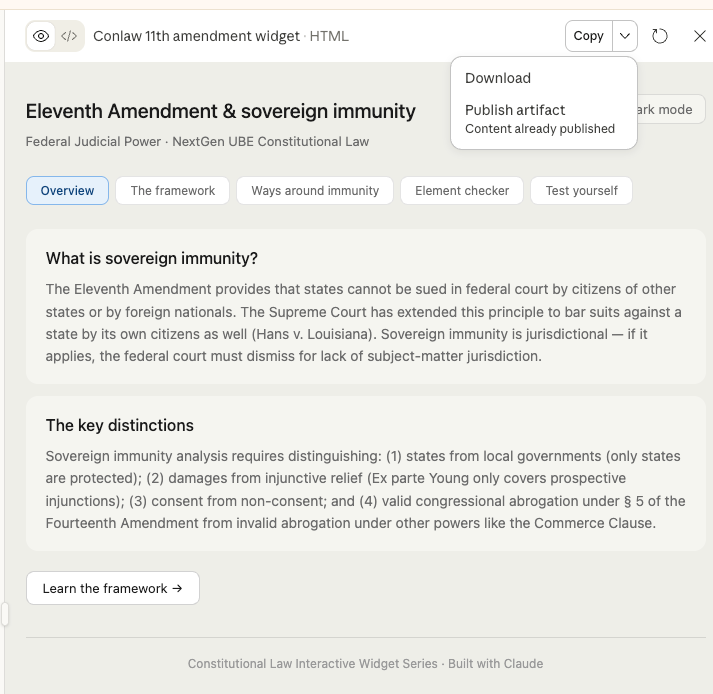
Here, it's telling me that the artifact is already published, but if it had not been, clicking on the "Publish artifact" button would get me a window that contains the URL for the artifact as well as a click to copy button that lets me save that URL to a scratchpad. I ended up with 25 such URLs each of which points to an artifact hosted by Claude.
Website creation
I then wanted to bundle up all my artifacts in a website that I could host on GitHub. I like putting websites there because the process is simple and free. My prompt to Claude was simple: "Can you design a simple webpage that has links to all of these interactive widgets." I then gave it all the URLs I had dutifully stored on the scratchpad. After some negotiation with Claude – the original proposal was rather dull and did not think through use of the website on mobile carefully enough – I had what I needed. Per Claude's instructions, I uploaded all the HTML files to a GitHub repo that I had created for this purpose. Here's a screen capture of what the repo looks like (or at least part of it).
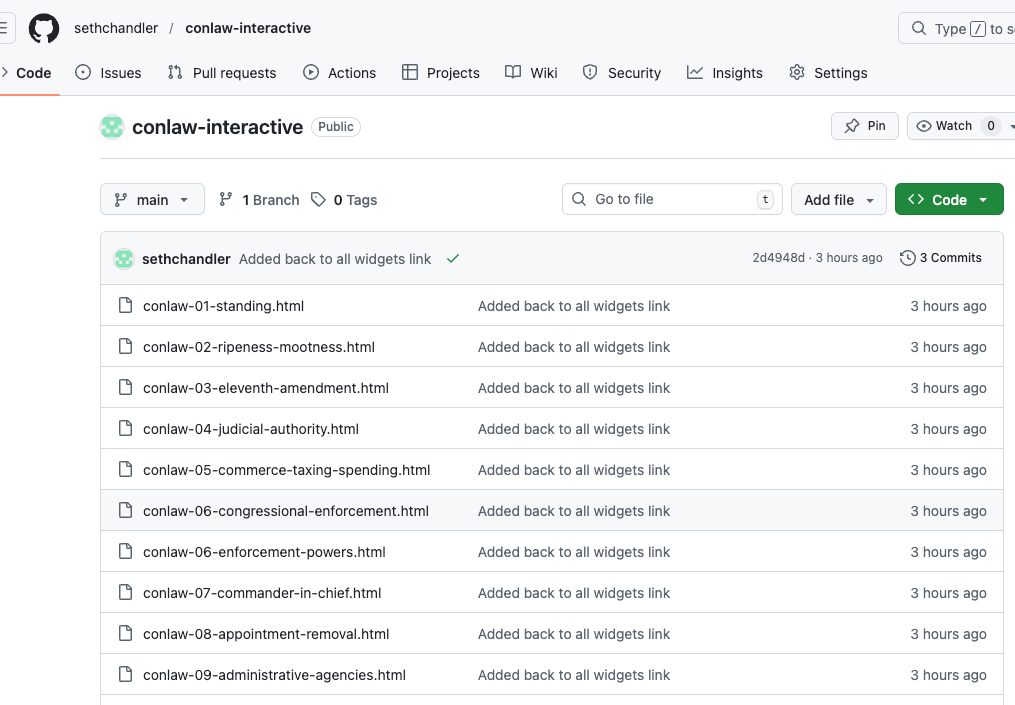
I then clicked on that "Settings" gear icon up at the top left, clicked on "Pages" in the left side bar of the settings page, told GitHub I wanted to deploy from the main branch, waited a minute or so and ... voila... a website. Now, to be perfectly honest it did take a few iterations before all the website navigation worked and the visual elements were to my liking (Claude seems to like very small fonts), but this was just a matter of going back to Claude, giving it screen captures of the website, and telling it to fix whatever deficiency I had found. The revisions were then reuploaded to GitHub which automagically updated the website.
Adapt
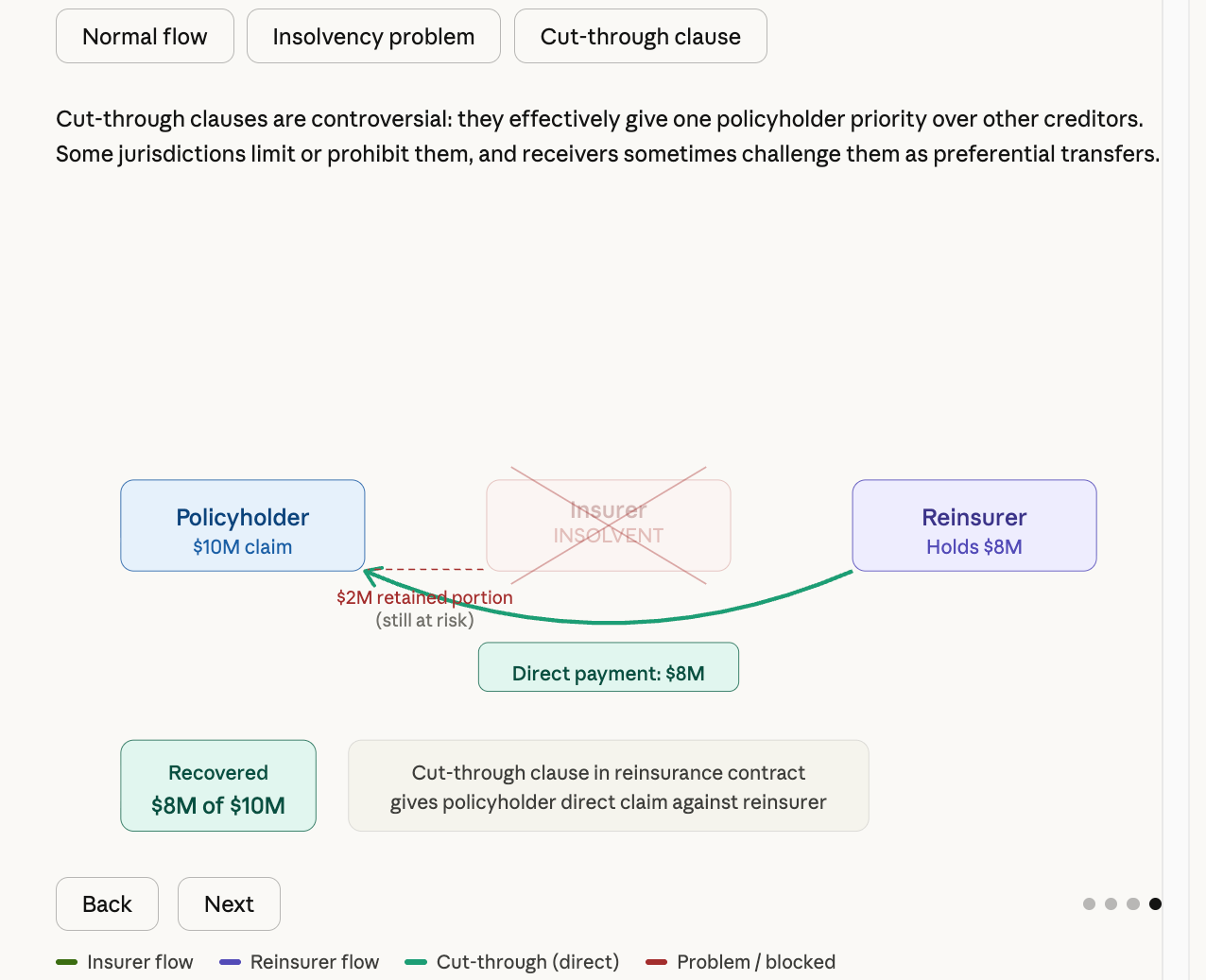
So now let's generalize and figure out how you can use this same technology. The simplest adaptation would be to take another bar subject such as property law or criminal law, upload the NCBE outline and go through the same process. You could take the materials I have posted on GitHub as exemplars and ask for widgets that resemble the work I have done. But there's no need to either confine yourself to an NCBE outline or to the exact style of widgets I've created. Claude is considerably more flexible. Upload, as I originally contemplated, your own course syllabus. Pilfer a casebook from opencasebook.org and use that as the basis for widget production. Or ask an AI to generate an outline of whatever topic about which you want to create a widget-portfolio website. A prompt as simple as "Generate a topic outline on reinsurance law" is likely to succeed on any modern large language model. ChatGPT, for example, just generated an 18 item outline with 64 second level items in response to that very query. Then discuss widget types that you like. Claude is quite flexible. For example, my prompt was "Create an interactive item that shows me how reinsurance cut-through works." Claude responded with a perfectly sensible interactive chart that I saved as an artifact that you can see here. You don't have to build a full website as I did, although one that created a portfolio of interactive widgets on reinsurance law would be thrilling. Here's a screen capture.
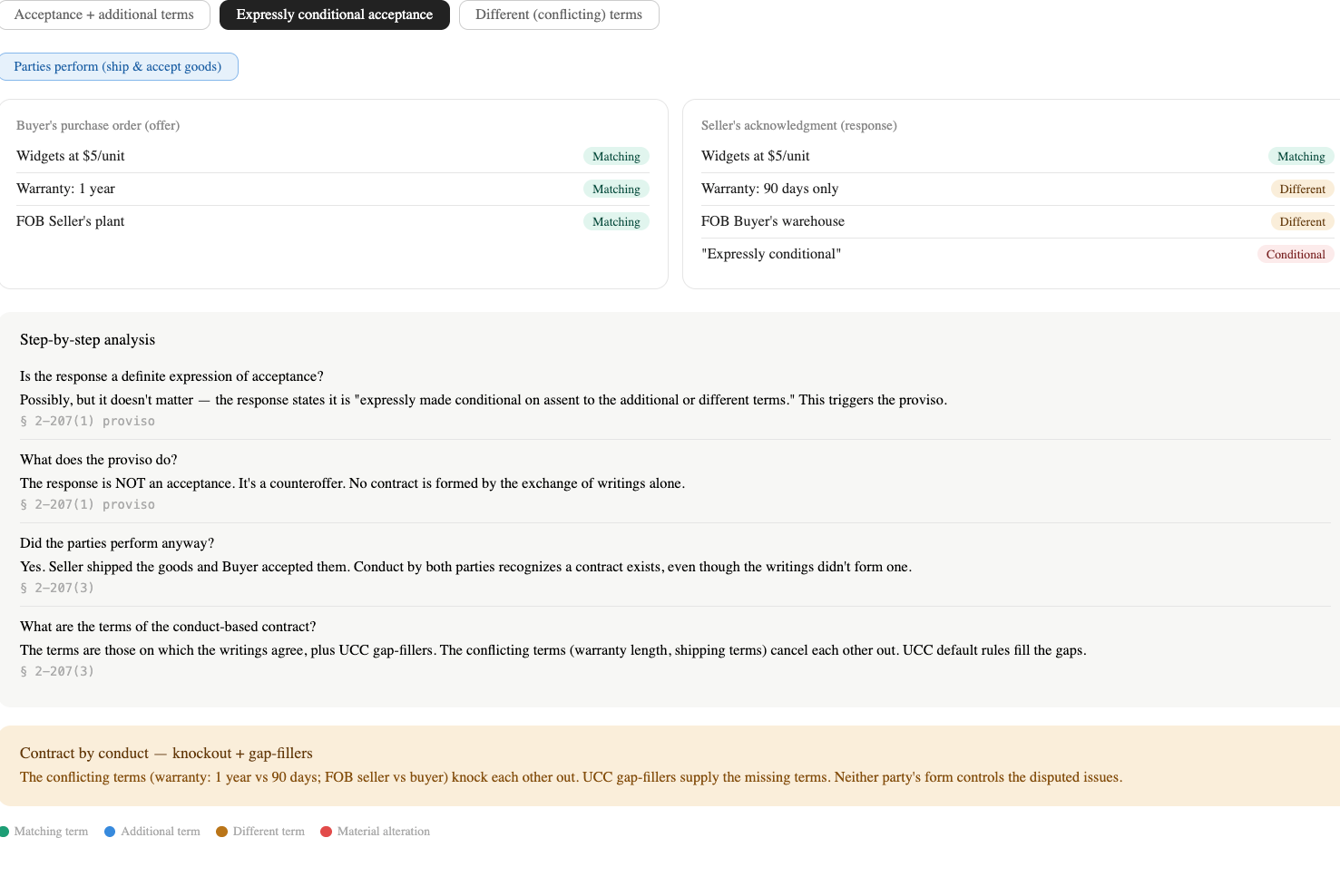
Or here's one on Uniform Commercial Code section 2-207, the infamous "battle of the forms" whose incoherence no one has apparently thought to redraft over the past 60 years perhaps in order to preserve a rite of passage for first-year law students. Again, the prompt did not take much intellectual heft: "Create an interactive diagram that explains how UCC 2-207 works." After a few minutes, Claude generates this. It's a little hard to see as a screen capture, but if you click on this link you will get a working version and refresh yourself on this notorious area of contract law.
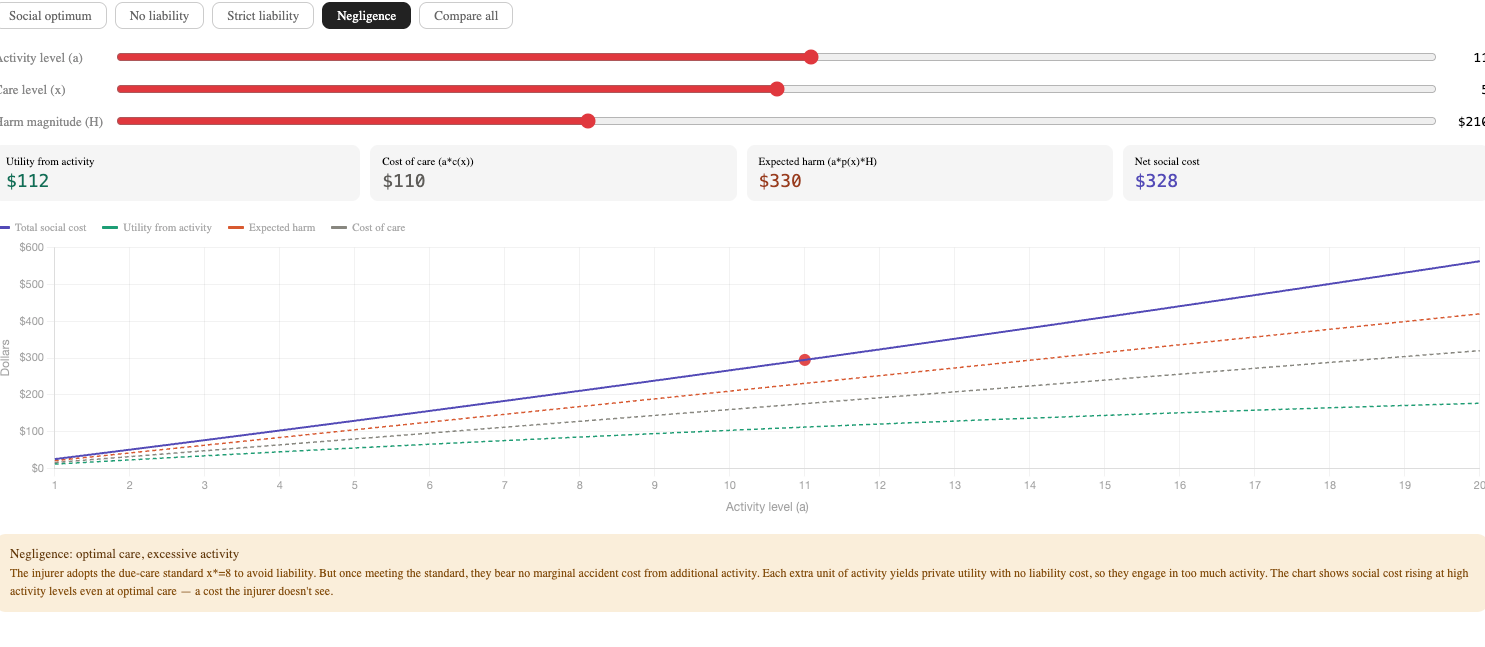
One final example and we will call it a blog post. I asked Claude, "Create an interactive widget that explains Professor Shavell's unilateral accident model with varying levels of activity." After a few minutes, Claude produced what doubtless took Professor Shavell at least a little longer back 40 years ago. Here's a screen capture of the artifact and a link to a working version. People teaching law and economics either as a standalone class or as a courageous component of some other course (torts) no longer need to make elaborate diagrams themselves. They can create an exploratorium for students.
The takeaway
Students learn differently. Some learn by reading. Some by listening. Some by outlining. Some by simulating. And some in eclectic ways (creating songs, arguing with friends, etc.). With modern large language models it now becomes possible for both teachers and students to cater to students who learn by interacting with text or with controls and seeing what happens, the same way they might at a modern science museum. The advantages of that learning modality haven't increased in recent years. What has changed, however, is the cost and difficulty of producing these interactive widgets. With modern large language models such as Claude the amount of effort it takes to generate reasonable quality interactive demonstrations has gotten very low. The barrier to entry has essentially vanished.