
Harvey Can Write a Screenplay: Explaining Congress's Power to Investigate After the Midterms
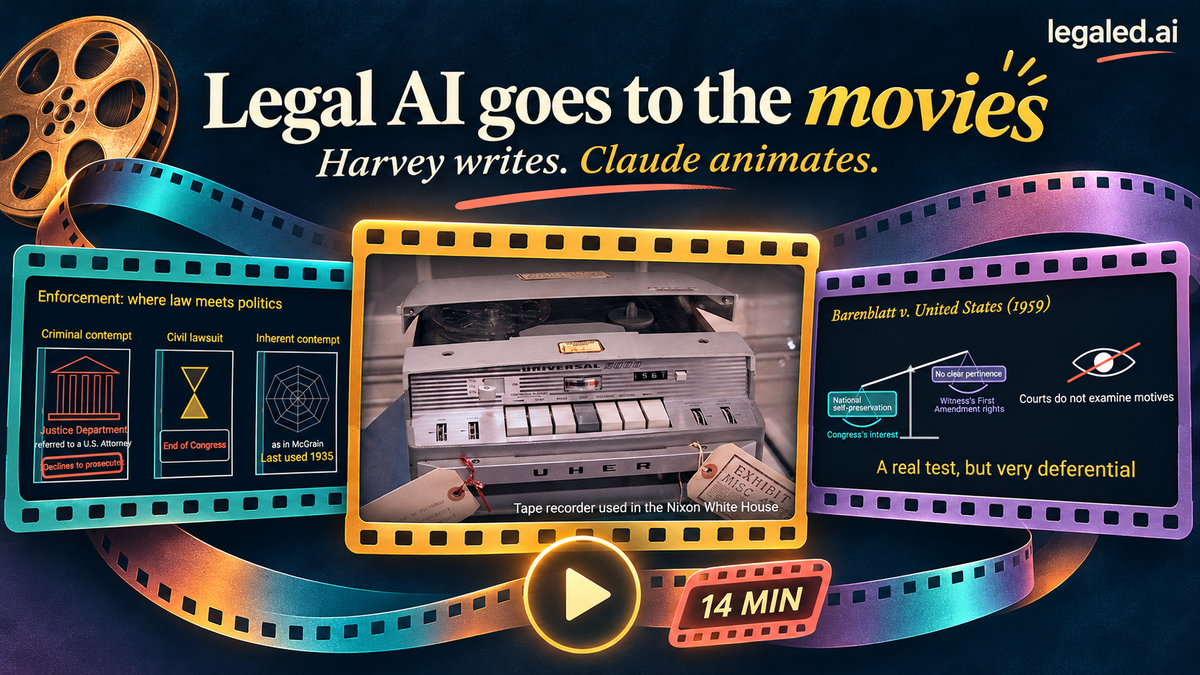
I just made a 14-minute animated video on Congress's power to investigate the executive branch. The timing is deliberate. In Tuesday's midterm elections, Democrats won control of both the House and the Senate. Democrats are unlikely to pass much legislation, because President Trump has said he will become "Mr. Veto" and will probably block their bills. Investigations are the tool Democrats will still have when the new Congress convenes in January. I expect Democratic committee chairs to aim investigations at alleged corruption and at the administration's conduct of the war with Iran.
Journalists and students will need to understand how those investigations work and where their legal limits lie. A video for that audience has two jobs: it has to get the law right, and it has to make the law watchable. I gave those jobs to two different AIs. Harvey wrote the screenplay. Claude turned the screenplay into a finished video. The result is up on YouTube. Claude could probably have done the whole thing alone; I did not give it the chance. I got Harvey two weeks ago and have been pushing its limits ever since. I have come to think Harvey can do a lot more than people realize. A movie screenplay about a breaking political story seemed like a fair test.
What I asked Harvey to do
The first job was a lecture. I asked Harvey for a 2,500-word lesson for law students on Congress's investigative power and its limits. The lecture runs from Kilbourn and McGrain through Watkins, Barenblatt, Eastland and Trump v. Mazars. It argues that the power is broad, implied and largely self-policed, and that real fights with the President usually end in negotiation rather than judgment.
Then I asked Harvey to turn the lecture into a screenplay for a 15-minute video in the style of 3Blue1Brown, using Manim animations and Ken Burns pans over still photographs. I added two requests: quote the courts, and make the quotes look good on screen. I knew another AI would build the video and Cartesia would voice it, so I asked for a screenplay that machines could follow.
What came back was a production document. It had twelve scenes. Each scene had a timecode, numbered animation directions, quote cards and the exact narration to send to the voice service. It also had a style guide covering colors (teal for Congress, coral for the executive, violet for the courts), typography, a quote-card template, Ken Burns settings and a pronunciation guide for names like McGrain and Mazars.
Why Harvey suits this job
I would not have predicted how well Harvey fits this work. Probably like most people, I had thought of it as a tool for deal documents, diligence, and briefs. But, like them, a screenplay on a legal topic is mostly an exercise in disciplined legal thinking. So, why not?
First, the substance has to be right before anything is animated. A video is a poor place to discover that you misstated a holding. Harvey's lecture had a legal structure to build on: a source of power, a checklist of limits, and a section on the executive branch. The screenplay inherited that structure, but the audience never feels the scaffolding.
Second, the screenplay is a document with many working parts. It has timing, visuals, quotations and narration, all of which must agree with each other. Keeping those parts in agreement is closer to drafting a contract than to writing a poem. That coordination is the kind of document work Harvey is built around.
Third, the model Harvey selected put in the safeguards a handoff needs. The screenplay told the production team to verify every quotation against the official opinion before rendering, and not to alter words inside quotation marks. It told them to confirm the rights status of every photograph. Thanks for saving me a take down notice.
Where I fell short
I made a rookie but instructive mistake in using Harvey. Our academic license does not permit users to connect Harvey to Lexis. (Insert sad emoji here). It does permit you, however, to connect it to CourtListener and, if you have a subscription as I do, to Midpage. Either method is a lot cheaper than Lexis and lets you ground Harvey in actual caselaw. But those connections aren't yet automatic in a new "thread" and I forgot to set it up. As a result, Harvey made a small mistake. Its quote card for United States v. AT&T read "an optimal accommodation" and dated the opinion to 1976. When Claude checked the quotation against the opinion, it found that the court wrote "seek optimal accommodation" and that the opinion is from 1977. Claude fixed both the narration and the card.
Time to trot out the cliché: verification is not optional, even when using the most powerful AIs on the market.
What Claude did next
Harvey can produce many types of files: it built the Word documents for this project and I have been using it to make PowerPoints, which it does quite competently. But this video appeared to need a media pipeline using capabilities I still do not believe Harvey yet possesses. Enter Claude.
· Building the animation. Claude installed Manim, wrote about a thousand lines of Python across twelve scenes, and rendered them at 1080p. It timed each scene to the narration so that a quote card appears as the narrator begins the quotation and its words turn gold as they are spoken.
· Making the voice. Claude used my Cartesia key to generate narration in "Seth," a clone of my own voice, and checked the pronunciation of names such as Daugherty and Mazars by running the audio through speech-to-text.
· Gathering and treating images. Claude pulled the Constitution's first page from the National Archives, a 19th-century engraving of the Capitol, a Teapot Dome oil field photograph and a Nixon tape recorder, tinted each toward the navy palette, and credited them at the end.
· Looking at its own work. Claude made low-resolution test renders and reviewed frames from every scene. Those test renders caught overlapping labels, text running off the screen, and a bug that dropped the last letters of quoted lines.
· Human in the Loop. On Claude's first effort my synthetic voice just didn't sound as it had in the past. Instructed by me to investigate, Claude traced the problem to two changes from my earlier videos: an older Cartesia model, and sentences sent one at a time and stitched together. It redid the narration with each scene as a single request, inserted pauses afterward from word timestamps, and re-timed all twelve scenes.
Claude also departed from the screenplay in three places. It cut the frame rate to 30 frames per second, skipped the music bed because no licensed music was available, and drew the House Un-American Activities Committee scene instead of using a 1950s photograph whose rights it could not confirm. Last, it wrote the YouTube description and chapter list from the actual scene lengths.
Moral of story: Push your tools past their labels
If you use Harvey or a similar legal AI, try this experiment. Stop asking only for memos and contract markups. Push it. Ask for the next artifact in your teaching or practice: a screenplay, a training module, a mock hearing script. Then ask which tool could turn that document into the finished product.
If you use Harvey or a similar legal AI, try giving it a job outside your usual requests. Think of something you would like to make for a client or a class but have put off because producing it seemed too complicated. Ask Harvey to develop the material, then see what another tool can do with it. My screenplay became a video; a lawyer’s explanation of deposition procedure might become a training module for witnesses.
Most lawyers will have little occasion to commission a screenplay. The broader value is having room to experiment with uses the software’s designers may never have anticipated. Harvey deserves credit for allowing that flexibility. And its growing connections to other tools suggest that the company understands how much customers can accomplish when they can carry their work beyond Harvey itself.
Harvey looks like it is resisting any temptation to become another closed system. Last month Harvey made its Connector Library generally available. The library includes Custom MCP, which lets a firm connect any tool that speaks the Model Context Protocol, the open standard for linking AIs to outside tools and data. Connectors are how my academic workspace reaches CourtListener and Midpage. I'm hoping my workplace administrators let me connect it to capabilities that interest me such as Wolfram MCP so that Harvey can do math. The openness runs in the other direction too: Harvey publishes its own MCP server, so Claude, Gemini and Microsoft 365 Copilot can call Harvey directly. A company building a walled garden would not open doors in both directions. And maybe one day the Connector Library will include a movie plugin. Certainly the next two years of oversight fights will supply plenty of fodder for the next screenplay.