
AI can now produce a respectable case comment
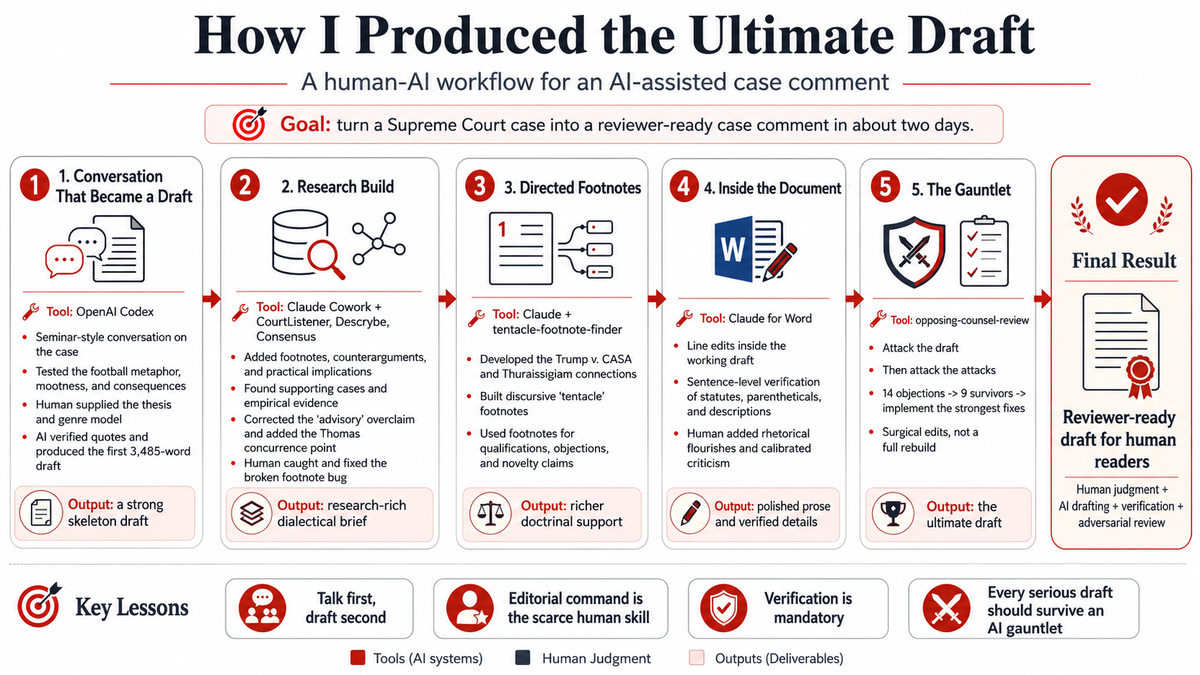
Days after the Supreme Court decided Mullin v. Al Otro Lado — the June 25 decision holding that an asylum seeker blocked one step short of the borderline has not "arrive[d] in the United States" — I decided I wanted to collaborate with AI in writing a case comment on the subject. Two reasons: (1) I was curious to see what advances there had been over the past six months in AI production of legal scholarship and (2) I actually needed to say something intelligent about the case because my dean had volunteered me to do so in a month at a Supreme Court CLE likely to involve over 500 legal professional attendees. That latter task was complicated by the fact that, although I know something about immigration law and federal courts, neither are areas in which I would claim the highest level of expertise. If, however, I could succeed here by using AI heavily to produce quality legal scholarship in areas to which my own expertise is only indirect, it would suggest that subject-matter expertise is becoming less a prerequisite for legal scholarship than a head start — a proposition that should unsettle and interest law faculties in roughly equal measure. The experiment seemed worth running.
I did not expect nor did I have any problems in getting a modern AI to say something reasonably coherent about the case and to do a good job at summarization and explication. Any current model will produce four thousand fluent words on Al Otro Lado in minutes. The obstacle is that fluent drafts fail in ways that matter to the only audience I care about: theses overclaimed by half a step, the concurrence nobody read, footnotes that do not exist, or the strongest opposing argument never engaged. The interesting question is not whether a model can write a case comment. It is what workflow turns a model's draft into something you would put your name on.
Attached below is the result of my efforts. You can see it indeed has my name on it.
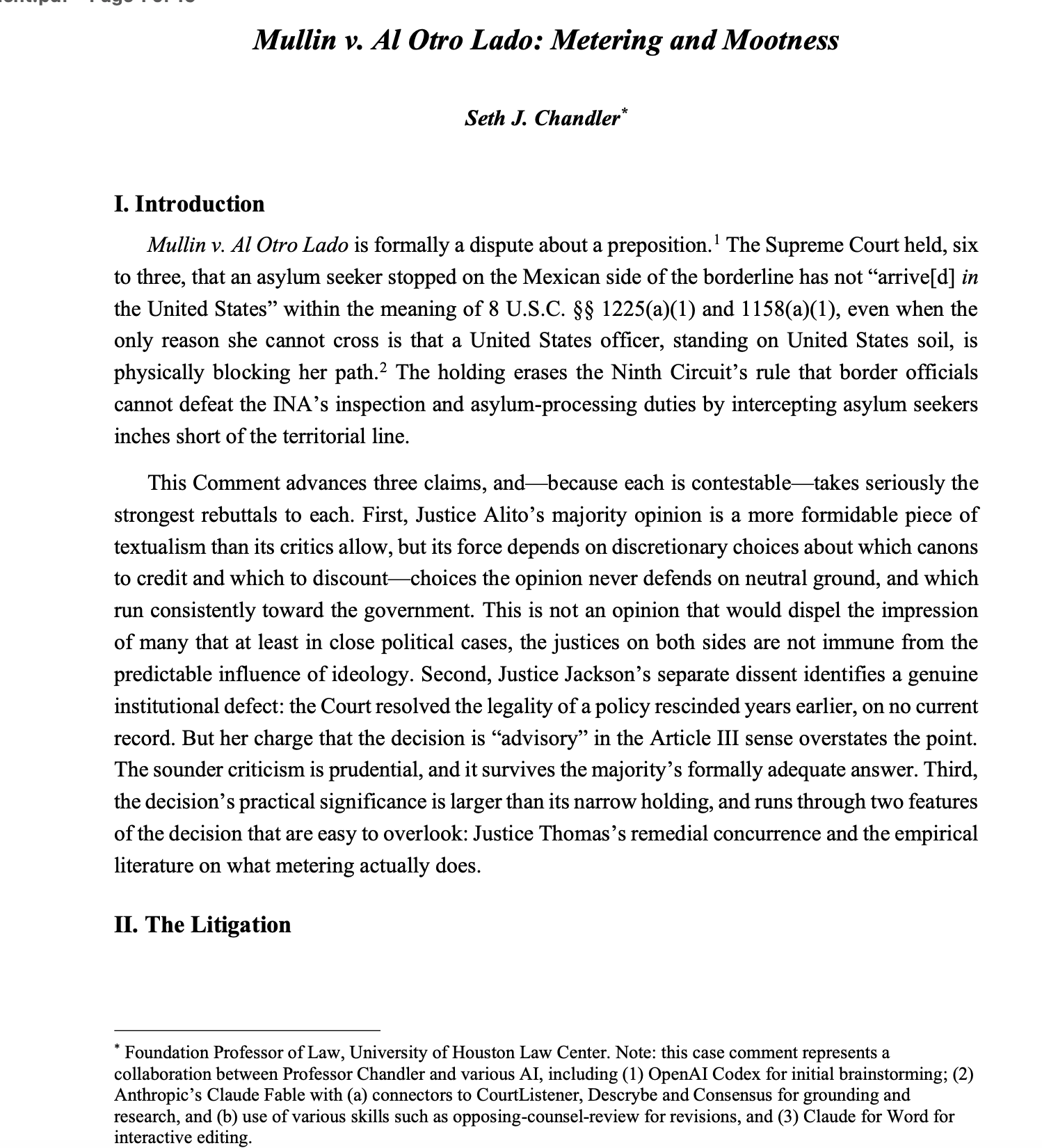
Why should any of this matter to you? Because of what the exercise reveals about the present moment. The point is not so much the case comment itself, though I think it is pretty decent, but what producing it demonstrates. It now takes little effort and only a modicum of legal knowledge to turn out scholarship that is genuinely decent, if not quite outstanding. With a capable frontier model, connectors that reach primary legal materials, and a modest amount of domain expertise, a single author-cum-producer can now assemble what I would regard as fairly sophisticated legal scholarship. That is a change in kind, not degree, and the legal academy has not yet reckoned with it.
It needs to reckon with it, and soon. These developments force three questions the profession has mostly deferred. How should we evaluate scholarship when a plausible, competently cited, footnoted comment can be produced in about two days? What even counts as scholarship when the drafting is largely machine-supplied and the human contribution lives between the sentences rather than in them? And what are the right expectations for the scholarly productivity of faculty who have these tools within reach? I do not pretend to have settled answers. I am fairly sure the current ones are now wrong.
In the meantime, there is a practical use for what follows. You can treat the workflow I describe below as a template. It's a repeatable procedure you can use or adapt to whatever question interests you. I suspect the end product will be real scholarship by which I mean material that provides knowledge and insights that might be difficult or inefficient to capture otherwise.
The rest of this post is that template, session by session, with the prompts left in: OpenAI Codex for a conversation that became a draft; Claude Cowork wired to CourtListener, Descrybe, and Consensus, for the research build; Claude for Word for line work inside the document; and three skills (tentacle-footnote-finder, opposing-counsel-review, belcher-proof, copy-edit, check-doc, verification-xxxxx) fired at moments I chose. Since I have the transcripts of my sessions with AI, I can show you the prompts, warts and all. Indeed, here they are.
Phase one: the conversation that became a draft
The Codex session did not start with "write a case comment." It started with a session in which I was trying to understand a Fifth Circuit decision, Sosnava Rodriguez v. Ortega, that a friend had mentioned to me about habeas relief for immigrants held without bond. I had run my “case-briefer” skill on that case. I then decided to shift gears and start in on Al Otro Lado. I’d read the case quickly and had been immediately troubled by the majority’s use of a football metaphor to equate arriving in the end zone with arriving in the United States. It struck me that there were relevant differences:
use the same skill [case-briefer] to brief this case. Add a separate section discussing the legitimacy of the football analogy – player tackled at one yard line. The point is that asylum law is not supposed to resemble football in which the goal of one team is to prevent the other person from "scoring". Does the dissent pick up on what I regard as a deeply flawed metaphor.
Codex extracted the 70-page slip opinion, verified the quotations against the Supreme Court's PDF and Cornell's copy, and reported back that the dissents split the work: Sotomayor answers the majority's analogies indirectly with her movie-theater counter-example, while Jackson attacks decision-by-metaphor head on. That answer mattered, because it told me my irritation was not idiosyncratic.
Then came a half-dozen exchanges that look, in the transcript, like a seminar. I pushed on mootness ("Justice Jackson seems to me to make a pretty strong case that the court should not have decided this case at all. Why do you suppose the majority did decide to take on the case?"). I pushed on consequences ("If the US were now to actively obstruct people from reaching the border, under this opinion, those people would still not have arrived in the US and the only issues would be whether we had violated treaty obligations? Correct?"). I pushed on the dissent's own soft spots ("Justice Sotomayor has some decent points in her dissent, but how would she propose dealing with a massive number of people seeking admission to the United States?"). And somewhere in there I talked myself into the thesis, possibly with some overstatements on my part:
I don't know, the more I think about this case, the more I think Justice Jackson had the best point. It just doesn't seem to me there are enough facts here. . . . The fact that it existed once surely isn't enough to justify Supreme Court review just because, well, the current administration hasn't ruled out doing it again. That would render unmoot basically the entire history of american law.
Only then did I ask for a document — "Create a 2000 case comment . . . It should capture our conversation and present Justice Jackson as having the most persuasive opinion" — and the first version was structurally wrong. It read like a memo of our chat. The fix was mine, and it was the cheapest edit of the whole project: I sent Codex a link to a Harvard Law Review case comment (Walls v. Sanders) and said "make it read like that." One more nudge ("You still have not really discussed the statutory interpretation issues, particularly Justice Alito's reasoning") and the draft stood at 3,485 words.
Notice what each side contributed. The thesis, the football objection, the "greenlighted policies" frame, and the genre model came from me — through conversation, not specification. Could an intelligent rank amateur have done the same? I think not. Could one of my better upper-level students? Probably. Codex contributed fast reading, quote verification, honest reporting on which dissent said what, and a document pipeline that rendered its own output to page images and checked them. What it did not contribute: a single footnote, any engagement with the Thomas concurrence, any empirical evidence, or any pressure against my own claims. What Codex produced was a skeleton with a spine but no immune system.
Phase two: the research build
I moved the draft to Claude on Cowork because that platform had the connectors. I also had heard that Claude Fable had re-emerged from government censorship and was now available. It was definitely worth retesting that model, particularly when for the next few days only it would be available “for free” within my subscription and not billed by the token. The assignment prompt is worth quoting because the last sentence is the one I would now copy into every scholarly prompt:
Read this case and this draft case commentary. Then use your Courtlistener, Consensus and Descrybe connectors to improve the case commentary. Improvements should include footnotes, a critical analysis of the arguments made in the case, including but not limited to justiciability, and a harder look at the practical implications of the decisions. You should also critically appraise the arguments made in the case comment and provide reasonable rebuttals and surrebuttals.
Call the result of this prompt the dialectical brief: every load-bearing claim paired with its strongest rebuttal and a surrebuttal, in the text, not the margins. Watching the process is instructive because the connectors miss before they hit. Claude's first CourtListener query — full-text search for Sadhvani plus "arrives in the United States" — returned nothing. The retry, searching the case name alone, found Sadhvani v. Holder, 596 F.3d 180, in the Fourth Circuit, filed December 31, 2009, which is why the comment can cite the majority's circuit support with a straight face. The same session verified the Ninth Circuit history down to the en banc denial over twelve dissents, ran Munsingwear, Bancorp, Fikre, and Camreta through Descrybe, and put this query to Consensus: "asylum metering ports of entry US-Mexico border effects migrants." The top result was the Amuedo-Dorantes and Puttitanun econometric study finding that metering increased unauthorized crossings among the nationalities it targeted. These finds generated a section arguing that the majority resolved an empirical question with no record and probably got the empirics backwards.
The build also corrected me. My Codex-era draft called the decision "advisory." The Cowork draft demoted that to a prudential objection because an extant declaratory judgment plus Chafin satisfies Article III. The Court's vice lies in its grant of certiorari and equitable practice. The Cowork draft likewise added a section I had entirely missed: the Thomas concurrence as a remedial time bomb, reading § 1252(f)(1) through Grace Brethren to threaten even declaratory relief for a certified class.
Then came the bug. We are not yet at the stage where one can push a “produce quality scholarship” button and expect AI to deliver a polished result. The delivered document had footnote numbers with no footnotes under them. Oops! My prompt:
It looks to me as if the text to these footnotes are missing: 3,41,42, 50,54,55 . That is a big problem. Please figure out what is going on.
The diagnosis took one script: the file carried 66 footnote references but only 57 definitions, because the generator had reused a single definition wherever the same authority was cited twice. Word numbers every reference; the text attaches only to the first; the second occurrence displays a number pointing at nothing. There were ten of these — I had caught six. The rebuild gave every reference its own note with proper short-form cites, and the generator now throws an error if any footnote is referenced twice. Two lessons follow. The document validator passed while the document was broken. And the failure surfaced only because a human producer (me) read the output the way a human reader would. Trust, but count. Repeat after me: Never submit anything you care about produced by an AI until you have verified it carefully.
One more correction from this phase belongs in the record because it is about genre, not substance. An intermediate draft kept referring to its own revision history — "the original draft of this Comment pronounced Jackson's dissent the most persuasive opinion." My testy response: "Absolutely no discussion of prior drafts. This is a standalone document. . . . I don't know why you made a decision to write it this way." Models apparently default at times to narrating their work. Scholarship does not carry its scaffolding into print, and apparently nobody but the editor was going to enforce that directive.
Phase three: directed footnotes
The next round involved direction more so than delegation. I supplied doctrinal ideas that I would like to think would be developed only by someone who had some considerable domain expertise. It required a suspected connection between the opinion language and two cases that I periodically teach in my constitutional law class: Trump v. CASA (2025) on federal remedies and Dep’t of Homeland Sec. v. Thuraissigiam (2020) on fictional non-presence. I had the model research, draft, and push back. The instruction that shaped the Trump v. CASA footnote shows the pattern:
It is correct but it needs at least a footnote discussing Trump v. CASA on federal remedies absent a class action. The thomas concurrence + Trump v. CASA collectively work to narrow federal remedies. Use Consensus to find secondary literature on this point. . . . Also, if you think Trump v. CASA has less relevance than I am claiming, explain that in the footnote.
The model agreed with my pincer claim: universal injunctions gone after CASA, classwide relief barred in this context by § 1252(f)(1), individual relief useless to someone who under Mullin has no rights until she crosses — but it wrote the strongest objection into the note anyway (the Al Otro Lado plaintiffs proceeded through a certified class, the very vehicle CASA endorses) and then answered it. The fictions footnote ran the same way. I asked whether it was fair to charge the Court with indulging a fiction of non-presence in Thuraissigiam — twenty-five yards inside the country becomes "the threshold of initial entry" — while refusing any fiction of arrival in Mullin, and I ended with "If you think this is unfair, tell me." The model vetted the charge as fair, then added some useful detail: the entry fiction is inherited doctrine going back to Nishimura Ekiu in 1892, while Mullin construes a statute.
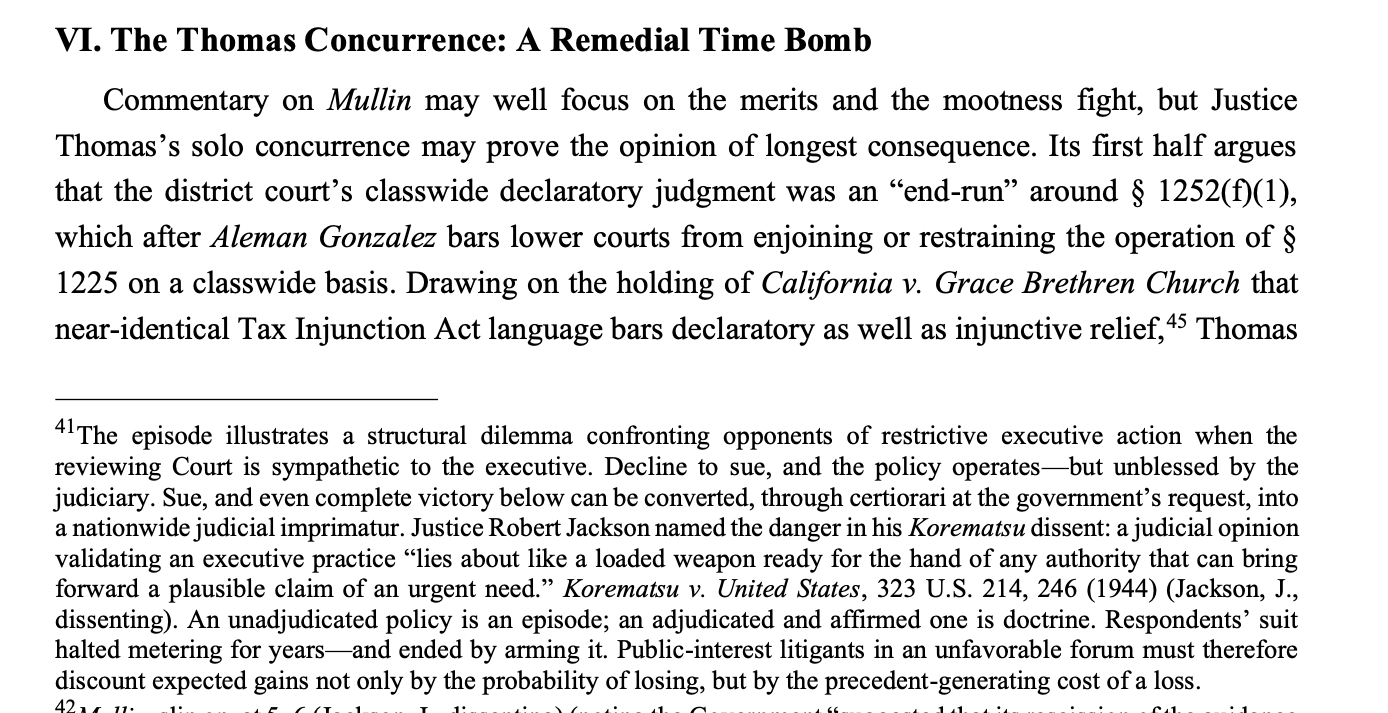
Law review articles are distinguished by their footnotes — not invariably bare citations, but sometimes discursive mini-essays ("tentacles") that carry the article's second conversation: qualifications, intellectual genealogy, engagement with rival scholars, novelty defenses. Drafts routinely under-supply them because authors, immersed in the main argument, don't notice which sentences are silently doing extra work. AI does not generally generate them without special prompting. My tentacle-footnote-finder skill finds those sentences in the text that might deserve a "tentacle footnote." A scoring script rates every sentence (and two-sentence "cluster moves") for features correlating with footnote-worthiness; editorial judgment prunes false positives. The output is a ranked report explaining why each candidate fired, with a short outline of what the footnote should cover. The Korematsu footnote in the draft (footnote 41) came from the tentacle-footnote-finder skill plus a directive I gave in almost these words: if you don't bring the lawsuit, the policy prevails but is unblessed by the judiciary — no loaded gun lying about; if you do bring it, you might get the policy reversed, but you run the risk of a devastating opinion. The note now sits under the comment's "docket curation" sentence, with Justice Robert Jackson's loaded weapon at its center and a closing line I have already had quoted back to me: an unadjudicated policy is an episode; an adjudicated and affirmed one is doctrine.
Here's the tentacle footnote in the current draft.
Phase four: inside the document
At some point, I moved the conversation inside Claude for Word. It's not quite as flexible as Claude Cowork but when what you want is a line edit of the document coupled with a retained ability to run at least many helpful skills, Claude for Word is where to go. I referred to it a few months back as "ridiculously useful" and nothing since then has changed my mind. Those in the legal profession could do far worse than living inside it.
The two Claude for Word sessions added two different kinds of value. The first kind only an author supplies. From the transcript:
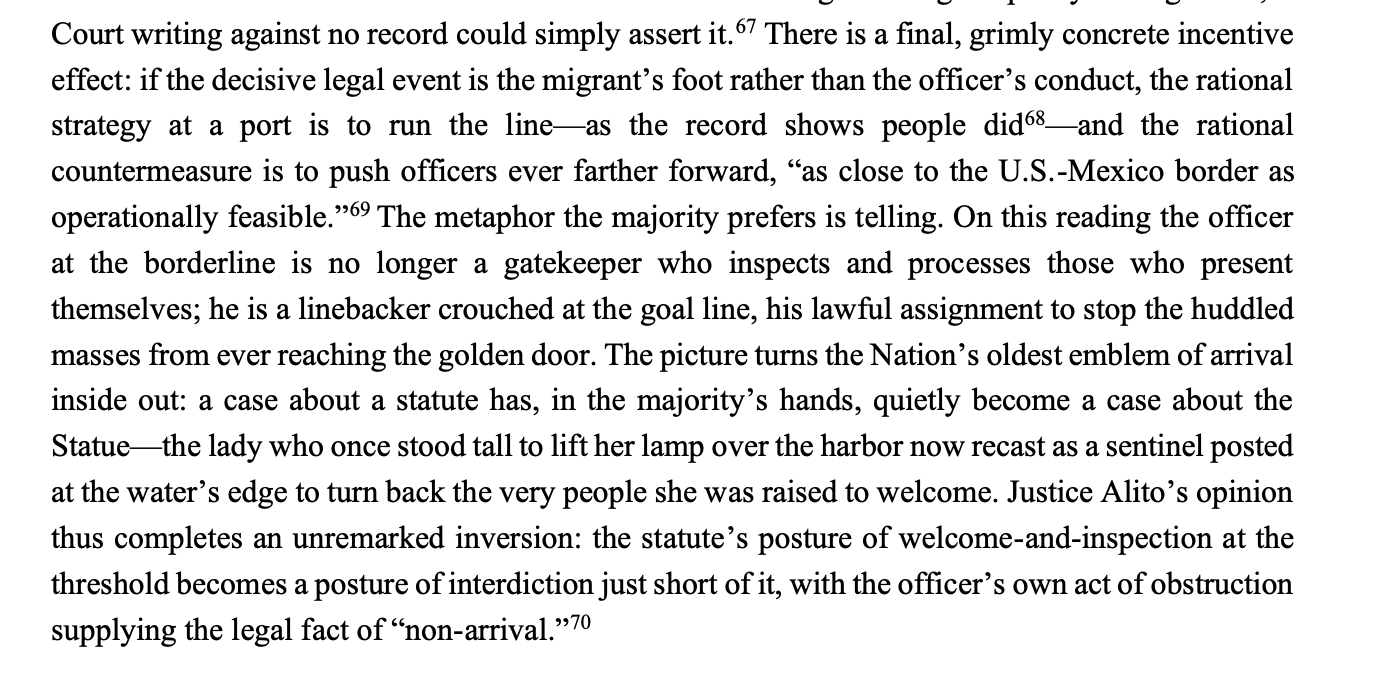
Someplace we need to poke at Justice Alito for having turned the statute of liberty from a lady standing tall with a beacon of freedom into a crouched linebacker seeking to prevent entry.
And, one exchange later: "Maybe we could do something clever but not too cute with statute and statue being similar words?" The resulting passage — a case about a statute quietly becoming a case about the Statue — is the most-flagged sentence in the piece so far. It is exactly the kind of move no model volunteers, because models are trained toward caution and the line is deliberately at the edge of too cute. I also suspect that it will be several more models down the line before a model is “smart” enough to think about morphing the Statue of Liberty into a linebacker or brave enough to promote a “statute” versus “statue” pun.
Here's what the draft now contains.
The second kind of value is a verification reflex operating at sentence scale. Asked for an appositive identifying Al Otro Lado, the model refused to draft until it had confirmed the organization is a real binational nonprofit with offices in Tijuana and Los Angeles. Asked to insert the verbatim text of § 1158(a)(1), it checked the language against the House Office of the Law Revision Counsel and Cornell's LII before touching the document. Asked for a Camreta parenthetical, it flagged that the case holds two distinct mootness-adjacent things: a prevailing official may seek review of an adverse ruling, and the case had separately become moot, drawing Munsingwear vacatur. My pincite had reached only the first. It also hit a tool wall worth knowing about: the Word review-card interface cannot anchor edits inside footnotes, so footnote surgery had to run through Office JavaScript against the footnote body directly. The model told me this instead of silently failing, which is the difference between a tool constraint and a bug.
And then came a difficult matter. We are in the middle of a remarkable run of six-to-three Supreme Court decisions, a fair number of which are difficult to read as anything but ideological. The temptation is to say so bluntly and often. I distrust that reflex. Cheap shots at the Court — the assumption that every divided decision is politics in a robe — are their own kind of laziness, and they cost a critic the standing to be heard when the charge is actually earned. So I wanted any motivated-reasoning charge to be demonstrated rather than asserted. I want it to be pinned to specific, unjustified canon choices that track the outcome, and withheld wherever the majority's reasoning could stand on its own. The model kept steering me toward the safe, un-earned version of the criticism; I kept steering back toward the earned one. Calibrating that line — tough where the text supports it, restrained where it does not — was one of the least mechanical things I did. Here's what I ended up saying: "This is not an opinion that would dispel the impression of many that at least in close political cases, the justices on both sides are not immune from the predictable influence of ideology." I could still be persuaded I have made the wrong choice in the draft case comment: either too tough or too gentle. Either way, deciding when a machine's caution is prudence and when it is timidity is not a delegable call.
Phase five: the gauntlet
Before sending the piece to humans, I deployed the terrific skill available on lawve.ai from Larissa Meredith-Flister: opposing-counsel-review. I used that skill to attack my comment — and then, because it tends to go a bit overboard, attack its own attacks:
Review it in light of everything you have learned. When done, put your output through the same /opposing-counsel-review to eliminate objections that really don't hold up. Your output should be a list of critiques that withstood the second round.
Round one produced fourteen objections. Round two culled five. From the nine survivors I picked three and had them implemented: a limiting principle that turns "docket curation" from epithet into test (vacatur is the presumptively sound disposition when the petitioner's only stake is a judgment against its own rescinded policy; plenary review is for questions that need no record); a confrontation with the Sale-to-IIRIRA ratification argument, the majority's best argument, which the majority never made; and repair of a genuine self-contradiction on surplusage. The implementation itself was surgical: each change was made in place, one at a time, threaded around my tracked changes and footnotes rather than rebuilding the whole file from scratch and wiping out a day of Word-session work.
The second round is the design insight. A model told to attack will hand you fourteen objections of uneven quality, and a tired author will either fix all fourteen or dismiss all fourteen. A model told to attack the attacks tells you which ones to ignore. It leaves the survivors pre-ranked for triage.
What this means for legal education
The comment now goes as I had planned all along to human readers. I'd be curious whether readers think I should post it on SSRN or otherwise try to get it published. Probably not yet. Probably not until there has been further human review by people who know more about immigration law and federal courts than I do. (Or perhaps by people who know less about immigration law and federal courts than I do – a volunteer very smart faculty member from another field found the draft rather cryptic and abstract.) Probably not until I let AI help me further by using more advanced techniques such as using Perplexity Computer or other AIs to integrate in more secondary authority on Supreme Court jurisdiction and the Munsingwear line of cases. Maybe there is a reason neither Justice Elena Kagan nor Justice Sandra Sotomayor joined Justice Ketanji Brown Jackson in her separate dissent even though those two clearly did not like the majority's result? Probably not until I come up with a few "infographics" with which to augment the piece – why law reviews in 2026 continue to resist non-textual exposition is beyond me. A draft infographic is below.
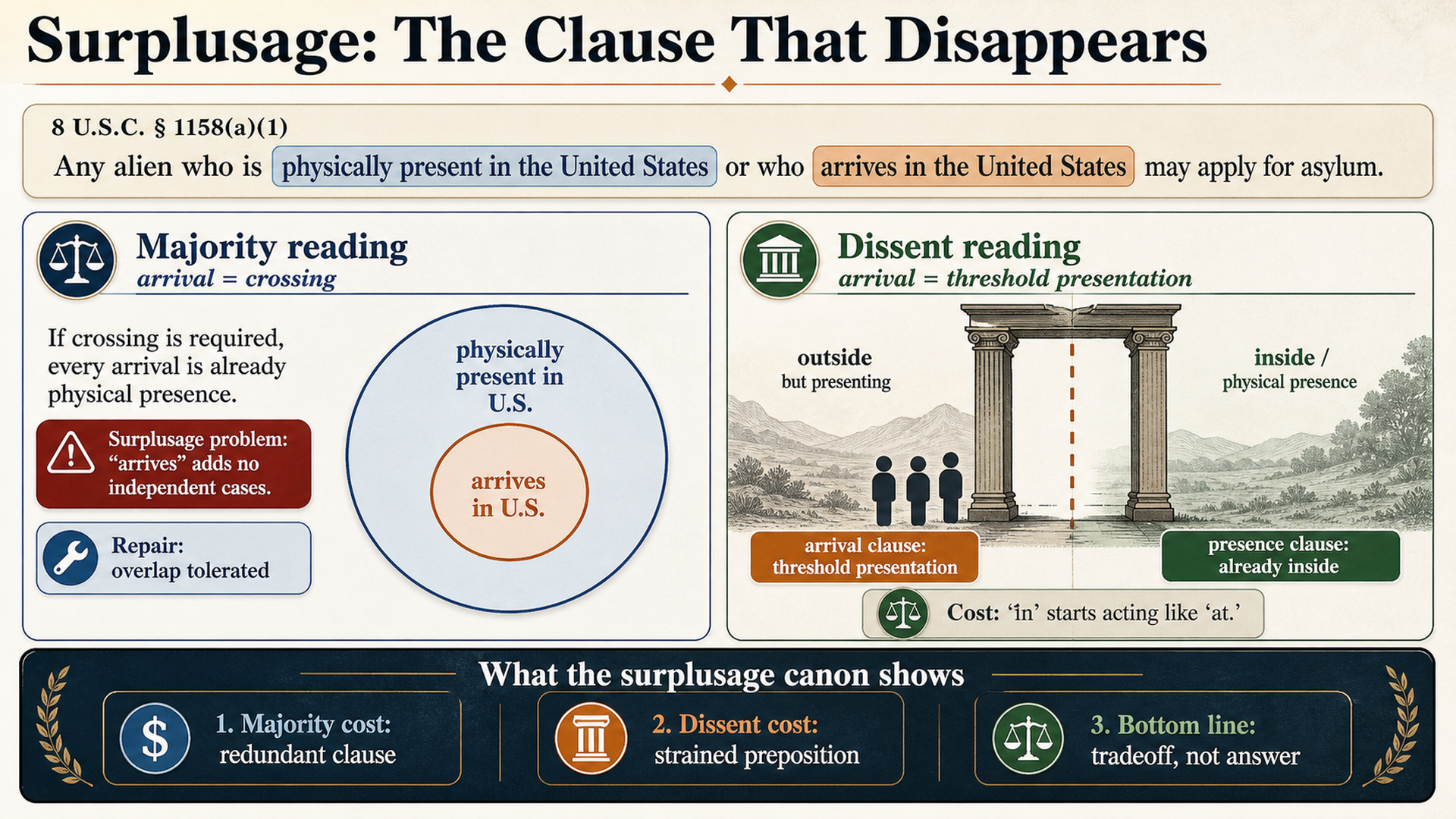
In the meantime, however, there are several lessons here for legal education and scholarship.
First, the Codex transcript is the most transferable artifact here, and it is not a prompt-engineering document. It is a seminar conversation — brief the case, test my irritation about the metaphor, argue about mootness, make me defend Sotomayor's practicality — that ends with "capture our conversation." Students already know how to talk about cases. Talk first, draft second is a workflow they can run tomorrow, and it produces drafts with a stance, which is something student notes often lack.
Second, the scarce skill on display was editorial command, not prompting: knowing the CASA footnote should exist, that "advisory" overclaims, that a case comment does not discuss its own drafts, when to overrule the model's caution. No phase of the workflow generated those judgments; decades of reading cases and legal scholarship did.
Third, verification is now a habit we can teach concretely. The footnote bug, the failed-then-fixed CourtListener query, the pincite catch, the statute check against OLRC — that is a syllabus in miniature, and every item on it generalizes.
Fourth, adversarial review scales. Every piece of legal scholarship should face at least a two-round AI gauntlet before a human reader sees it. Sorting attacks that hold from attacks that don't is issue evaluation, which is most of lawyering.
The Harder Questions
These five questions matter more than the workflow itself, and I want to answer them while the transcripts are still open on my desk.
Could a smart non-lawyer have produced this document?
A version of it, yes. That should unsettle us more than it comforts us. The pipeline itself requires no legal training: brief the case, converse until a thesis emerges, demand footnotes and rebuttals, run the gauntlet, ship. A bright journalist could execute every step, and the models would supply most of the missing law unprompted — Claude flagged Camreta's two holdings without being asked, and the gauntlet found the Sale-to-IIRIRA gap that I had missed too.
But look at where the pipeline needed legal knowledge it did not have. Knowing that "advisory" overclaims — that the Article III objection fails while the prudential one lands — is a distinction a smart layperson is unlikely to have spotted. The Codex draft that a layperson would have shipped contained exactly that error. The CASA pincer required knowing that a case about birthright-citizenship injunctions bears on border-processing remedies, a connection no prompt in the record supplied. And the triage of the gauntlet's nine surviving objections — three implemented, six left — is a set of judgment calls about which criticisms a law review editor would press. The non-lawyer's version would look ninety percent as good and be perhaps seventy percent as good, with the missing thirty percent concentrated precisely where expert readers look: thesis calibration, the unengaged best counterargument, the footnote that should exist and doesn't. The document would be plausible. It would not be safe.
Where does the record show the human adding value?
The transcripts let me answer this honestly, because everything I did is on the record with a timestamp. My contributions fall into four kinds. The first was originating ideas: the objection to the football metaphor, the Statue passage, the connections I drew between cases. The original moves in the comment came from my prompts, not from the model on its own. The second was catching mistakes: I found the missing footnotes by reading the draft, and I knew the piece should not narrate its own earlier versions, because I know what a case comment is supposed to look like. The third was judging how hard to push: I decided the comment could stand behind a tough charge against the majority that the model kept wanting to soften. The fourth was choosing: which of the reviewer's objections to fix, which published comment to imitate, and when the piece was done. And notice what is missing from that list — the sentences themselves. The model wrote nearly all of them, although it did display the infamous excessive uses of em-dashes. My value showed up in between: in what I asked for, what I kept, what I cut, and what I overruled.
What is faster scholarship worth?
This comment went from decision to reviewer-ready in about two days. The traditional timeline for a case comment — drafting, workshopping, submission windows in February and August, editing — delivers commentary a year or more after the decision, by which point the lower courts have already fought over the opinion's meaning without scholarly help. Speed changes what the genre is for. A comment circulating now can inform the motions being drafted now; the Sale-ratification argument and the § 706(2) gap identified in this piece are arguments litigants will need this year, not next. Scholarship gains the option of participating in a decision's reception rather than its historiography.
The costs are real and mostly borne downstream. Fast production propagates fast errors — my footnote bug would have been a retraction-grade embarrassment in print. Speed also shifts the bottleneck from writing to reviewing: if every professor can produce a plausible comment this quickly, the scarce resource becomes the colleague willing to read it, and the law reviews' traditional functions — selection and cite-checking — get partially performed upstream by the author's own tooling. I do not think that destroys the reviews' value. I think it forces them to say what their value is.
What further review does this document need?
From machines, several passes it has not had. A quote-level cite-check running every quotation against the retrieved source — the tools exist; I sampled rather than swept. A replication read of the empirical claims: the comment leans on the Amuedo-Dorantes study via its abstract and reported findings, and someone should read the paper's tables. It likewise would benefit from a second gauntlet run by a different model family, because a reviewer trained like the author shares the author's blind spots.
From humans, it needs four things machines cannot yet give. A federal-courts scholar should pressure-test the limiting principle — is vacatur-first defensible as a presumption, or did I invent doctrine to give my intuition a test? An immigration litigator should check the CBP One and port-practice descriptions against the ground. A committed textualist should read the motivated-reasoning charge and report whether it lands as analysis or as accusation — the piece fails if it only persuades people who already agree.
How far are we from push-button placement?
We are still a ways from push-button scholarship where it is the AI that contributes exceptional insight. Some of that gap may be the inherent limitations of the models. The rest, however, may be due mostly to the limitations on its access to data. What is missing is less mysterious than "judgment" and more specific than "taste." Access: the models cannot easily read secondary materials Westlaw, Lexis, HeinOnline, or most paywalled scholarship, so genuine preemption checking and deep secondary-source work sit outside their reach. In theory, Claude does have a connector to CoCounsel but typical law school licenses sadly don’t permit use of CoCounsel in that way. There are some workarounds: Perplexity Computer, for example, lets you access HeinOnline previews and possibly Lexis or Westlaw, but these routes are cumbersome and expensive. They don't yet provide an integrated solution that would, for better or worse, facilitate push button scholarship. Memory: no model in this project knew my prior work or positions; every session started cold. Permission: models trained toward caution do not stake edgy theses — the motivated-reasoning overrule was me licensing a claim the machine kept retracting — and a comment without an edge is a summary. Verification at reader level: the footnote bug passed schema validation and failed the human eye; models still check documents the way compilers check code. And the market sense of novelty — knowing what a particular readership already believes and what would surprise it — is social knowledge models currently approximate badly.
Still, when I hear criticism of AI I often ask “compared to what?” If you want legal superintelligence autonomously producing novel ideas that humans wouldn’t or couldn’t produce on their own, my experiment here will confirm your disappointment. On the other hand, I do think a human-AI collaboration can now produce work that is quite good provided the human is skilled enough. I thought that five months ago and reported out my findings in this blog. Improvements in models, skills, and connectors have made the case for human-AI collaboration even stronger. The combination can produce work far more swiftly and almost certainly better than even this skilled human could produce on this own. (It took more time to write this blog entry explaining what I had done than to actually do it). But don’t trust me. Read the piece. I’ll put it here again. Let me know what you think. Better yet, use the techniques outlined here or those you develop independently, and see what you get. The field of AI-assisted legal scholarship is wide open.
Notes
1. This post went through belcher-proof and other AI checking before publication, as did the case comment inside Word.
2. Quoting your own prompts has a vanity risk — the transcript flatters the questions that worked and buries the ones that flopped. For candor: the first Codex case comment read like a memo of our chat, my first word-limit instruction produced a document I later made the model exceed, and I handed the review process a superseded draft once, which cost a full re-run.
3. The worry I cannot resolve: this workflow made me faster because I already knew what a case comment should do. A 2L running it learns editing only if she already has taste, and my taste came from years of writing without any of this. I do not know what that apprenticeship looks like now.