
AI and Legal Education News Brief: August 29, 2026

Remember a few posts ago when I told you I was having a hard time keeping up with everything going on in AI, let alone blogging about it. This post, and some successors, are an imperfect solution. I'm going to try to post a news briefing every week. The idea is to take items going on in the big world of AI, find those that I think are most relevant to legal education, and give a brief explanation of each of them. I'm also going to mention any activities in which I have been engaged that, though perhaps not making the front page of the New York Times (or even aidailybrief.ai) may nonetheless be of interest to this audience. They won't displace the longer blog entries, but I am optimistic that these weekly updates will both inform my readers and relieve my gloom about this blog's inability to keep pace with AI's exponential growth in law, legal practice, and legal education.
Gemini Enterprise for Legal is in preview for law firms; no academic route has been announced
Source: AL TV Interview: Weil and Gemini Enterprise for Legal — Artificial Lawyer, August 27, 2026; Introducing Gemini Enterprise for Legal — Google Cloud, August 25, 2026.
On August 25 Google Cloud released Gemini Enterprise for Legal in preview. It is a plugin inside the Gemini Enterprise app with three parts: prewritten task instructions Google calls skills (contract review against a playbook, regulatory monitoring, NDA drafting); agents from Google, Deloitte, and Eudia; and MCP connectors to iManage, NetDocuments, Everlaw, Harvey, Legora, CourtListener, and Courtroom5. Cleary, Freshfields, Weil, and Williams & Connolly (an alma mater) are the launch customers. In an Artificial Lawyer interview, Weil's Andrew Simon says the appeal is reaching Legora, Harvey, and Thomson Reuters through connectors without logging into "forty five different places." Security is the key. Each connector passes the user's existing permissions through: Everlaw, for example, limits the agent to what the user's own Everlaw account can see. That is how a firm keeps a matter walled off while letting an agent work across its systems. This is the kind of agent our graduates will be asked to supervise.
Alas, our students may not have an opportunity to practice with this software. Gemini for Education, the product universities can buy, is the chat app with Docs and Gmail integration and contains none of this, however. Access runs through a "Contact sales" form whose industry menu includes "Education," and Google's FAQ says educational institutions get "tailored offerings" through a sales representative, so the gate is a sales process rather than a written exclusion. But no academic program has been announced, and no Google document mentions law schools. An academic preview would probably cost Google little. Without one the students who will supervise this platform cannot see it before they are hired. And the small group of professors who would love to put this platform through its paces and teach its usage to others are, for the moment, stymied.
Harvey and Thomson Reuters build legal models on Chinese open weights
Source: Harvey Tenet Research Preview — Harvey, August 20, 2026; Thomson-1.0-Small model card — Thomson Reuters, August 27, 2026.
Harvey and Thomson Reuters have each built a legal model from Chinese open weights. Harvey began with Moonshot's Kimi K3 and, with Fireworks, post-trained it for long legal assignments. Harvey says its fine-tuned Tenet model completed nearly twice as many held-out benchmark tasks and 20 percent more contract tasks than Kimi K3. Thomson Reuters used Alibaba's Qwen3.6 to build Snowdon, then trained Thomson-1.0-Small on legal, tax, and news material. Its larger Thomson model is entering CoCounsel production for document review; Thomson Reuters reports performance near leading closed models.
The graph below shows a semi-log scatter plot of pass rate on Harvey's own benchmark against cost per task. It's a little complex with the logarithmic cost axis reversed and a pre-Harvey Tenet Pareto frontier superimposed through a faint dashed line that seems to ignore Meta's Muse Spark 1.1 model. Still, it shows Harvey Tenet performing well (at least on the Harvey Benchmark!) relative to other frontier AI such as Claude Fable 5 and GPT-5.6 Sol and open source models such as Qwen 3.8-Max and DeepSeek V4 Pro.
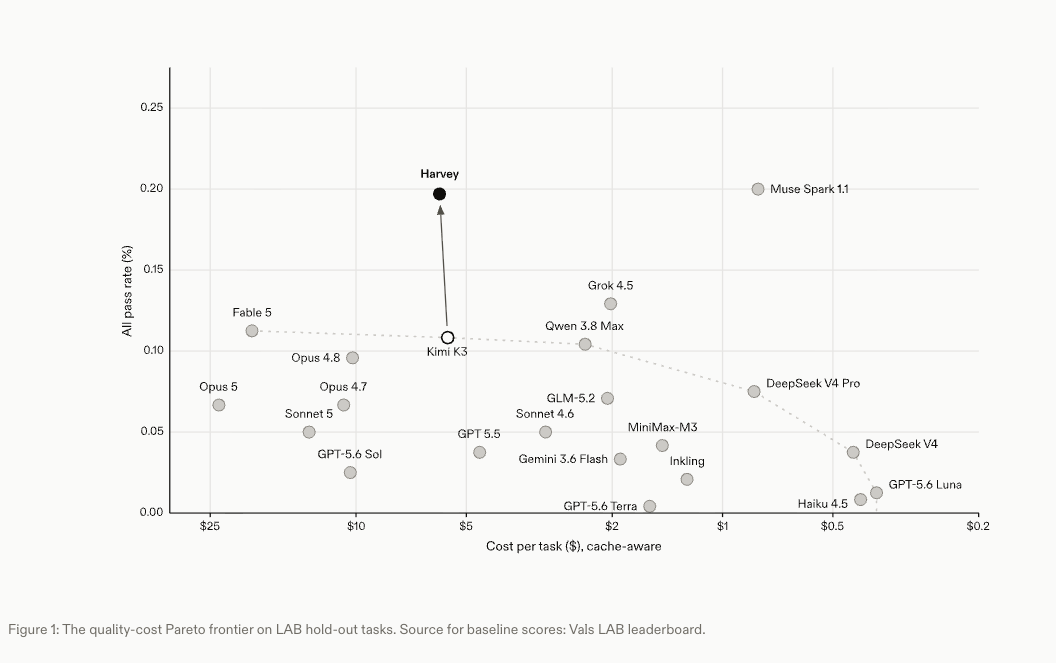
Why is this important? First it shows that leading providers servicing the largest legal enterprises and businesses in the world are not afraid of using models derived from Chinese open-weight models. They understand that a model that runs on an American inference provider that happens to have numbers (weights) and architectures that derive in some way from those created by an entity that some fear is no more dangerous than uttering the number 3 just because a villain once used it too. When people use Harvey's Tenet or Westlaw's Thomson1, Moonshot and Alibaba do not receive the client prompts, documents, or outputs. Moreover, if Moonshot or Alibaba had somehow managed to infect their original open-weight models with anti-Taiwanese propaganda or (somehow) commands to erase a hard drive, the fine tuning process used by Harvey and Westlaw surely washed away those delicate snares. The weights are numbers used in calculations; they cannot open a network connection to their original developer. Harvey says its Azure product offers regional processing and requires outside model providers to retain none of the customer's data; it used no customer data to train Tenet. Thomson Reuters says customer data does not train Thomson.
Second, it shows that at least two leading legal AI providers believe that fine-tuned frontier (or recently frontier) models are superior to general purpose frontier models of the sort coming out of Anthropic, OpenAI and, increasingly, xAI and Meta. If they're right, it means that a lot of the effort in legal tech is going to move to figuring out how to efficiently, effectively, and swiftly conduct fine tuning. To be sure, fine tuning and post training is not nearly as expensive as building and training a model from scratch, but if that process is really the path to success, it may mean that larger enterprises that have the financial and technical wherewithal to pursue it have an advantage in producing the highest quality legal AI. It remains to be seen whether that hypothesis is true or whether users are better served by reliance on the latest and greatest general purpose frontier and closed weight models from Anthropic, Claude and the other American leaders.
Westlaw Deep Research shows vast improvement
Source: Thomson Reuters Launches Next Generation of CoCounsel Legal — Thomson Reuters, August 20, 2026. Second source: Deep Research in Westlaw and CoCounsel: Building Agents That Research Like Lawyers — Thomson Reuters Labs.
Thomson Reuters has released a rebuilt version of CoCounsel that vastly improves the performance of its Deep Research agent. The new design is based on Anthropic's Claude Agent SDK and creates separate sub-agents for case law, statutes, and secondary sources. Each plans its own steps, runs several in parallel, picks which Westlaw tool to call, and stops on criteria set in advance, after which a citation check runs against KeyCite before the report reaches the lawyer.
I have run Deep Research most days this past week on matters in fields I know well. The improvement in research and writing is obvious in a way no published benchmark yet captures: memos that once needed heavy rewriting now read like a strong associate's first draft. Plus, to its credit, Westlaw Deep Research now adds a verification steps that scours for any hallucinations. It's optional and some might dispense with verification if they are in a hurry. But, to its great credit, Westlaw now makes high quality verification a single button push. Lexis and its Protégé AI are now definitely far behind. I've run the same query through both and the results are not close. Sure, my subjective experience is not a benchmark. But, trust me, it's like comparing an A answer on a final exam to a B-.
The ubiquity of Westlaw in law schools (and the legal profession) makes this development extremely important. It also means that faculty who think that "AI is bad" but "Westlaw and Lexis are OK" need to rethink. Westlaw now has outstanding AI research and drafting capabilities. If Claude and ChatGPT cause brain rot, the same is now true of the time-tested industry standard products. It's why I harp on the fact that when people talk about "banning AI," they need to think very carefully about what they actually think AI is and the extent to which such bans are even possible as use of this technology becomes more widespread. Also, three cheers for Thomson and Westlaw for vast improvements in their AI capabilities over the past year or so. Looks to me like that company is now on the right track. Lexis also appears to be heading in a promising direction (see Lexis Intelligence Engine), but that's for another week.
ChatGPT temporary chats can now use memory, and be saved afterward
Source: ChatGPT release notes: More controls in temporary chat — OpenAI, August 27, 2026; Temporary Chat FAQ — OpenAI Help Center.
On August 27 OpenAI changed ChatGPT's temporary chats. Until now a temporary chat ran without memory, custom instructions, or plugins, and never entered chat history. Now a user starting a temporary chat can choose a personalized version that draws on existing memories, custom instructions, and plugins. It still creates no new memories and stays out of history unless the user saves it, at which point it becomes an ordinary chat governed by the account's data settings. OpenAI's help pages say temporary chats are not used to train models while they remain temporary and may be kept for up to 30 days for abuse review. The claim in some newsletters that users can make temporary mode their default does not appear in OpenAI's release notes or FAQ.
The change removes a trade-off that mattered for law students. Under policies at some schools, clinic students may use AI but may not put confidential information into it, and the temporary chat was the closest thing consumer ChatGPT offered to a no-training mode. Using it meant giving up the custom instructions that make the tool behave like a legal assistant rather than a general chatbot. Students can now keep both. What the change does not do is make consumer ChatGPT a confidential tool: a 30-day retention window with abuse review is not the zero-retention term firms negotiate, and a saved temporary chat loses the protection entirely. Students should learn to find the difference between "not used for training" and "not retained" in a vendor's terms, and this feature is a good place to teach it.
OpenAI's enterprise data: lawyers use ChatGPT to write, and Codex use in legal grew 108-fold
Source: From assistance to execution: How enterprises put AI to work — OpenAI, August 12, 2026; Enterprise signals: What frontier firms are doing differently — OpenAI.
On August 12, OpenAI published two studies of its enterprise customers: a working paper by economists at Columbia and Wharton, and an Enterprise Signals report. The studies draw on more than ten million messages. Writing was the most common category of ChatGPT use in 19 of 20 departments. In legal, writing accounted for 57 percent of messages, followed by knowledge retrieval at 20 percent.
The Enterprise Signals report also tracks Codex, OpenAI’s tool for delegating multistep tasks. Between February and June, weekly active enterprise Codex users grew 108-fold in legal, compared with 41-fold in sales, 41-fold in recruiting, 26-fold in marketing, and fivefold in engineering. OpenAI does not provide absolute user counts, so the 108-fold figure may reflect growth from a small initial base. It is a growth rate, not a measure of how many lawyers use Codex.
The numbers still matter for legal education. Lawyers’ most common use of ChatGPT is writing. A policy that bars AI-assisted drafting therefore bars the activity for which lawyers use the tool most often. Students need practice directing, verifying, and revising machine-generated prose—not simply rules telling them not to use it.
The Codex figure points to a second problem. Legal work is beginning to include delegated, multistep tasks, yet few first-year programs teach students how to supervise an agent that gathers information, works across files, and produces a draft. OpenAI’s data come from its own customers and serve its commercial interests. The 108-fold increase may not tell us how widespread Codex use is. It does tell us that law-school AI policies should anticipate the tools graduates will encounter, rather than regulate a snapshot of last year’s technology. Again, if you haven't looked at what AI has been up to over the past six months, you have no idea as a faculty member how to regulate its usage or, of equal importance, how to teach it to students. Yes, we have been using the word "AI" for a few years to describe what generative large language models can do, but that's like calling a six-month-old and a three-year-old a "child" and coming up with the same rearing practices for both. Bad idea!
Perplexity's agent now runs entirely on a $4,700 desktop machine
Source: Introducing Portable Computer for local-first AI — Perplexity, August 25, 2026; Portable Computer product page; DGX Spark price change — NVIDIA, February 2026.
On August 25 Perplexity released Portable Computer, a version of its computer-use agent that runs entirely on an NVIDIA DGX Spark, a desktop machine with 128 GB of memory that NVIDIA prices at $4,699. (Subscribers are free to send me one for evaluation!) The planner, the language model (Qwen 3.8 27B), the code sandbox, file search, and connectors to Gmail, Outlook, and Slack all run on the device, and local work uses no subscription credits. When a task needs live web search or a stronger model, the agent stops, flags any personal information, shows the user what would leave the machine, and asks before sending that single step to a cloud model such as GPT-5.5 or Claude, which returns text and gets no access to local files. It is included in Pro and Max subscriptions, Linux only for now.
I have argued here that the confidentiality objection to AI in legal work is an engineering problem, and this is what the engineering looks like. A clinic could put client files on a machine costing under $5,000 and let an agent read, sort, and draft against them without a document leaving the room. (At least if the state does not prohibit you, irrationally, from using Chinese models even on a device that is not connected in any way to any company about which the state harbors hostility). For teaching, that prompt is the lesson: students see which step needed the cloud and what it would have sent. The limitation is that the local model is weaker. Perplexity's own coding benchmark puts it at 59.6 percent against 82.4 for Claude Opus 5, and when I tested a local model on a Texas insurance question in June, it produced something shaped like legal analysis without the accuracy to rely on. A clinic would be trading competence for privacy and would have to decide where that trade is acceptable.
Websites for my courses are on Netlify
People often ask me what I actually teach in my Large Language Models for Lawyers course. Now you can find out for yourself. Go to llms4l.netlify.app and take a look. The website is of course itself built through a collaboration among me, Claude and ChatGPT, with ChatGPT Sites capability providing much of the initial work. They take advantage of Netlify connectors for Claude and ChatGPT that are free to use. The result is not a glossy shell around a syllabus. It presents all 27 class meetings, readings, products, guests, office hours, deadlines, and project pathways. To keep administrators happy, it uses university color and font branding, which is easy for an AI to impress on virtually any website. It also lets anyone download the public course data as Excel, SQLite, or a Canvas package.
That openness matters to legal education because a course website can do more than announce assignments; it can embody the course’s theory of professional competence. Students in this class do not merely discuss AI. They build a legal-technology project, demonstrate it, and keep it to show employers. The site exemplifies my commitment to "dogfoodism": use what you teach, use what you preach. The site takes structured information, designs a useful interface around it, tests the result, and retains control of the underlying data. Colleagues can inspect the curriculum rather than guess what “AI for lawyers” means. The broader point, however, isn't for you to (merely) admire the website. It's to inspire you to build your own. With ChatGPT sites or Claude (or probably Grok Build, though I've never used it), it is no longer that hard to build an attractive and useful website. You don't have to rely on tiresome Canvas or, worse, Blackboard anymore.
The companion site for my Advanced Constitutional Law seminar shows that the same architecture works outside a legal-technology course. It makes the writing process, topic choices, deadlines, and AI expectations public, while I (reluctantly) reserve the possibility of using Canvas to handles private submissions and grades. That division gives law schools and law firms a rule: keep confidential records inside controlled systems; build clear, purpose-made interfaces for everything that benefits from access or a hint of creativity. Lawyers entering a profession crowded with cumbersome software should learn not only how to operate inherited systems, but how to improve the layer through which people actually work.
New Mediation Practice Skills
On August 7 I published two Claude Agent Skills on Lawve.ai's marketplace, mediation-problem-generator and mediation-problem-validator, and presented them with a browser-based practice tool, Mediation Practice Studio, at Charleston School of Law's National Trial Advocacy Conference that weekend. The generator takes a user-provided sketch and drafts an original commercial-mediation problem, a public packet plus one confidential packet per side, then runs a Python script that checks every number reconciles, confirms no side's private fact leaks into the wrong packet, and will not finish until two to four genuinely different settlement packages actually work. The validator runs that same audit on a packet someone else wrote, against a 30-point rubric.
The skills lower the practical costs of creating a competition or giving students practice. Competition packets are usually drafted by a faculty advisor on a deadline and take considerable time to perfect. A frequent concern is arithmetic that will not reconcile, facts that just don't line up. and creating the right size zone in which the mediating parties can find opportunity for mutual gain. The skill automates this process and creates, in my experience, a very good first draft of a final packet. Lawve licenses the skills at no charge under Apache-2.0.
The bigger point is again that AI has driven down the cost of producing legal simulation materials. What I did for mediation, others can do for moot court or mock trial. And, although again it is too big a topic to cover here, you can already see this area being commercialized for students and potentially practitioners though BenchSim and My Appeal Coach, two independently built practice sites that are beginning to leverage advances in speech-to-text and text-to-speech AI.